

AI Summary
- 8 GPM is the commercial benchmark. Higher flow systems (like 8 GPM) clean significantly faster than 4 GPM units, reducing labor time and increasing daily job capacity.
- Flow rate matters more than pressure. Gallons per minute (GPM) is the primary factor driving cleaning speed and efficiency in commercial pressure washing.
- Buffer tanks are essential. Typical water sources provide only 4–6 GPM, so a buffer tank (200+ gallons) is necessary to maintain consistent flow and protect the pump.
- Multiple configurations available. Options range from compact 230-gallon units to 460-gallon tandem axle systems, commonly paired with 3,500 PSI output and commercial-grade engines.
- Nationwide shipping included. Trailer rigs are delivered across the United States without additional shipping costs.
- Industry trends are evolving. Advanced setups such as dual-wand systems, eco-compliant burners, and automated chemical delivery are shaping modern pressure washing operations.
TABLE OF CONTENTS
If you’ve been running a 4 GPM machine on commercial jobs, here’s something nobody’s going to sugarcoat for you: you’re working twice as hard as you need to, for half the money you could be making. Every hour you spend on a job site with an undersized rig is an hour your competition — the guy with the proper 8 GPM pressure washer trailer — is finishing two jobs to your one.
The jump from 4 GPM to 8 GPM isn’t just a spec bump. It’s not like upgrading your phone for a slightly better camera. It’s a genuine, fundamental shift in how your business operates — how many jobs you can take on, how fast your crew works, what kinds of contracts you can even bid for, and ultimately, how much money you take home at the end of every single week.
At Universal Trailer and American Water Works, we’ve built our entire operation around giving serious commercial contractors the equipment they actually need to scale. That means fully spec’d, production-built 8 GPM pressure washer trailer rigs — with Honda and Karcher engines, hot water burner capability, and tank sizes ranging from 230 to 460 gallons — all shipped completely free to your door, anywhere in the country.
This guide is going to walk you through everything: why 8 GPM is the number that matters, how the math works in your favor, which rig configuration fits your operation, and what the smartest contractors are doing in 2026 to pull further ahead of the pack. Let’s get into it.
Why an 8 GPM Pressure Washer Is the Gold Standard for Commercial Contractors
Let’s start with the fundamental question: why does everyone in the commercial pressure washing world eventually land on 8 GPM as the magic number? Why not 6? Why not 10?
The answer comes down to what the commercial market actually demands — and what equipment can sustainably deliver it day after day on real job sites.
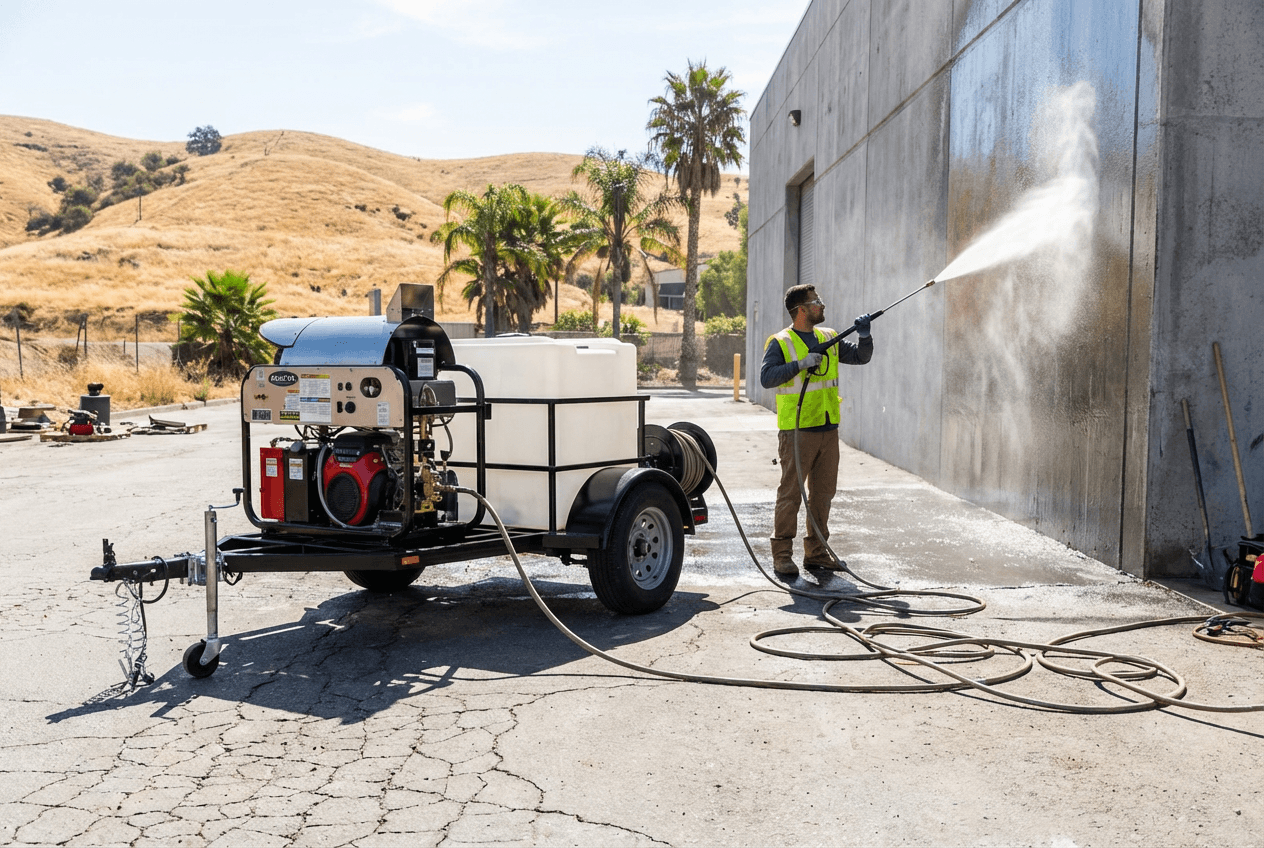
Commercial clients aren’t homeowners worried about their driveway. They’re fleet managers with 40 trucks. They’re property management companies with 12 apartment buildings. They’re warehouse operators with 80,000 square feet of concrete that needs to be spotless for safety compliance. These clients have massive surfaces, tight windows, and zero patience for contractors who show up underequipped and take all day to finish a job that a properly outfitted rig could handle by lunch.
An 8 GPM pressure washer gives you the flow rate to actually serve those clients at a professional level. It’s powerful enough to run a 28–36 inch surface cleaner at full efficiency — the kind that eats up flat concrete jobs in a fraction of the time a smaller spinner would take. It’s capable of splitting into dual wand operation so two people can work the same machine simultaneously. It’s got the volume to push hot water through 200 feet of hose without meaningful pressure drop. And it hits the cleaning unit threshold where grease, oil, bio-film, and heavy industrial buildup don’t stand a chance.
Below 8 GPM, you’re compromising somewhere. Above 8 GPM, you’re often getting into diminishing returns for most commercial applications and significantly more complex equipment requirements. Eight is the sweet spot that serious contractors have settled on for good reason — and it’s been the industry standard for high-production commercial work for years.
There’s also the simple matter of business positioning. Clients who are paying premium rates for commercial cleaning want to see a premium rig. When you pull up with a properly spec’d 8 GPM pressure washer trailer — branded, organized, and built for serious work — you’ve already won half the battle before the first drop of water hits the ground. We’ll come back to the visual side of that later, because it matters more than most contractors realize.
Flow Over Pressure: The Math Behind Cleaning 2x Faster
This is where a lot of newer contractors get confused, and honestly, it’s not their fault. The pressure washing industry spent decades marketing itself on PSI numbers because big numbers are easy to sell. “3,500 PSI!” sounds impressive. It makes people think about raw force. And pressure matters — don’t get it wrong — but if you’re optimizing for PSI at the expense of GPM, you’re optimizing the wrong variable.
Here’s the framework that actually matters: Cleaning Units.
The industry-standard formula for real cleaning power is this:
Cleaning Units (CU) = PSI × GPM
It’s beautifully simple. And when you apply it to compare a 4 GPM machine against an 8 GPM pressure washer, both running at 3,500 PSI, the result is pretty eye-opening:
Machine | PSI | GPM | Cleaning Units |
Standard 4 GPM | 3,500 | 4 | 14,000 CU |
8 GPM Pressure Washer | 3,500 | 8 | 28,000 CU |
Double the cleaning units. Same pressure. Just more flow. That’s not a marginal improvement — that’s a completely different class of machine producing a completely different class of results.
Now let’s turn that into actual money, because that’s what we’re really talking about here.
Say you’re doing commercial concrete cleaning — parking lots, loading docks, warehouse floors — and you’re charging a reasonable $0.12 per square foot. A 4 GPM machine running a 20-inch surface cleaner in capable hands might cover around 4,000 to 5,000 square feet in a working day. Call it $480 to $600 in revenue.
That same day, with an 8 GPM pressure washer running a 30-inch surface cleaner at full efficiency, you’re covering 9,000 to 11,000 square feet. That’s $1,080 to $1,320. Same hours. Same crew. More than double the revenue. Do that math across a five-day week and you’re looking at an extra $3,000 to $3,600. Across a month? You’re talking about the difference between a struggling operation and a genuinely profitable business.
And that’s before you factor in the premium rates you can command simply because you have the equipment to handle larger contracts that smaller operators can’t touch.
A quick word on pump technology, because it’s worth understanding when you’re making this investment. There are two main types of pump drive systems you’ll encounter on commercial rigs: gear-driven and belt-driven.
Gear-driven pumps are compact, direct-drive systems that are mechanically simple and slightly more powerful for their frame size. They run hot, though — and heat is the enemy of pump longevity, especially at 8 GPM flow rates where the pump is working hard for long hours.
Belt-driven pumps put a buffer between the engine and the pump, which means the pump runs at a lower RPM than the engine. Lower RPM means less heat, less wear, and significantly longer pump life. For a contractor running an 8 GPM pressure washer six days a week, that extended pump life is genuinely valuable — the difference between a pump lasting two seasons and one lasting five or six.
Our rigs are engineered with longevity in mind precisely because we know what commercial use actually looks like. This isn’t equipment that gets used on weekends and stored in a garage. It’s going to work every single day, and it needs to be built accordingly.
Hot water burner efficiency is the other piece of this puzzle that multiplies the value of an 8 GPM setup dramatically. A diesel-fired hot water burner paired with your 8 GPM pressure washer doesn’t just clean faster — it fundamentally changes what you can clean. Hot water breaks down grease, oil, food waste, bio-film, and industrial residue at the molecular level. You’re not just blasting stuff off the surface with force; you’re actually liquefying the contamination so it lifts and rinses away cleanly.
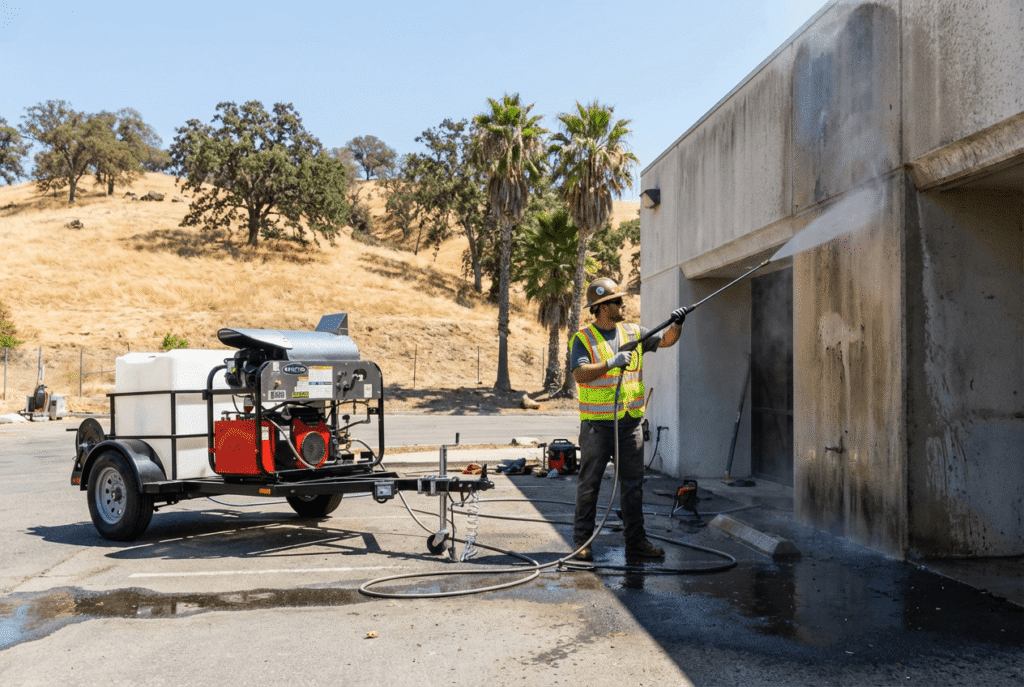
In practical terms, this means jobs that would require heavy chemical pre-treatment, long dwell times, and multiple passes with a cold water machine can be handled in a single hot water pass. Fewer chemicals, less time, better results. That’s a margin improvement on every single job you do.
Explore Our In-Stock 8 GPM Trailer Configurations (Free Shipping Included)
Every rig below is in stock, production-built, and ships completely free to your door anywhere in the United States. These aren’t showroom queens or custom builds with 16-week lead times. They’re ready to work, right now.
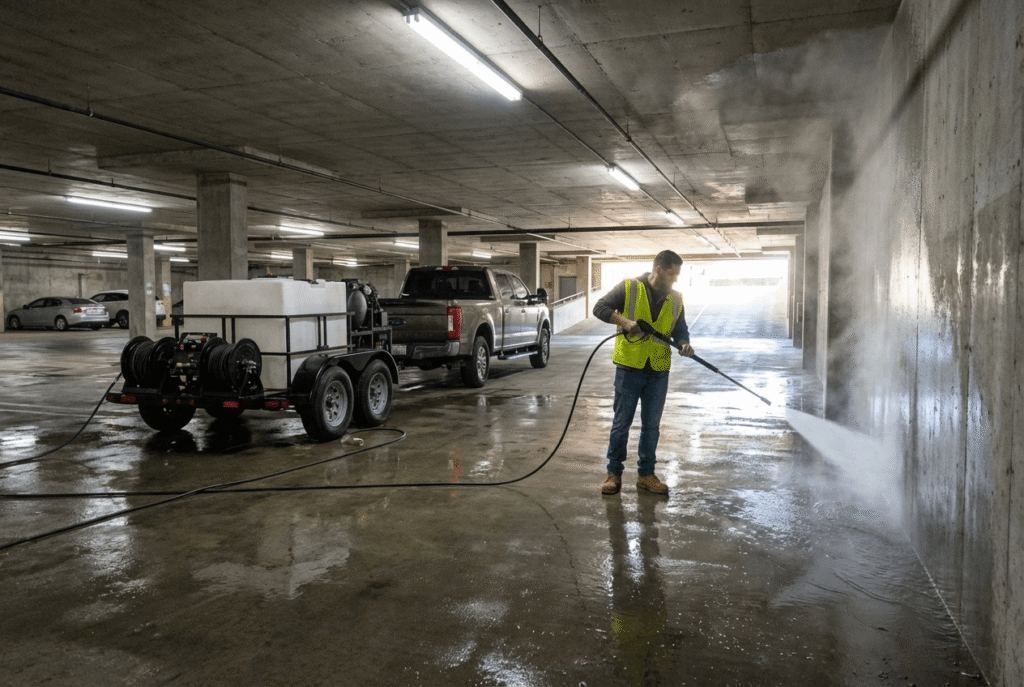
Let’s talk about access. Some of the most lucrative commercial cleaning contracts are in exactly the kinds of spaces that a standard trailer can’t reach — underground parking garages, tight loading dock corridors, enclosed courtyards, building interiors. The contractors who can get into those spaces command serious money precisely because most of the competition can’t follow them in.
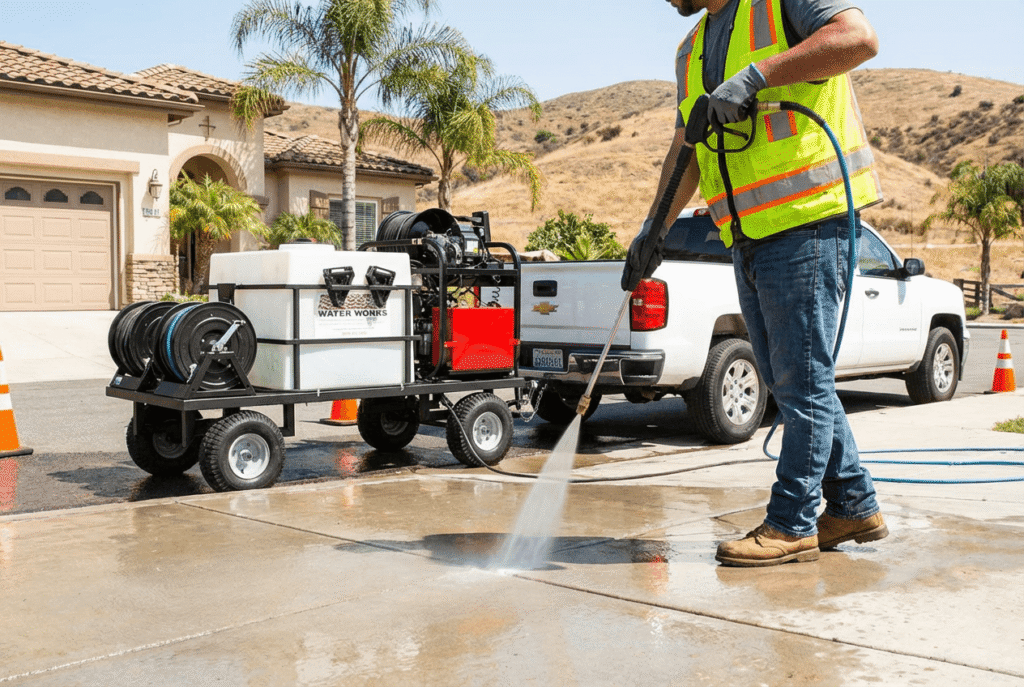
This 8 GPM pressure washer on a maneuverable pull cart is your access-all-areas solution. The Honda GX690 — an 18HP V-twin that’s become the gold standard engine in commercial outdoor power equipment — delivers all the grunt you need in a package that rolls through any door and into any space your target client has. Full 8 GPM flow, 3,500 PSI, and the flexibility to go anywhere. Don’t underestimate how much business this capability opens up.
This is the pressure washing rig that built a thousand pressure washing businesses. It’s the workhorse. The one that solo operators scaling up from residential work grab when they’re ready to get serious about commercial accounts without going all-in on a massive tandem rig right out of the gate.
The 230-gallon buffer tank gives you a solid 28 minutes of continuous run time at full 8 GPM flow — more than enough to handle most urban commercial jobs where water access is nearby. The single axle chassis is compact enough to park in standard commercial lots, light enough to tow with a half-ton pickup, and tough enough to handle daily commercial use without rattling itself apart. The Honda GX690 starts in any weather and runs all day. This is the smart, capable starting point for a growing commercial operation.
Same nimble single-axle chassis and 230-gallon tank setup, but now you’re running a 25HP Karcher commercial engine — and that extra horsepower and Karcher’s pump-specific engineering tuning genuinely changes the feel of this machine under load.
Karcher designs their commercial engines with high-demand pump applications specifically in mind. That means optimized torque curves for sustained high-flow operation, tighter tolerances, and engineering that understands what it means to run an 8 GPM pressure washer flat-out for eight hours straight. If you’re doing back-to-back commercial jobs and you want every ounce of performance your setup can deliver, the Karcher-powered single axle is an extremely compelling choice — all without stepping up to the larger footprint and tow weight of a tandem rig.
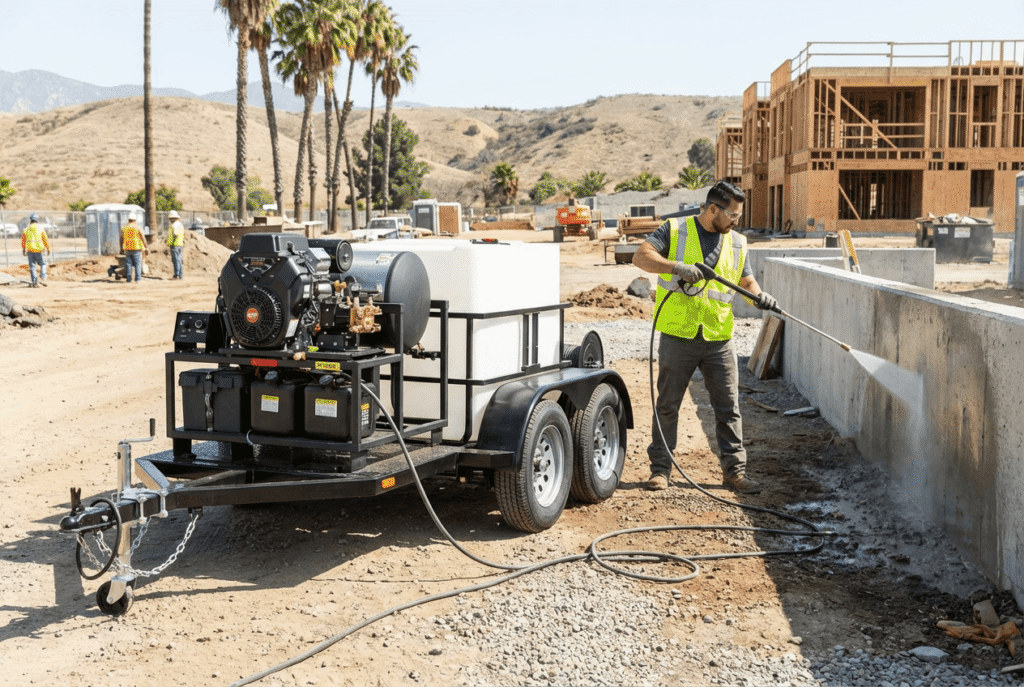
This is where you stop worrying about water access on most jobs. The 330-gallon tank gives you over 40 minutes of continuous operation at full 8 GPM flow — meaning you can run full-speed through the average commercial cleaning job and refill on your own schedule, not the site’s water supply schedule.
The tandem axle chassis is a fundamentally different towing experience than single axle. More stable at highway speeds with a full tank, better braking control, and a much more planted, professional feel when you’re pulling into a client’s property. The Honda GX690 brings all the reliability you’d expect. This configuration hits an incredible sweet spot between capacity, capability, and manageability — and it’s the setup we see growing commercial operations gravitate toward when they’re ready to stop leaving jobs on the table.
This is the one that makes contractors stop scrolling and lean forward. The dual-fuel configuration — gasoline for the engine, diesel for the hot water burner — gives you complete fuel independence on every job site, no matter how remote. You’re not hunting for the right fuel type or making compromises. Each system runs on exactly what it’s optimized for.
The 25HP Karcher engine paired with a 330-gallon buffer tank and hot water capability makes this 8 GPM pressure washer trailer a legitimate industrial cleaning weapon. Food processing facilities, transportation yards, heavy manufacturing floors, grease traps, commercial kitchen exhaust systems — this is the rig that gets invited to the jobs most contractors can’t handle. If you’re building toward premium industrial contracts, this is your platform.
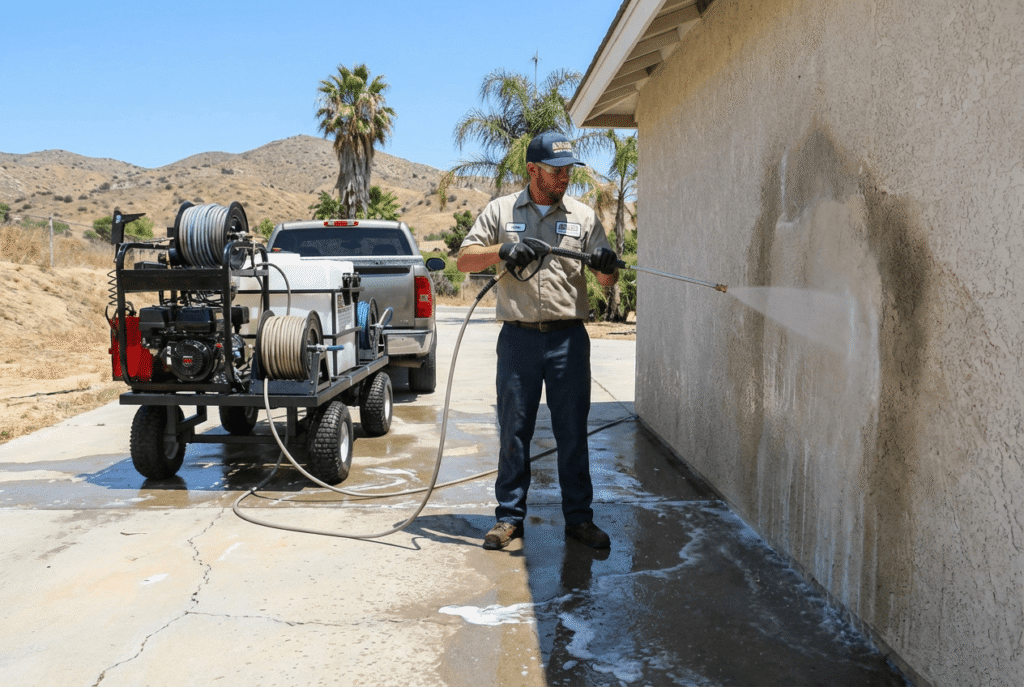
The flagship. The big dog. The rig you pull out for the jobs that nobody else is equipped to handle.
A 460-gallon buffer tank means you can run your 8 GPM pressure washer continuously for nearly 60 minutes without a single refill. On a remote highway rest stop, a rural industrial facility, a construction site miles from any water hookup — this machine makes you completely self-sufficient. You show up, you set up, and you clean until the job is done, entirely on your own terms.
The tandem axle chassis handles the weight of a full 460-gallon tank with authority, and the Honda GX690 delivers day-in, day-out reliability that remote job sites absolutely demand — because when you’re 40 miles from the nearest equipment dealer, you cannot afford a breakdown. This is the rig contractors who win large-scale government, infrastructure, and remote industrial contracts depend on.
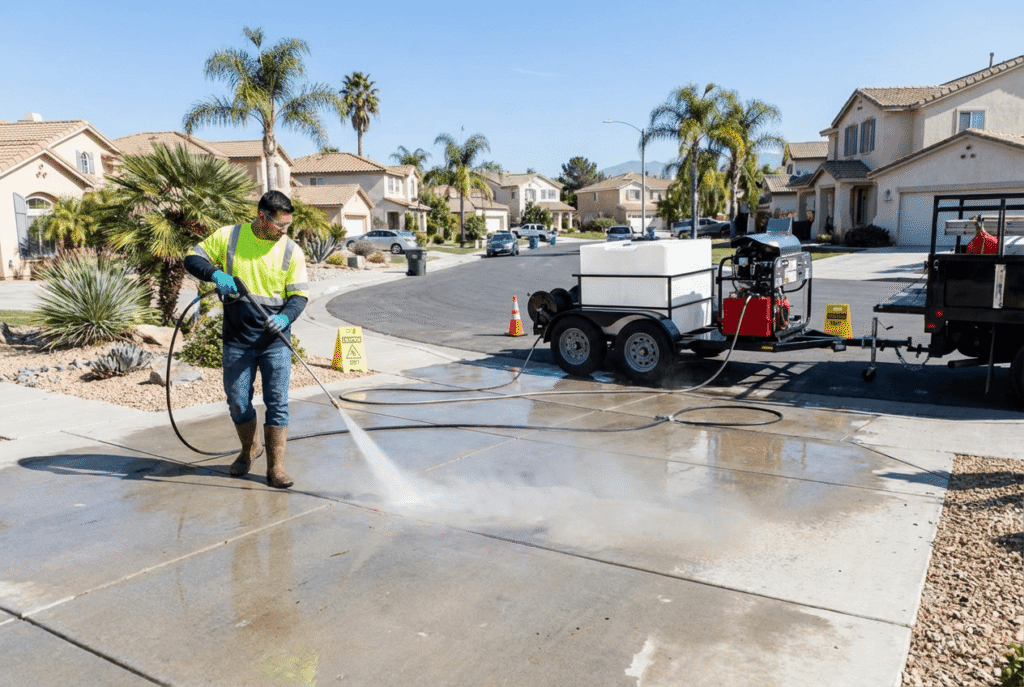
If the Honda-powered 460-gallon rig is the big dog, this one is the big dog that went to the gym. You’re getting everything that makes the flagship so formidable — nearly 60 minutes of continuous 8 GPM run time, full water independence, tandem axle stability — and then you’re layering a 25HP Karcher engine and a dual-fuel setup on top of it.
That means gasoline running the engine at peak Karcher-engineered efficiency, and diesel firing the hot water burner exactly the way it was designed to run. No compromises, no fuel-type juggling, no “close enough.” Every system on this rig is running on what it’s actually optimized for.
This is the configuration you spec when the jobs are serious, the sites are remote, the surfaces are filthy in an industrial way, and you simply cannot afford for anything to go wrong. Food processing plants, petrochemical facilities, large-scale transportation depots — the clients writing the biggest checks tend to end up in front of this rig. It’s not the most approachable number on a price tag, but it’s the one that makes the most sense when you run the numbers on what it can earn you.
How to Choose the Right Buffer Tank Size for Your 8 GPM Rig
The buffer tank conversation is one of the most important ones you’ll have when investing in an 8 GPM pressure washer setup — and it’s one that a surprising number of contractors get wrong because they underestimate how quickly 8 GPM burns through available water.
Here’s the core problem: the average residential or light commercial water spigot delivers somewhere between 4 and 6 gallons per minute. Your pump wants 8. That gap — 2 to 4 GPM depending on your water source — is water your pump is trying to pull from somewhere, and if there’s no buffer tank in the way, it’s pulling from air. That means cavitation, overheating, and pump damage that can cost you thousands of dollars in repairs and days of lost revenue.
The buffer tank bridges that gap. It stores water faster than the pump draws it when flow is adequate, and then supplies the deficit when the feed slows down. It’s the most critical piece of infrastructure on your rig, and sizing it correctly is a business decision as much as a mechanical one.
Tank Size | Runtime at Full 8 GPM | Ideal Job Types | Water Access Required? |
230 Gallons | ~28 minutes continuous | Urban commercial, restaurant pads, storefront routes, fleet washing near water access | Yes — moderate supply needed |
330 Gallons | ~41 minutes continuous | Mid-size commercial properties, multi-building sites, shopping centers, light industrial | Occasional — can bridge poor supply |
460 Gallons | ~57 minutes continuous | Remote industrial, highway rest stops, construction sites, large-format flat work | No — fully self-sufficient operation |
The decision framework is straightforward. If your jobs are in urban or suburban environments where a decent hose bib is within 100 feet of your work area, 230 gallons is solid. You’ll refill during natural breaks — moving between sections, switching chemicals, repositioning — and you’ll rarely run dry.
If you’re doing larger properties or sites where water access is inconsistent, the 330-gallon tank turns that uncertainty into a non-issue. You’ve got enough reserve to bridge bad supply and keep working at full speed.
If you’re going after remote or large-scale industrial contracts — or you just want to never think about water access again — the 460-gallon flagship makes you completely autonomous. That independence has real dollar value when you’re bidding against contractors who can only operate within reach of a fire hydrant.
Top 2026 Commercial Pressure Washing Trends
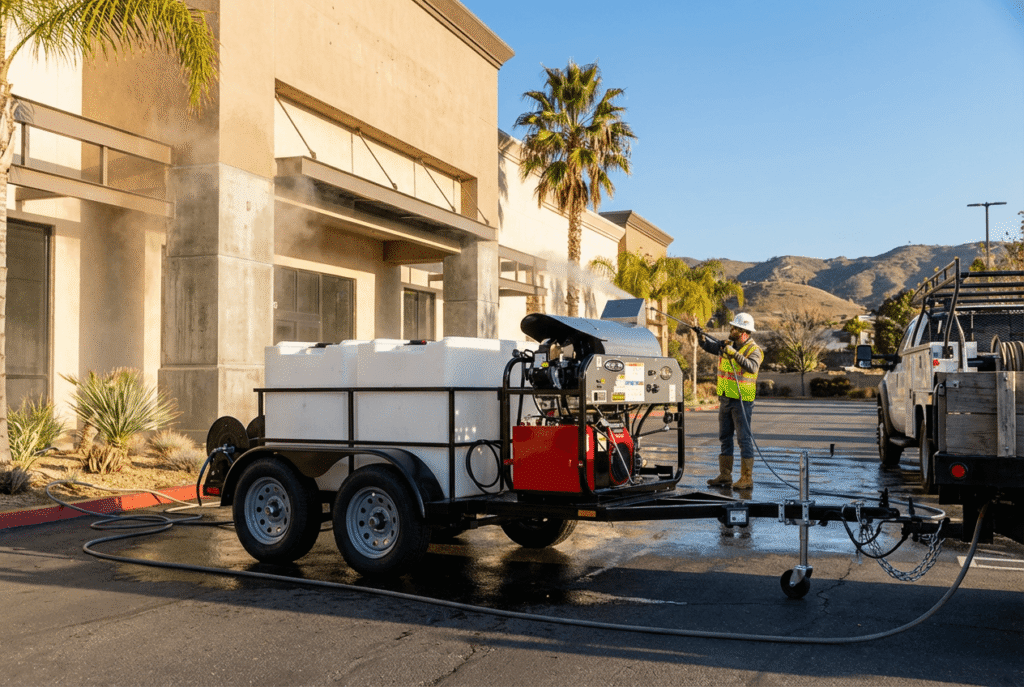
The industry is moving, and it’s moving fast. The contractors who are paying attention to what’s changing in 2026 are positioning themselves to dominate their markets. Here’s what’s actually reshaping the commercial pressure washing landscape right now.
Dual-Wand Operation is reshaping crew productivity. This is probably the single most exciting capability that an 8 GPM pressure washer unlocks, and it’s getting serious traction among crew-based operations. The concept is elegant: split your 8 GPM output into two streams, put a 4 GPM wand in the hands of two different operators, and suddenly your one machine is doing the work of two. For large flat-work jobs — expansive parking lots, airport tarmacs, warehouse floors — you’re effectively doubling your labor productivity without adding a second rig, a second trailer, or a second engine to maintain.
The math on this for crew profitability is extraordinary. If you’re paying two operators and running one machine, your equipment cost per job stays flat while your output doubles. That’s a direct, significant margin improvement on every crew job you run.
Eco-Friendly Hot Water Burners are shifting from a nice-to-have to a compliance requirement. Municipalities across the country have been tightening storm drain, runoff, and emissions regulations consistently — and 2026 is seeing that enforcement get meaningfully stricter in major metro markets. Contractors still running old, high-emission burners are finding themselves squeezed out of commercial contracts with government facilities, institutional clients, and environmentally conscious property management companies. Clean-burn diesel burners aren’t just better for the planet; they’re the price of admission to a growing tier of premium contracts. Our rigs are built with this reality in mind.
Automated Chemical Proportioners are replacing guesswork with precision. High-volume contractors are moving away from manual downstream injection — which works, but requires operators to estimate and eyeball ratios — toward automated proportioning systems that dial in chemical concentrations exactly. The benefits compound quickly: less chemical waste (significant cost savings at 8 GPM volumes), perfectly consistent cleaning results across your entire crew regardless of who’s holding the wand, and dramatically easier new-hire training. When you’re scaling a pressure washing operation, consistency is everything. Automated proportioners deliver it.
Rig Styling & Customization Tips to Win High-End Clients
Let’s talk about something that doesn’t get nearly enough attention in the contractor community: your rig’s appearance is a pricing signal. It is, whether you like it or not, one of the primary ways potential and existing clients evaluate your professionalism before you’ve said a single word or cleaned a single square foot.
Here’s the honest reality. Two contractors can show up to bid the same commercial account with identical equipment, identical credentials, and identical references. The one with the clean, branded, organized 8 GPM pressure washer trailer is going to get the contract at the higher price, almost every single time. People pay premium rates for premium-presenting service providers. It’s human nature, and it’s not going away.
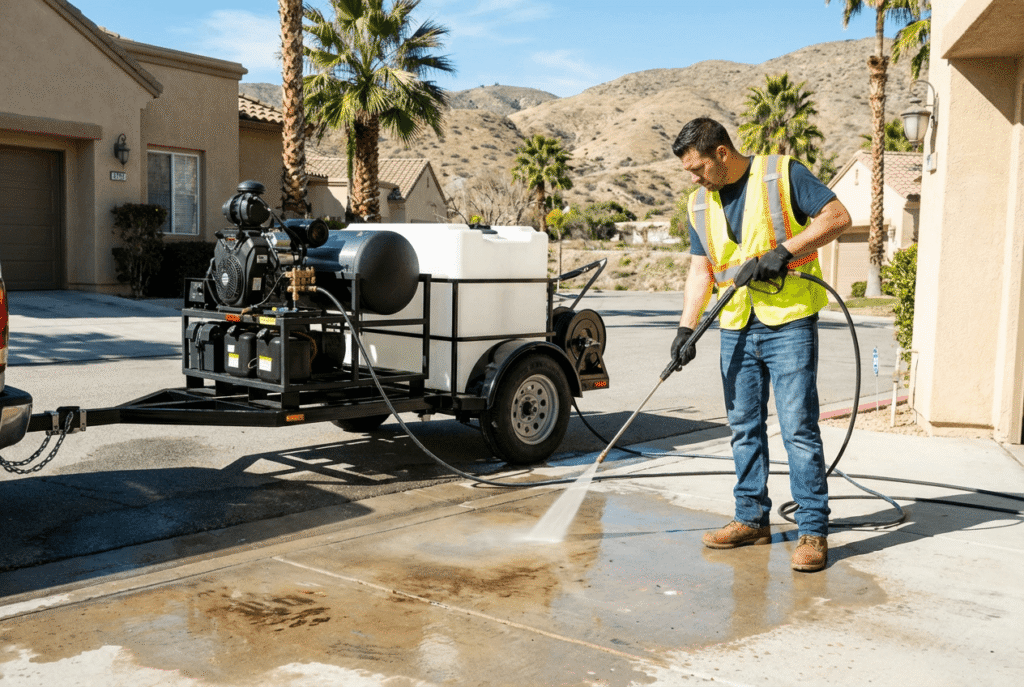
Here’s how the serious operators make their rigs do the selling for them:
- Custom vinyl wrap your water tank with your logo and brand colors. A professionally designed and installed wrap transforms your rig from anonymous equipment into a moving advertisement for your business. Every commercial property you pull into is a showcase — the facility manager watching you work, the neighboring businesses, the other contractors on site. A wrapped tank with your name and number on it is working for you all day, every day, at every job site. The cost of a good wrap is recouped in a single premium contract.
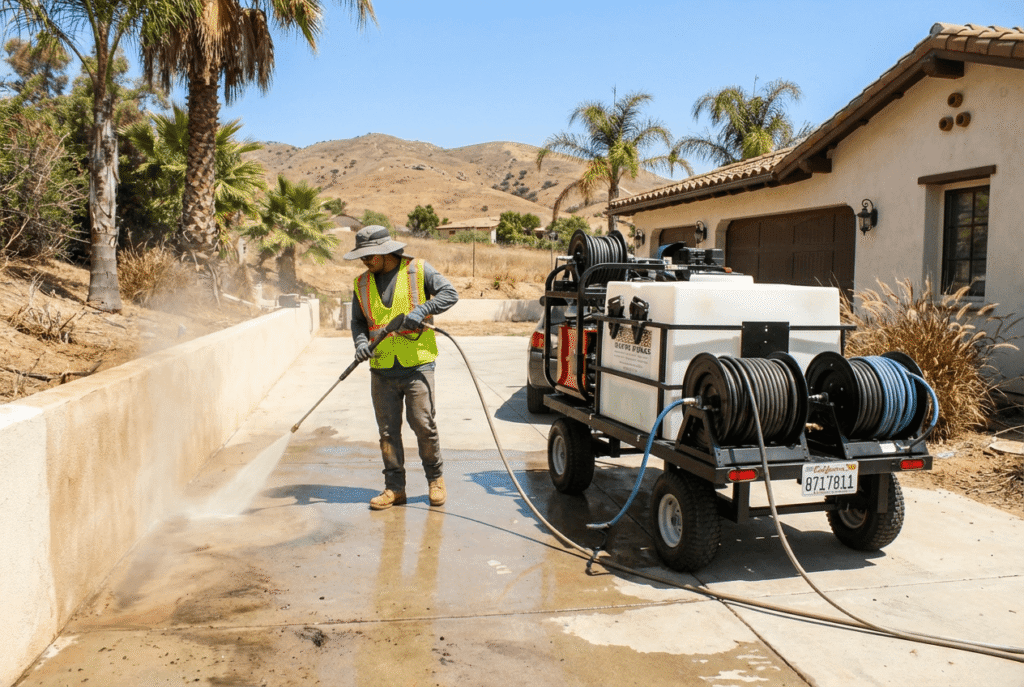
- Stack your hose reels ergonomically and consistently. Two reels mounted at a comfortable working height, angled outward for smooth pull-out, with hose coiled cleanly and stored consistently after every job — this tells clients you operate systematically and professionally. Hose piled chaotically on the trailer deck, tangled around equipment, hanging off the sides — that tells clients something very different. The hose reel setup is one of the first things experienced property managers notice when they evaluate a contractor’s professionalism.
- Polish your diamond-plate aluminum and keep it that way. If your trailer features diamond-plate surfaces, that polished aluminum reflects light and reflects professionalism. It takes maintenance, which is exactly the point — it signals that you maintain your equipment with the same care you’ll apply to the client’s property. A dull, oxidized diamond plate says the opposite.
- Color-code your hoses systematically. This is one of the simplest, most visually effective things you can do to immediately look more professional than 90% of your competition. The standard that’s becoming common among premium operators: red for hot water lines, yellow for chemical application, black for cold water supply. When a client or property manager watches your crew set up and sees a color-organized, clearly purposeful system, the implicit message is that you run a professional operation with real systems and real training — not two guys figuring it out on the fly.
- Keep the trailer frame clean and painted. This one costs almost nothing and pays dividends out of proportion to the effort. A few hours with a wire brush, a can of gloss black or your brand color, and some touch-up work on the frame makes a rig that’s several years old look sharp and well-maintained. You’re not just cleaning other people’s stuff — your own equipment needs to be clean too.
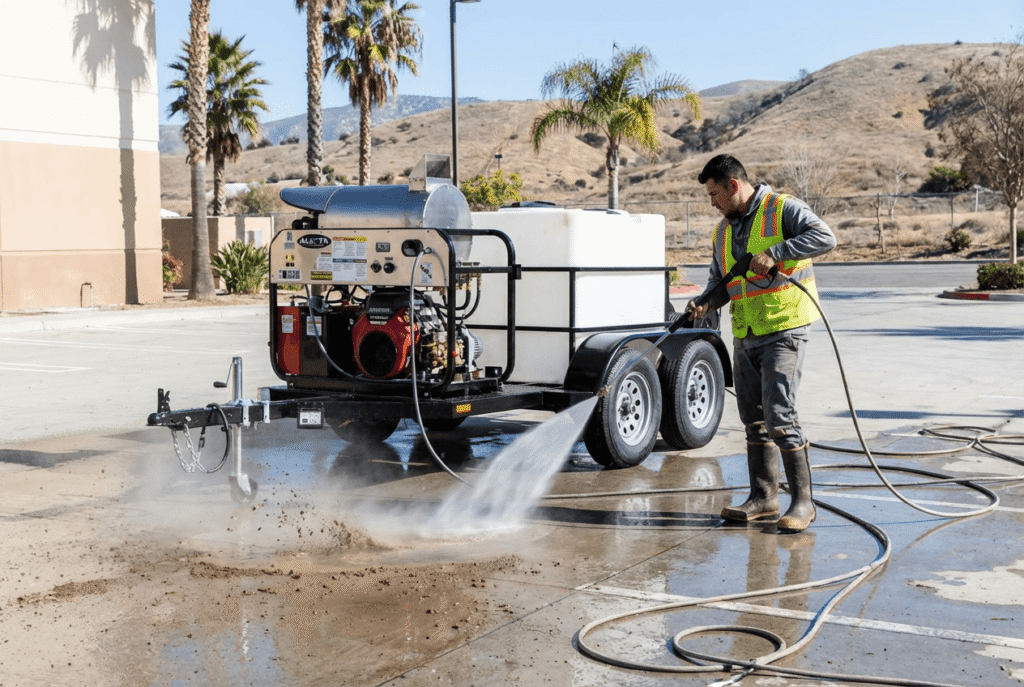
The contractors pulling $0.30 to $0.50 per square foot on premium commercial accounts aren’t necessarily the ones with the most expensive equipment. They’re the ones who present themselves and their 8 GPM pressure washer rigs in a way that justifies premium rates before the conversation even starts.
The Bottom Line: Stop Leaving Money on the Table
Every day you spend on a commercial job site with an undersized rig is a day your competition is outpacing you — cleaning more, billing more, and building the kind of business that lets them pick their contracts instead of taking whatever they can get.
An 8 GPM pressure washer trailer from Universal Trailer and American Water Works isn’t just a piece of equipment. It’s the foundation of a commercial operation that can actually scale — that can handle the big contracts, run dual-wand crews, serve remote industrial clients, and show up to every bid looking like the most professional outfit in the room.
Six configurations. In stock. Honda and Karcher engines. 3,500 PSI. Tank sizes from 230 to 460 gallons. And free shipping to your door, anywhere in the United States.
The math worked itself out two thousand words ago. The only question left is which rig you’re pulling out of our yard and into your operation.
Browse all 8 GPM configurations at pressurewashertrailers.com →
Frequently Asked Questions
Is an 8 GPM pressure washer worth the investment?
Yes, an 8 GPM pressure washer is highly profitable for commercial contractors because it cleans surfaces twice as fast as a 4 GPM machine, cutting labor costs in half and allowing you to complete more jobs per day.
What size water tank do I need for an 8 GPM pressure washer?
For an 8 GPM pressure washer, you need a minimum buffer tank of 200 gallons. However, for large commercial jobs with poor water supply, a 330-gallon or 460-gallon tank is highly recommended.
Can I run two wands off an 8 GPM pressure washer?
Yes, an 8 GPM pressure washer produces enough water flow to be split, allowing two operators to run 4 GPM wands simultaneously from a single machine.
Do I need a buffer tank for an 8 GPM pressure washer?
Yes, a buffer tank is mandatory for an 8 GPM pressure washer because standard residential and commercial water spigots only output 4 to 6 GPM, which will quickly starve and destroy an 8 GPM pump without a reserve.
What is the difference between Honda and Karcher engines for pressure washing?
Honda GX series engines are industry standards known for extreme reliability and easy-to-find aftermarket parts, while Karcher engines offer commercial-grade durability specifically optimized for European-engineered pump systems.
Can an 8 GPM pressure washer be used for soft washing?
Yes, an 8 GPM pressure washer can be paired with a downstream injector and specific low-pressure nozzles to perform highly efficient, high-volume soft washing on roofs and siding.
What size surface cleaner is best for an 8 GPM pressure washer?
The optimal surface cleaner size for an 8 GPM pressure washer is between 28 inches and 36 inches, following the industry rule of 4 inches of surface cleaner diameter per 1 GPM of flow.
How far can an 8 GPM pressure washer push water?
An 8 GPM pressure washer can easily push water through 200 to 300 feet of high-pressure hose with minimal pressure loss, making it ideal for large commercial properties and multi-story buildings.
Disclaimer: Equipment specifications and performance capabilities may vary based on specific configurations and operating conditions. Professional consultation is recommended for custom applications and specialized requirements. Regulatory compliance requirements vary by location and application – consult local authorities for specific permit and operational requirements.