

Key Takeaways (TLDR)
- Commercial-grade systems require 3.5-5.0 GPM and 3,000-4,000 PSI for efficient, profitable work
- DOT compliance includes proper brakes, lighting, safety chains, and correct GVWR rating for highway use
- Hot water capability increases cleaning speed by 3-5x and justifies premium pricing with clients
- Tandem axle trailers distribute weight better for larger water tanks (200-400 gallons) and extended jobs
- Quality components (General Pump, professional diesel burners, polypropylene tanks) deliver 7-10 year lifespans versus 2-3 years for budget alternatives
TABLE OF CONTENTS
Understanding Custom Pressure Washer Trailers
Back in 2019, I watched a contractor try to clean a fleet of concrete mixers with a big-box store pressure washer mounted on a Harbor Freight trailer. Three hours in, the pump gave out. The burner never worked right to begin with. He lost the contract. That’s when he called us.
Here’s what we’ve learned building professional systems for over two decades: a custom pressure washer trailer isn’t just equipment on wheels. It’s a mobile profit center that needs to survive brutal conditions while delivering consistent results.
The commercial cleaning services market reached $415.93 billion in 2024 and projects 6.9% annual growth through 2030. North America alone holds 32.2% of that market. Translation? There’s serious money in professional cleaning work, but only if your equipment can handle it.
A proper custom pressure washer trailer combines three essential elements:

The power plant
Whether you choose a gas engine (Honda GX series or Vanguard) or diesel (Kubota, Kohler), you need reliable horsepower that starts every time. Professional units run 8-23 HP depending on your GPM requirements.
The pump system
General Pump and CAT pumps dominate commercial work because they're engineered for thousands of hours. These triplex plunger pumps use ceramic pistons and heavy-duty seals that laugh at daily use. Belt-driven configurations run cooler and last longer than direct-drive setups for operations exceeding 20 hours weekly.
The heating system
Here's where amateurs separate from pros. A diesel-fired burner system (typically 200,000-400,000 BTU) heats water to 140-200°F, cutting cleaning time by 60-80% on grease and oil jobs. That temperature boost isn't just nice—it's the difference between profitable contracts and breaking even.
We build complete turnkey solutions around these core components, matching specifications to your actual workload. A fleet washing operation needs different specs than a building restoration contractor. Getting this match right means your custom pressure washer trailer earns money instead of sitting idle.
Fun Fact: The first mobile hot water pressure washing units were developed in the 1950s for military equipment cleaning. Soldiers discovered that heated water at high pressure could remove hardened grease from tanks and trucks in a fraction of the time cold water required—technology that revolutionized the commercial cleaning industry.
The key advantage of going custom? You’re not paying for features you’ll never use or accepting compromises that limit your earning potential. That sets the stage for understanding exactly what power specs your operation actually needs.
What You Can (and Should) Customize for Your Specific Work
Here’s the thing about custom trailers—everything’s negotiable based on what you actually do for a living. Think of it like ordering a pizza: you wouldn’t order the same toppings for a kids’ party and a Super Bowl gathering, right? Same deal here.
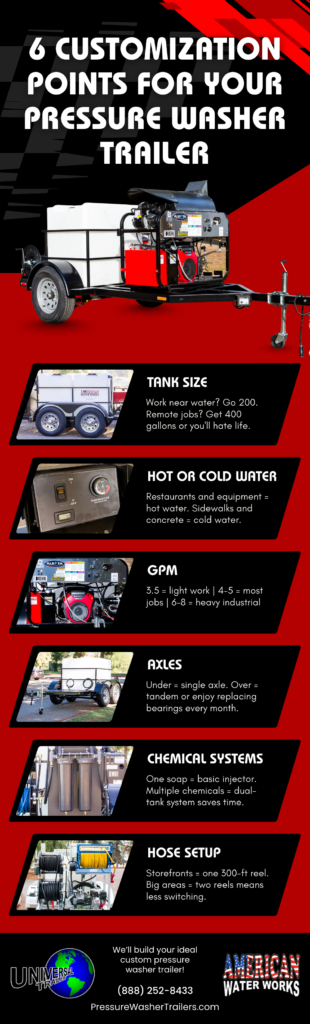
Water tank size depends on how far you work from water sources. Doing quick parking lot jobs near hydrants? A 200-gallon tank keeps things light and maneuverable. Working remote construction sites or rural properties? You’ll want 300-400 gallons so you’re not constantly hunting for water. It’s that simple.
Hot water vs. cold water is basically asking: do you clean grease and oil, or mostly dirt and concrete? Restaurant hoods, equipment yards, and industrial facilities need hot water (it’s literally 3-5x faster on greasy stuff). Sidewalks, driveways, and basic building washing? Cold water saves you $3,000-5,000 upfront.
Hose length and reel setup matters more than people think. One 300-foot hose reel works great for linear jobs like storefront cleaning. But if you’re doing parking garages or large equipment, you might want two separate reels—one for high-pressure, one for soap application. Saves a ton of time switching back and forth.
Chemical injection systems range from basic soap injectors (fine for general cleaning) to dual-tank systems that let you switch between different detergents mid-job. If you’re doing both soft washing (low pressure with chemicals) and high-pressure work, you need the flexibility.
Pump power (GPM) is where beginners get confused. Here’s the cheat sheet: 3.5 GPM for light commercial (small businesses, residential add-ons), 4-5 GPM for most commercial work (the sweet spot), 6-8 GPM for industrial and fleet washing. Don’t overthink it—match your pump to your biggest regular job, not your dream contract.

Single vs. tandem axle sounds technical but it’s just math. Under 3,500 pounds total weight? Single axle is cheaper and easier to maneuver. Over that? You need tandem axles or you’ll be replacing wheel bearings every few months and fighting trailer wobble on the highway.
Storage compartments and tool mounting depend on your style. Minimalists want basic lockable boxes for nozzles and quick-connects. Detail-oriented contractors want dedicated spots for every accessory, labeled and organized. Neither’s wrong—it’s about how you work.
The beauty of custom? You’re not paying for stuff you’ll never use, and you’re not compromising on things that make you money. A contractor doing restaurant work needs completely different specs than someone cleaning construction equipment. That’s exactly why we spend time understanding your actual business before recommending anything.
How Much GPM and PSI Do I Need for Commercial Work?
This question determines whether you’re equipped for profitable commercial contracts or stuck chasing residential driveways. Let me break down the math that actually matters.
PSI (pounds per square inch) provides the “punch” that breaks the bond between dirt and surface. Think of it as your stripping force. GPM (gallons per minute) delivers the flow that rinses debris away. It’s your rinsing power.
Multiply them together and you get cleaning units (CU): PSI × GPM = CU
Here’s the reality check: A 2,000 PSI machine at 4 GPM produces 8,000 CU. A 2,500 PSI machine at 2 GPM only delivers 5,000 CU. The first setup with lower pressure but higher flow cleans faster despite the lower PSI number.

Commercial cleaning work typically requires:
For most commercial applications: 3.5-5.0 GPM paired with 3,000-4,000 PSI hits the sweet spot. This configuration handles equipment washing, building maintenance, parking lot cleaning, and fleet services efficiently.
For heavy industrial work: 5.5-8 GPM at 3,500+ PSI tackles oil rigs, construction equipment, and heavy machinery. These rigs move serious water volume for maximum productivity.
For specialized applications: Some contractors run dual gun systems pulling from a single pump, effectively doubling their coverage area. Others spec lower GPM (2.5-3.5) for soft wash systems where chemicals do the heavy lifting.
Industry veterans know this: GPM matters more than PSI for commercial profitability. Once you have sufficient pressure to break surface bonds (usually 3,000 PSI), additional flow speed determines how many square feet you clean per hour.
The calculation for nozzle matching tells the story. A 4 GPM system needs roughly a 2.5-3.0 orifice at 3,000 PSI. Use too small an orifice and you create excessive backpressure that damages your pump. Too large and you lose cleaning power. Professional systems balance these factors precisely.
Myth-Busting: "More PSI is Always Better Than More GPM"
FALSE.
This misconception costs contractors thousands in lost productivity. Yes, ultra-high PSI (5,000+) strips paint and removes coatings, but for 80% of commercial cleaning work, you’re better off with moderate pressure (3,000-3,500 PSI) and higher flow (4-6 GPM).
Why? Because most commercial contracts involve rinsing away loosened dirt, not jackhammering through concrete. The faster you rinse, the more you earn per hour. A 5 GPM system at 3,500 PSI (17,500 CU) outproduces an 8 GPM system at 2,000 PSI (16,000 CU) on typical jobs.

We help customers match specifications to actual job requirements through detailed consultations. A contractor focusing on restaurant hood cleaning needs different specs than someone doing parking garage maintenance. Getting this right before you build means your custom pressure washer trailer delivers maximum return from day one.
That brings us to the legal requirements that keep your investment road-legal and insurable.
What Are the DOT Requirements for a Custom Pressure Washer Trailer?
Nothing kills profitability faster than getting pulled over with an illegal trailer setup. Department of Transportation (DOT) compliance isn’t optional—it’s mandatory for operating your custom pressure washer trailer on public roads.
Let’s cut through the confusion with what actually matters for pressure washing operators:
Trailer Classification and GVWR
Your trailer’s Gross Vehicle Weight Rating (GVWR) must match or exceed your fully loaded weight. Add up everything: trailer frame, water tanks, pump system, diesel fuel, chemical tanks, hoses, and accessories. Most commercial hot water trailers fall between 3,500-7,000 pounds GVWR.
Single axle trailers work up to approximately 3,500 pounds. Beyond that, you need tandem axle construction for proper weight distribution and braking capacity.
Required Safety Equipment
Every DOT-compliant custom pressure washer trailer includes:
- Electric brakes on at least one axle (both axles for tandem configurations)
- Sealed LED lighting (tail lights, brake lights, turn signals, running lights)
- Properly rated safety chains with appropriate hook ends
- 2-5/16 inch ball hitch for most commercial trailers (verify your specific requirements)
- Breakaway safety system that automatically activates brakes if the trailer detaches
- DOT-approved tires with proper load rating and tread depth
- Visible VIN plate with manufacturer information
- Functional parking brake that holds the loaded trailer stationary

Lighting and Visibility Standards
Lights must meet Federal Motor Vehicle Safety Standard (FMVSS) 108 specifications. That means waterproof sealed LED units positioned for maximum visibility. Murphy’s Law says your cheapest lights will fail during a rainstorm en route to your biggest client.
Fender Requirements
Most states require fenders that prevent wheels from spraying debris. On a pressure washing trailer where you’re hauling 200-400 gallons of water, proper fenders aren’t cosmetic—they’re safety equipment that prevents road spray from obscuring your own visibility or affecting vehicles behind you.
Securing Your Load
Guns, wands, nozzles, chemical jugs, and loose accessories need permanent stowage locations. During emergency braking or accident conditions, a 5-gallon chemical container becomes a dangerous projectile. Professional trailers include lockable storage compartments and dedicated mounting locations for every component.
The OSHA Overlay
While DOT governs highway transportation, OSHA (Occupational Safety and Health Administration) standards apply when you’re operating the equipment at job sites. OSHA 29 CFR 1910.147 requires lockout/tagout devices for equipment servicing. Professional systems include clearly marked shutoffs and safety controls.
State-Specific Variations
Some states impose additional requirements like mudflaps, specific licensing for commercial trailers, or annual safety inspections. California, for example, maintains stricter emissions standards for diesel burners. Check your state’s commercial vehicle regulations or consult with your local DOT enforcement office.
Building DOT-compliant trailers isn’t just about avoiding tickets—it’s about protecting your business from liability. An accident involving non-compliant equipment can void insurance coverage and expose you to personal liability.
At Universal Trailer and American Water Works, every custom pressure washer trailer we build meets full DOT requirements as standard equipment. No upgrades, no exceptions. Because we know your business depends on staying legal and insured.
Now that you understand the legal framework, let’s examine the components that determine whether your system lasts two years or twenty.

Skid Mount vs. Integrated Trailer: Which Configuration Works Better?
This decision impacts everything from job flexibility to long-term costs. Let’s examine both approaches honestly.
Skid Mount Systems: Removable Power
A skid mount pressure washer sits on a steel frame designed for forklift handling. You can pull it off the trailer and set it up independently at the job site or swap it between different trucks and trailers.
Advantages:
- Versatility: One skid services multiple vehicles or stays on-site for multi-day projects
- Maintenance access: Easier to work on when removed from trailer
- Equipment protection: Store indoors when not in use
- Future flexibility: Upgrade trailer independently of washer
Disadvantages:
- Setup time: Loading and unloading adds 15-30 minutes per job
- Forklift dependency: You need lifting equipment for safe handling
- Connection complexity: Repeated connecting/disconnecting accelerates wear on quick-disconnects
- Higher initial cost: Skid frame adds $500-1,200 to build
Integrated Trailer Systems: Purpose-Built Efficiency
Integrated builds mount everything directly to the trailer frame as a unified system. This is what most commercial operators choose for daily route work.

Advantages:
- Instant deployment: Pull up, connect hose, start washing
- Optimized layout: Every component positioned for maximum efficiency
- Lower cost: Eliminates separate skid frame expense
- Better weight distribution: Engineers can balance the entire system
- Professional appearance: Clean, cohesive look that impresses clients
Disadvantages:
- Fixed configuration: Changing trucks means moving the entire trailer
- Maintenance access: Sometimes tighter working spaces
- Outdoor storage: Entire trailer typically stays outside
Real-World Application Guide
Choose skid mount if you:
- Work extended projects at single locations
- Need equipment for multiple vehicles
- Have secure indoor storage
- Run specialized applications requiring frequent reconfiguration
Choose integrated trailer if you:
- Run daily service routes
- Need fastest possible deployment
- Want optimized component layout
- Prioritize professional appearance
- Value simplicity and lower cost
Most contractors discover that integrated trailer systems deliver better ROI for everyday commercial work. The time savings per job add up to several thousand dollars annually in increased productivity.

We’ve built both configurations for different client needs. A municipality managing their own equipment fleet might prefer skid mounts for flexibility. A contract cleaner running 5-6 jobs daily almost always chooses integrated efficiency.
Now let’s talk about the number that really matters: when does this investment start making you money?
Calculating Your ROI: When Does Your Trailer Pay for Itself?
Numbers don’t lie, and these calculations separate profitable operators from those wondering why they’re working so hard for so little.
A professional custom pressure washer trailer costs $18,000-35,000 depending on specifications. That’s real money. But here’s what smart operators understand: it’s not an expense—it’s a capital investment with measurable returns.
The Commercial Cleaning Market Reality
The commercial cleaning services market hit $415.93 billion in 2024, with projected 6.9% annual growth through 2030. U.S. commercial cleaning specifically grows at 5.6% yearly. Those aren’t speculative numbers—that’s documented market expansion backed by post-pandemic hygiene awareness and aging infrastructure requiring more maintenance.
Your custom pressure washer trailer captures a profitable slice of that market.
Baseline Profitability Analysis
Let’s run realistic numbers for a mid-range $25,000 system:
Financing costs: $460/month over 60 months at 6.5% APR (many operators finance)
Operating costs per job:
- Fuel (diesel/gas): $15-25
- Water (if purchased): $10-20
- Chemicals: $20-40
- Labor (your time): $40-60/hour
- Total per job: $85-145
Average commercial job billing: $350-750 depending on scope
Profit margin per job: $200-600 after operating costs

Break-even calculation:
At just 3-4 commercial jobs monthly, you cover your payment plus operating costs. Everything beyond that is profit.
Run 12 jobs monthly (three per week) at an average $450 per job: that’s $5,400 gross monthly revenue. Subtract $460 payment and approximately $1,400 in operating costs, and you’re netting $3,540 monthly—over $42,000 annually.
The trailer pays for itself in under 7-8 months of active use.
The Efficiency Multiplier: Hot Water Impact
Here’s where professional equipment shows its value. Hot water cleaning cuts job time by 60-80% compared to cold water on grease and oil applications.
Example: A restaurant hood and loading dock that takes 4 hours cold water takes 90 minutes with hot water at 160°F.
That time savings means:
- More jobs per day (3-4 instead of 1-2)
- Ability to underbid competitors still using cold water
- Higher profit margins from improved efficiency
- Less physical fatigue (hot water does more work than you do)
Equipment Lifespan: The Hidden ROI
Quality components deliver 7-10 year operational lifespans with basic maintenance:
- General Pump rebuilds at 2,000 hours: $350-500 (vs. $2,000 pump replacement)
- Diesel burner service annually: $200-300
- Hose replacement every 2-3 years: $300-400
- Overall system longevity: 2,000-3,000 operating hours before major overhaul
Budget equipment needs replacement in 2-3 years. Professional systems run a decade. Over that timeframe, the quality investment saves $15,000-25,000 in replacement costs and lost revenue from downtime.

Tax Advantages
Section 179 deduction allows immediate write-off of up to $1,160,000 in equipment purchases for 2024 (consult your accountant for current limits). That means your $25,000 custom pressure washer trailer could reduce your tax liability by $6,250-9,250 depending on your bracket.
Bonus depreciation and standard depreciation schedules offer additional tax planning strategies that improve effective ROI.
Real Contractor Math: Year One
Conservative scenario (part-time operation):
- Investment: $25,000 financed
- Monthly jobs: 8 at $425 average
- Annual gross revenue: $40,800
- Operating costs: $13,600
- Equipment payment: $5,520
- Net profit: $21,680
That’s a 47% return on investment in your first year while maintaining another income source.
Full-time scenario:
- Same investment
- Monthly jobs: 20 at $475 average
- Annual gross: $114,000
- Operating costs: $34,000
- Equipment payment: $5,520
- Net profit: $74,480
The equipment pays for itself in under four months of full-time operation.

The 2026 Reality Check
Commercial cleaning demand continues accelerating. Inflation has stabilized around 3%, but labor costs keep rising. Clients increasingly value contractors who show up with professional equipment because it signals reliability and capability.
Your custom pressure washer trailer isn’t competing against other trailers—it’s competing against your client’s alternative: hiring employees, maintaining equipment, and managing the headaches themselves. When you demonstrate that you can handle their cleaning needs efficiently with professional-grade systems, you’re offering a solution worth premium pricing.
At Universal Trailer and American Water Works, we help contractors run these calculations based on their actual markets and business plans. Because we’re not just selling equipment—we’re building profit-generating systems designed for long-term success.
Ready to discuss your specific business case? Get a custom quote and we’ll show you exactly how quickly your system pays for itself in your market.
2026 Quick-Start Component Checklist
Before specifying your custom pressure washer trailer, verify you’ve addressed each critical decision:
Power Specifications
- [ ] GPM requirement (3.5-8.0 for commercial work)
- [ ] PSI requirement (3,000-4,000 typical)
- [ ] Hot water capability (diesel burner recommended)
- [ ] Engine choice (gas: Honda/Vanguard; diesel: Kubota/Kohler)
Trailer Configuration
- [ ] Axle type (single 3,500 lb or tandem for heavier loads)
- [ ] Water tank capacity (200-400 gallons based on job duration)
- [ ] Frame construction (channel iron, diamond plate deck)
- [ ] DOT compliance package (brakes, lights, safety chains)
Critical Components
- [ ] Professional pump (General Pump or CAT)
- [ ] Diesel burner system (200,000-400,000 BTU)
- [ ] Polypropylene water tank with baffling
- [ ] Electric hose reels (at least one 250-300 ft capacity)
- [ ] Chemical injection system
Accessories & Features
- [ ] Quick-disconnect fittings throughout
- [ ] Multiple spray nozzles (0°, 15°, 25°, 40°, soap)
- [ ] Secure storage compartments
- [ ] Adjustable trailer hitch
- [ ] Spare tire mount with lock
Legal & Documentation
- [ ] DOT-compliant specifications confirmed
- [ ] State-specific requirements checked
- [ ] Insurance coverage arranged
- [ ] Financing options explored
Ready to build your custom pressure washer trailer?
Contact Universal Trailer and American Water Works for a detailed consultation and quote. We’ll help you specify the exact system your business needs to maximize profitability and minimize downtime.
📞 Call us today
🌐 Visit pressurewashertrailers.com
📋 Request a quote
Frequently Asked Questions
How much does a fully custom pressure washer trailer cost?
Professional systems range $13,000-22,000 depending on specifications. Basic cold water setups with 200-gallon tanks and single axle trailers start around $13,000. Hot water systems with 300-400 gallon capacity, tandem axles, and premium components run $18,000-22,000.
Can I finance a pressure washer trailer?
Yes. We work with multiple commercial lenders offering 60-72 month terms at competitive rates. Many contractors secure approval with 650+ credit scores. Contact us to discuss financing options.
What maintenance does a mobile power washer require?
Basic maintenance includes: checking pump oil every 50 hours, inspecting hose connections monthly, servicing diesel burner annually, replacing worn nozzles as needed, and winterizing for freezing climates. Professional systems require 3-5 hours of maintenance per year.
Do I need a special license to tow a custom pressure washer trailer?
Standard driver’s licenses cover trailers under 10,000 pounds GVWR in most states. Commercial operators may need additional endorsements depending on state regulations and business structure. Check your state DOT requirements.
How long do commercial pressure washer pumps last?
General Pump and CAT pumps run 2,000-3,000 hours between rebuilds with proper maintenance. That translates to 5-10 years for most commercial operators. Rebuilds cost $350-500 versus $1,800-2,500 for complete replacement.
What's better: gas or diesel engine for the power plant?
Gas engines (Honda, Vanguard) cost less initially, start easier in cold weather, and have lower maintenance requirements. Diesel engines offer better fuel efficiency, longer lifespan, and higher torque. Most operators choose gas for convenience unless running continuous high-duty cycles.
Can I add a second gun to my pressure washer system?
Yes, but pump capacity must support dual gun operation. An 8 GPM system can run two 4 GPM guns simultaneously. Dual gun setups nearly double productivity on large flat surfaces but require proper plumbing and unloader valve configuration.
How much water do commercial jobs typically use?
A 5 GPM system uses 300 gallons per hour of operation. Most commercial jobs consume 100-400 gallons depending on scope. Larger water tanks (300-400 gallons) reduce fill-up stops and increase profitability on remote jobs.
Disclaimer: Equipment specifications and performance capabilities may vary based on specific configurations and operating conditions. Professional consultation is recommended for custom applications and specialized requirements. Regulatory compliance requirements vary by location and application – consult local authorities for specific permit and operational requirements.