

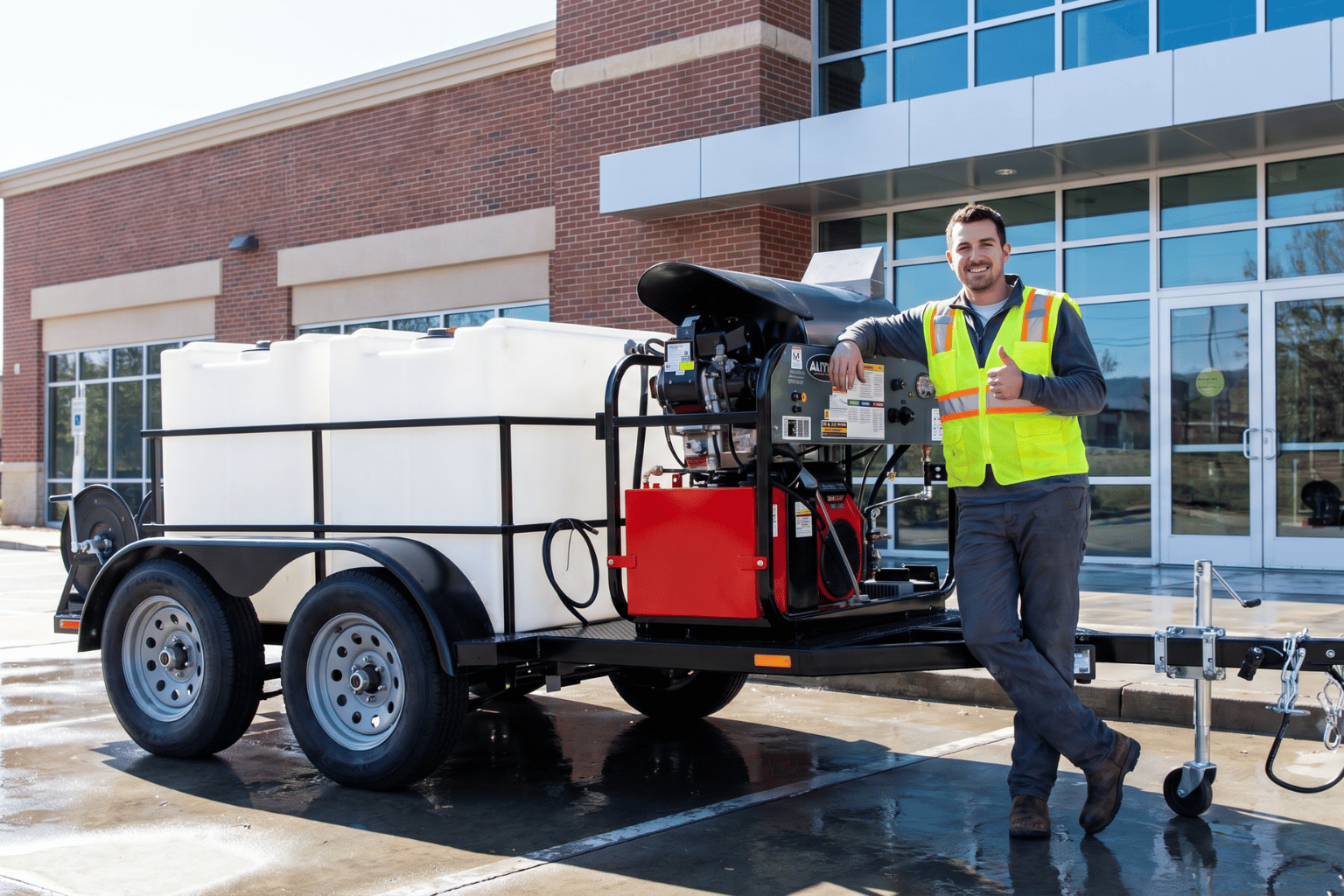
AI Summary: Dual Axle Pressure Washer Trailer Systems
- Dual axle trailers are essential for high-capacity water loads. A 330-gallon tank holds approximately 2,752 pounds of water, while a 460-gallon tank carries about 3,836 pounds before adding the trailer, engine, pump, burner, and accessories.
- Tandem axles improve towing safety and stability. Four wheels provide better braking, more controlled weight distribution, safer handling during water movement, and additional protection if a tire fails at highway speed.
- Available systems support different commercial workloads. Configurations range from 5 GPM gas-powered Vanguard and Honda systems to 8 GPM Honda and Kärcher rigs, plus lower-noise Kubota diesel platforms for demanding municipal and industrial environments.
- Tank size and flow rate directly affect productivity. At 8 GPM, a 330-gallon tank provides approximately 41 minutes of continuous operation, while a 460-gallon tank provides about 57 minutes, reducing refill downtime on remote job sites.
- Universal Trailer and American Water Works provide purpose-built, USA-made systems. Their trailers are designed for fleet washing, municipal work, industrial cleaning, agricultural decontamination, and other high-output applications, with safety equipment, custom configurations, and nationwide shipping available.
TABLE OF CONTENTS
When your operation demands maximum water capacity, highway-safe towing stability, and the kind of industrial output that gets large contracts done on time, a single-axle rig simply doesn’t cut it. A dual axle pressure washer trailer is the engineering standard for commercial mobile wash operations — and for good reason. Whether you’re managing a municipal fleet restoration contract, running multi-shift industrial decontamination, or servicing agricultural operations across California, the tandem axle platform is what separates professional operators from under-equipped competitors.
At Universal Trailer and American Water Works, we build and stock turnkey dual axle pressure washer trailer rigs configured for the most demanding field environments in the industry. This guide breaks down the physics, the powerplants, the compliance requirements, and the ROI math behind every major configuration we carry — so you can match the right rig to your workload the first time.
The Physics of Fluid Transport: Why High-Capacity Mobile Rigs Require a Dual Axle Pressure Washer Trailer
Let’s start with the number every serious operator needs to internalize: water weighs 8.34 lbs per gallon.
That single figure defines the entire engineering case for the tandem axle platform. A fully loaded 330-gallon tank carries 2,752 lbs of water before you’ve accounted for the trailer frame, engine assembly, pump, hose reels, and burner system. Scale to a 460-gallon configuration and you’re managing 3,836 lbs of water payload alone — nearly two full tons of fluid sitting on a moving vehicle.
The danger isn’t just the weight. It’s the movement of that weight.
Liquid in a large tank doesn’t travel as a fixed mass. It shifts, surges, and sloshes dynamically in response to braking, acceleration, and lateral lane changes. This fluid dynamic creates a phenomenon engineers call center-of-gravity migration — where a sudden shift in fluid momentum can overwhelm the trailer’s tracking stability, trigger rear-wheel lockup on the tow vehicle, and initiate the high-speed fishtail that causes catastrophic loss of vehicle control.
A dual axle pressure washer trailer addresses this threat through load distribution physics. By spreading the gross trailer weight across four wheels rather than two, tandem running gear delivers three critical mechanical advantages:
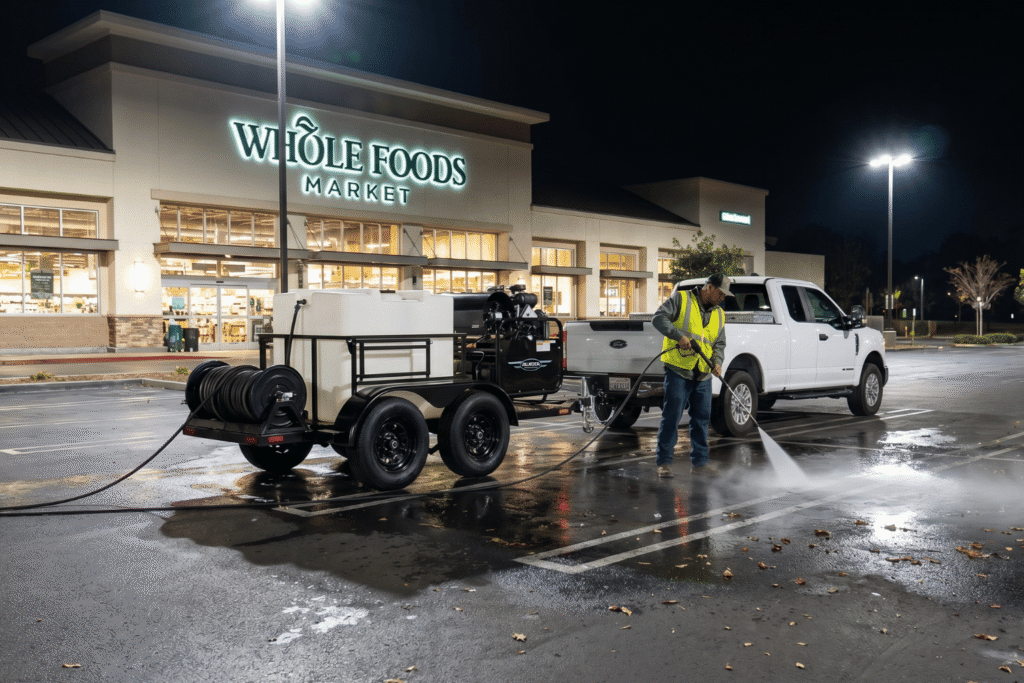
Braking Force Distribution. Four contact patches mean significantly greater aggregate stopping power. Under emergency braking with a loaded 460-gallon tank, the difference in stopping distance between a single and tandem axle setup can be measured in dozens of feet — which on a highway is the margin between an incident and a fatality.
Tire Blowout Survivability. On a single-axle trailer, a tire failure at highway speed is a catastrophic event. On a properly loaded dual axle pressure washer trailer, the redundant axle keeps the rig tracking while you safely bring the vehicle to a controlled stop.
Tongue Weight Management. Maintaining tongue weight in the 10–15% range of total trailer GVWR is the mechanical key to preventing sway. Our tandem axle frames are engineered with tank mounting positions precisely centered over the axle grouping to maintain this ratio across both 330 and 460-gallon configurations.
This isn’t optional engineering. It’s the baseline standard for any commercial operation running water payloads above 300 gallons.
Bestselling Workhorses: High-Output Gas-Powered Dual Axle Trailer Configurations
For the majority of commercial field applications — property management contracts, municipal wash programs, fleet wash accounts, and restoration work — our gas-powered dual axle pressure washer trailer builds represent the core of the professional market.
We stock these configurations in both 330 and 460-gallon tank capacities, paired with two of the most proven commercial powerplants in the industry.
The 18HP Vanguard Gas Platform — 5 GPM @ 3500 PSI
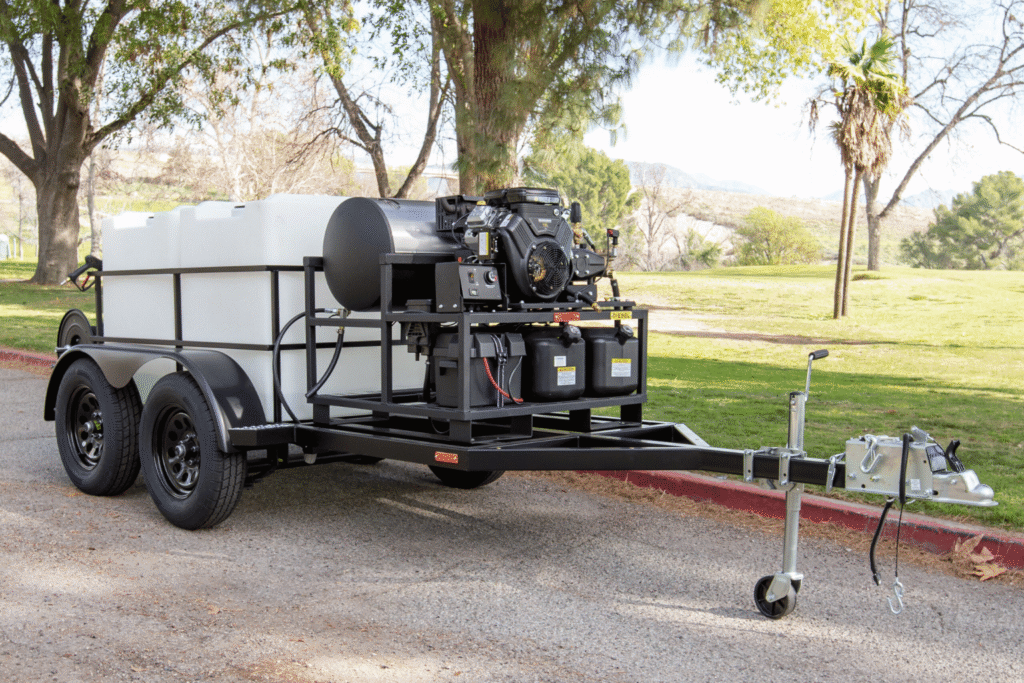
The Vanguard V-Twin is a field-tested commercial workhorse built for extended run cycles, cold-weather starting reliability, and lower total maintenance cost over a multi-year service life. Our 330-gallon Vanguard tandem axle rig delivers 5 GPM at 3500 PSI — the ideal output profile for commercial property management, residential wash accounts, and graffiti removal programs. For operators who need extended onboard water autonomy without stepping up to a 460-gallon frame, the 460-gallon Vanguard configuration delivers the same pump performance with nearly 40% more water supply before a refill stop.
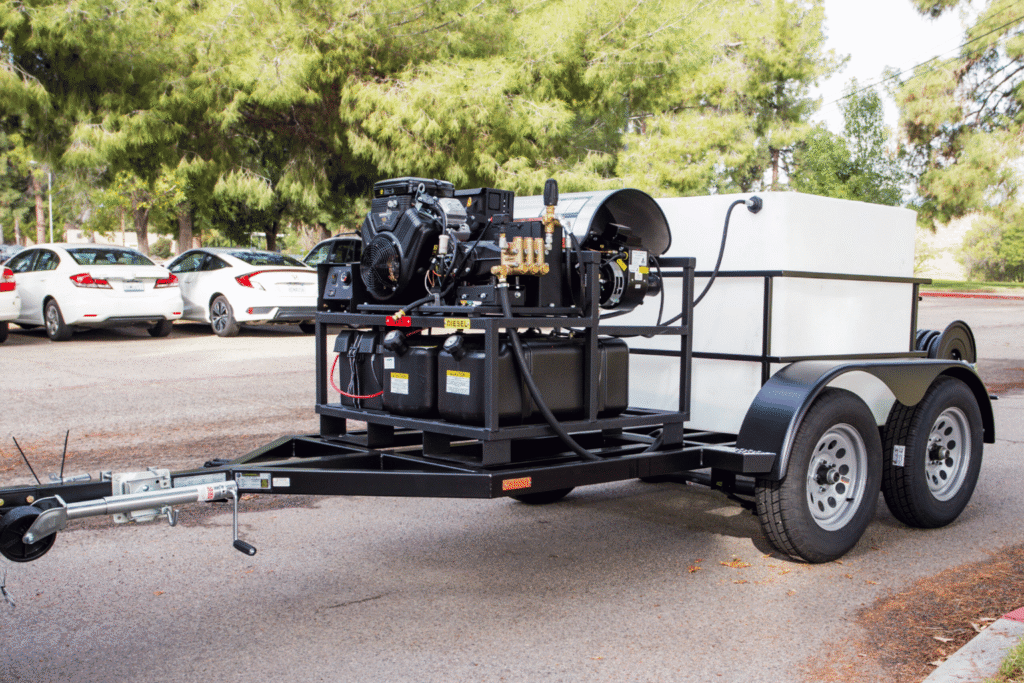
The 20HP Honda Gas Platform — 5 GPM @ 3500 PSI
Honda’s commercial engine lineup requires no introduction in this industry. The GX series is the globally dominant standard for commercial pressure washer applications precisely because parts availability, certified technician access, and proven longevity are unmatched. Our 330-gallon Honda tandem axle rig and 460-gallon Honda configuration are the default specification for municipal restoration accounts and wash bay operators who demand guaranteed parts supply anywhere in North America.
The 24HP Honda GX800 Platform / Fuel Injected — 8 GPM @ 3500 PSI
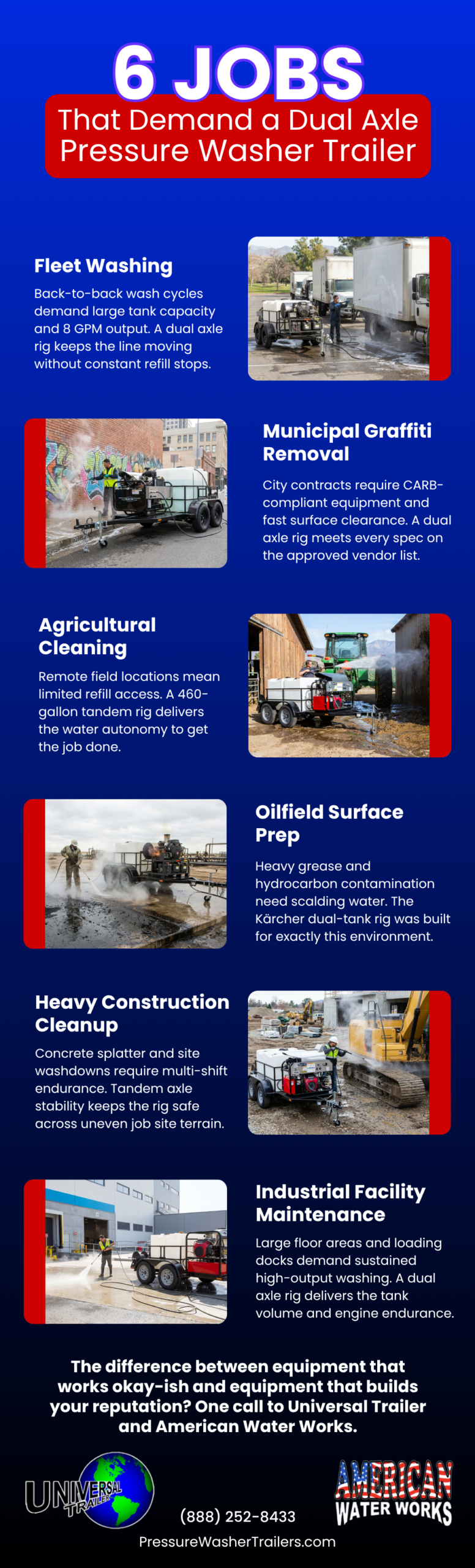
Step up to 8 GPM and the entire productivity equation changes. At 8 GPM, your rig is moving water at a rate that literally doubles rinse cycle speed compared to a 5 GPM configuration — the volume flushes debris, oils, and contaminants off surfaces faster than the pump’s pressure alone can achieve. This is the standard for large-scale fleet washing, agricultural decontamination, and any contract where job-site time is a direct cost variable. We build this configuration in both 330-gallon and 460-gallon tank capacities.
Elite Configurations for Extreme Environments: Enclosed Diesels and Dual-Fuel Heavy Machinery
When the job environment exceeds what commercial gas platforms are designed to sustain — multi-shift industrial cycles, oilfield site prep, mining operations, heavy construction decontamination — we build to a different specification entirely.
The 25HP Kärcher Dual-Tank Platform — 8 GPM @ 3500 PSI
The Kärcher 25HP build is our highest-output gas-powered configuration, and its defining mechanical feature is the dual-tank fuel architecture. The primary high-pressure pump runs on commercial gasoline. A completely separate onboard diesel/kerosene tank feeds the hot-water burner coil exclusively. This separation eliminates cross-contamination risk, allows independent fuel management for each system, and maximizes thermal BTU output from the burner without compromising pump engine performance.
Available in 330-gallon and 460-gallon configurations, the Kärcher dual axle rig is the platform of choice for operators facing heavy industrial grease, oil-field contamination, and extreme surface buildup where maximum heat and maximum flow volume have to run simultaneously.
The Kubota Z602 Clean Diesel Platform — 4.7 GPM @ 3500 PSI
The Kubota Z602 is in a different category entirely from a regulatory and operational standpoint. This is a liquid-cooled, ultra-low-emission diesel powerplant that meets full California CARB and EPA clean air mandates — making it the only platform in our lineup that can operate legally in the most strictly regulated urban and industrial territories in the country without restriction.
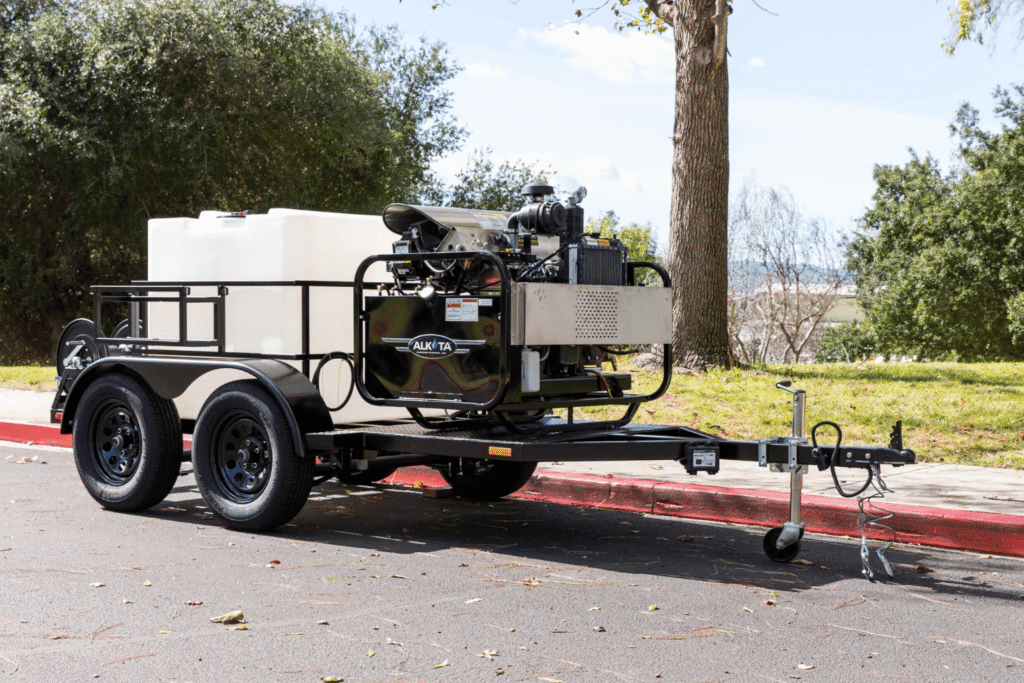
Beyond compliance, the Z602’s liquid-cooled architecture delivers substantially lower operating decibel levels than comparable air-cooled gas engines — a critical operational advantage when working under municipal noise ordinances, in hospital districts, or on contracts that specify low-noise requirements in their scope of work.
We stock this platform in both 330-gallon and 460-gallon configurations. For California-based operators, government contractors, and anyone bidding regulated municipal or state contracts, the Kubota dual axle pressure washer trailer is not a luxury — it’s a procurement requirement.
2026 Environmental Compliance: Navigating Stringent Emission and Water Regulations
The regulatory landscape for mobile industrial wash equipment has tightened materially heading into 2026, and operators who haven’t updated their equipment specifications are actively losing contract eligibility.
Urban Noise Ordinance Compliance. Major metropolitan contracts — from Los Angeles to San Francisco to Sacramento — increasingly specify maximum decibel thresholds for commercial equipment operating within city boundaries. Our California compliant pressure washer trailers like liquid-cooled diesel platforms like the Kubota Z602 operate significantly below the threshold that triggers ordinance violations, while air-cooled gas engines in the 20–25HP range frequently do not.
Hybrid Dual-Fuel Adoption. The dual-fuel architecture — gasoline to power the mechanical pump, diesel/kerosene to fire the hot-water burner — has moved from specialty configuration to mainstream commercial standard. It allows operators to optimize fuel consumption for each system independently and presents a cleaner compliance profile when the diesel component is a certified low-emission burner unit rather than the primary engine.
Wastewater Containment Requirements. Multiple California municipalities and state agencies now require mobile wash operators to demonstrate gray water containment or reclaim capability before granting work permits on commercial contracts. If your operation is bidding government or municipal work in 2026, verify your containment solution alongside your equipment certification package.
The ROI calculus on tank volume selection comes down to refill logistics. At 8 GPM, a 330-gallon tank runs approximately 41 minutes before depletion — workable if you have an on-site water source. A 460-gallon tank at the same output buys roughly 57 continuous minutes of run time. On remote job sites, that additional 16-minute window per fill cycle compounds to significant labor savings across a full workday. For operators running sustained contracts without reliable on-site water supply, the 460-gallon platform pays the tank volume premium back quickly.
Field Layout and Optimization Tips: Setting Up Your Dual Axle Pressure Washer Trailer for Faster Job-Site Execution
The engineering of the rig matters. How you configure and operate it on-site determines your actual throughput. These are the setup and maintenance practices that separate high-output commercial operations from operators who leave money on the table.
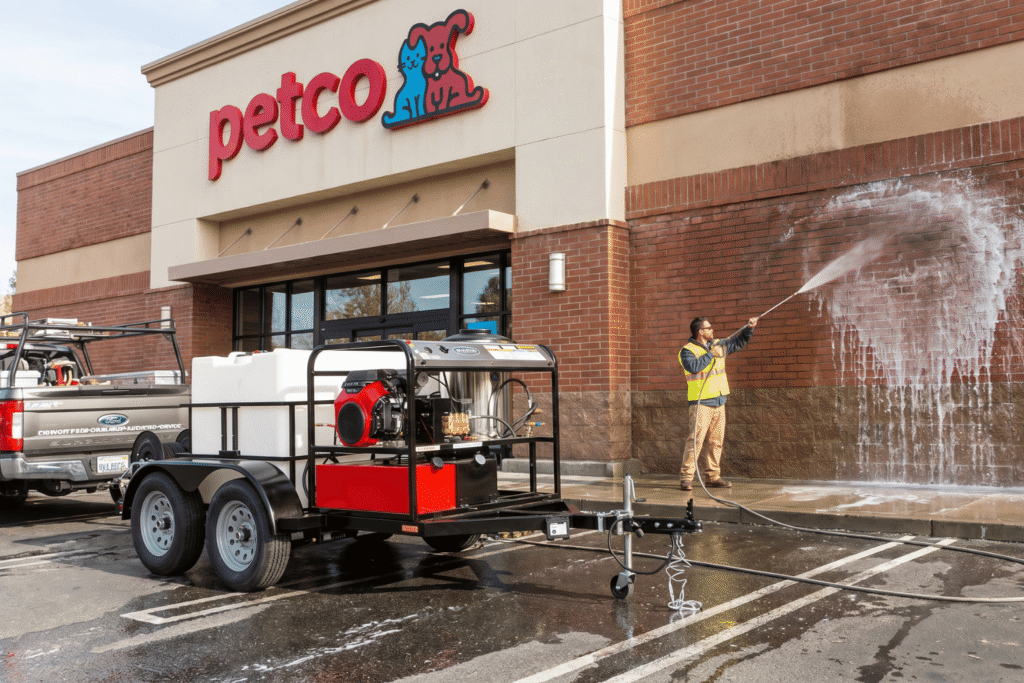
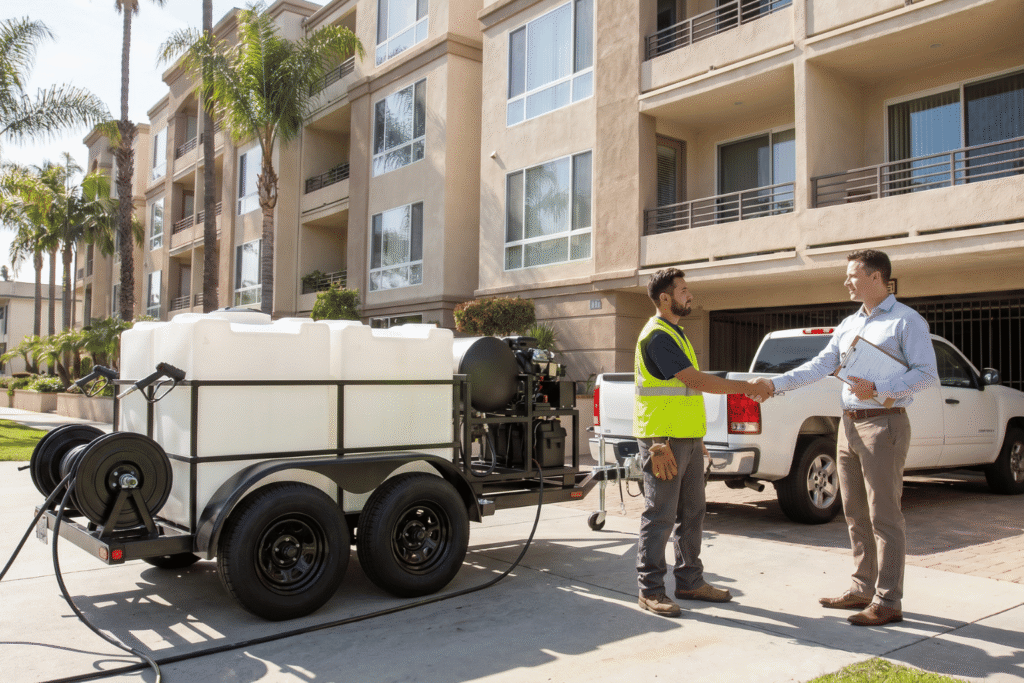
Rear Reel Configuration for 5-Minute Deployment. Mount your low-pressure supply inlet reel, high-pressure discharge reel, and bypass hose management at the curbside rear corner of the trailer frame. This layout allows a single operator to deploy from a road stop to active washing in under five minutes without repositioning the tow vehicle. Time-on-site is your primary variable cost; optimize the layout accordingly.
Precise 10–15% Tongue Weight Distribution. Your primary water tank must be mounted centered across the tandem axle group, not forward-biased toward the hitch or rear-biased toward the tail. The target tongue weight range is 10–15% of total loaded GVWR. Operators who don’t weigh their tongue pre-trip are guessing at a safety specification — invest in a tongue weight scale and verify it at full load before every highway run.
Continuous Loop Thermal Bypass Routing. Route your pump’s thermal relief and bypass output lines back into the main storage tank rather than a closed recirculation loop. When an operator closes the spray gun for extended periods — repositioning hose, talking to a site supervisor, moving the rig — the pump continues to cycle water. Without an open bypass route back to the tank, pump head temperatures rise rapidly and can cause seal and valve damage within minutes.
Hot Water Burner Warm-Up Protocol. On diesel and kerosene-fired burner systems, allow the burner coil a 2–3 minute warm-up cycle before engaging high-pressure flow through the heated circuit. Cold-starting into immediate high-volume hot-water demand stresses the coil and reduces long-term burner service life.
Winterization Before Every Seasonal Shutdown. Drain the primary tank completely. Connect an auxiliary feed line loaded with standard RV antifreeze and run it through the high-pressure pump, all plumbing valves, bypass loops, and hose reels until antifreeze is discharging at the gun tip. Pump head freeze fractures — caused by residual water expanding in cylinder bores — are one of the most common and most preventable sources of off-season equipment damage.
Pre-Trip Mechanical Checklist. Before every highway move: verify axle lug torque, check trailer brake controller engagement on the tow vehicle, confirm coupler lock and safety chains, inspect all hose reel retaining hardware, and verify the tank’s anti-slosh baffles are functional. A loaded dual axle pressure washer trailer moving at highway speed is a significant towing load — pre-trip discipline is not optional on commercial equipment.
Why Buy Your Dual Axle Pressure Washer Trailer from Universal Trailer and American Water Works
There’s no shortage of equipment dealers willing to drop-ship a pressure washer trailer to your door. What separates Universal Trailer and American Water Works is something no catalog can replicate: over three decades of hands-on expertise and a genuine commitment to getting your operation right.
We’ve been delivering results since 1990. American Water Works brings a combined 40-plus years of direct experience in pressure washer trailer design, configuration, and commercial application — and they’re not order-takers. They’re consultants who will work with you to engineer a system that matches your actual cleaning requirements, your tow vehicle capacity, your compliance environment, and your production goals. Whether you’re outfitting a single mobile rig or building out a commercial fleet, you get that expertise applied to your specific situation before a single bolt is torqued.
Every trailer we build is made in the USA. That’s not a marketing tagline — it’s a procurement advantage. Domestic fabrication means tighter quality control, faster turnaround on custom builds, and no supply chain exposure to international shipping delays when your contract timeline can’t afford them.
Our dual axle pressure washer trailer builds come standard with the safety and operational components that matter in real field conditions: LED lighting, reflectors, breakaway brakes, hitch safety chains, spare tire storage, and lockable toolbox storage for chemical management and accessory protection on the road. These aren’t optional add-ons — they’re part of how a professional rig should leave the factory floor.
We proudly serve Los Angeles and greater Southern California, and we ship fully built pressure washing rigs across the continental United States at no delivery charge. For operators in Alaska or Hawaii, contact us directly and we’ll put together a freight quote that works for your logistics.
Beyond the hardware, we stand behind the relationship. We welcome your feedback, your questions mid-project, and your calls when something in the field isn’t performing as expected. Our Contact Us page is a direct line to the team — not a ticketing queue. We’re in this business because we’re passionate about it, and our customers notice the difference.
When your next contract demands a high-capacity, highway-safe, professionally built dual axle pressure washer trailer — built by people who’ve been doing this since before most of today’s competitors existed — the answer is at https://www.pressurewashertrailers.com/shop/
Frequently Asked Questions: Authoritative Operational Insights on Dual Axle Pressure Washer Trailer Rigs
Why is a dual axle pressure washer trailer required for water tanks over 300 gallons?
At 8.34 lbs per gallon, a filled 330-gallon tank weighs 2,752 lbs and a 460-gallon tank exceeds 3,836 lbs — before frame, engine, pump, and accessories. Single-axle trailers at this weight class create unacceptable braking distances, dangerous sway under fluid shift, and catastrophic blowout risk. A dual axle pressure washer trailer distributes that payload across four wheels, maintains braking force margins, and provides tire redundancy that keeps a blowout from becoming an accident.
What is the operational difference between a 5 GPM and an 8 GPM configuration?
PSI breaks the surface bond. GPM determines how fast the loosened material is flushed away. An 8 GPM rig clears thick mud, heavy oils, and industrial grease at roughly twice the rate of a 5 GPM platform — not because it hits harder, but because it moves the volume faster. For fleet washing and large surface area contracts where job time is a direct cost, the 8 GPM dual axle pressure washer trailer is the specification that controls your labor margin.
How does the dual-tank gas/diesel hot water system work on the Kärcher configuration?
The primary Kärcher engine runs on commercial gasoline to power the high-pressure water pump mechanically. A completely separate onboard tank carries diesel or kerosene fuel exclusively for the hot-water burner coil. The two fuel systems operate independently, allowing operators to manage heat output and pump performance separately, maximize fuel efficiency for each function, and eliminate the contamination risk of running both systems from a single tank.
Are there California-compliant dual axle trailer configurations in stock?
Yes. All trailers (and all models) available in both 330-gallon and 460-gallon tank capacities — are built specifically to meet California CARB and EPA clean air certification requirements. These liquid-cooled diesel platforms also operate at substantially lower decibel levels than comparable air-cooled gas engines, satisfying urban noise ordinance requirements in Los Angeles, San Francisco, and other major California metro markets.
What tow vehicle do I need for a 460-gallon dual axle pressure washer trailer?
A fully loaded 460-gallon dual axle pressure washer trailer carries a GVWR between approximately 5,500 and 6,800 lbs depending on the engine and accessory configuration. Safe towing requires a 3/4-ton truck (F-250, Ram 2500, Silverado 2500 or equivalent) equipped with a Class III or Class IV hitch rated to the trailer’s GVWR, and an integrated electronic trailer brake controller. Do not tow this class of rig with a 1/2-ton platform.
Can you run cold water through a hot water pressure washer trailer?
Yes. Every hot water dual axle pressure washer trailer in our lineup operates as a fully capable cold water unit when the burner system is left off. For jobs that only require rinsing loose debris, dust, or mud — where heat provides no additional cleaning advantage — turning the burner off conserves diesel or kerosene fuel while the pump performs identically to a cold water configuration.
Where can I order a dual axle pressure washer trailer or request a custom build?
Browse our complete in-stock inventory of dual axle pressure washer trailer configurations and initiate custom fleet buildouts directly at pressurewashertrailers.com.
Disclaimer: Equipment specifications and performance capabilities may vary based on specific configurations and operating conditions. Professional consultation is recommended for custom applications and specialized requirements. Regulatory compliance requirements vary by location and application – consult local authorities for specific permit and operational requirements.