

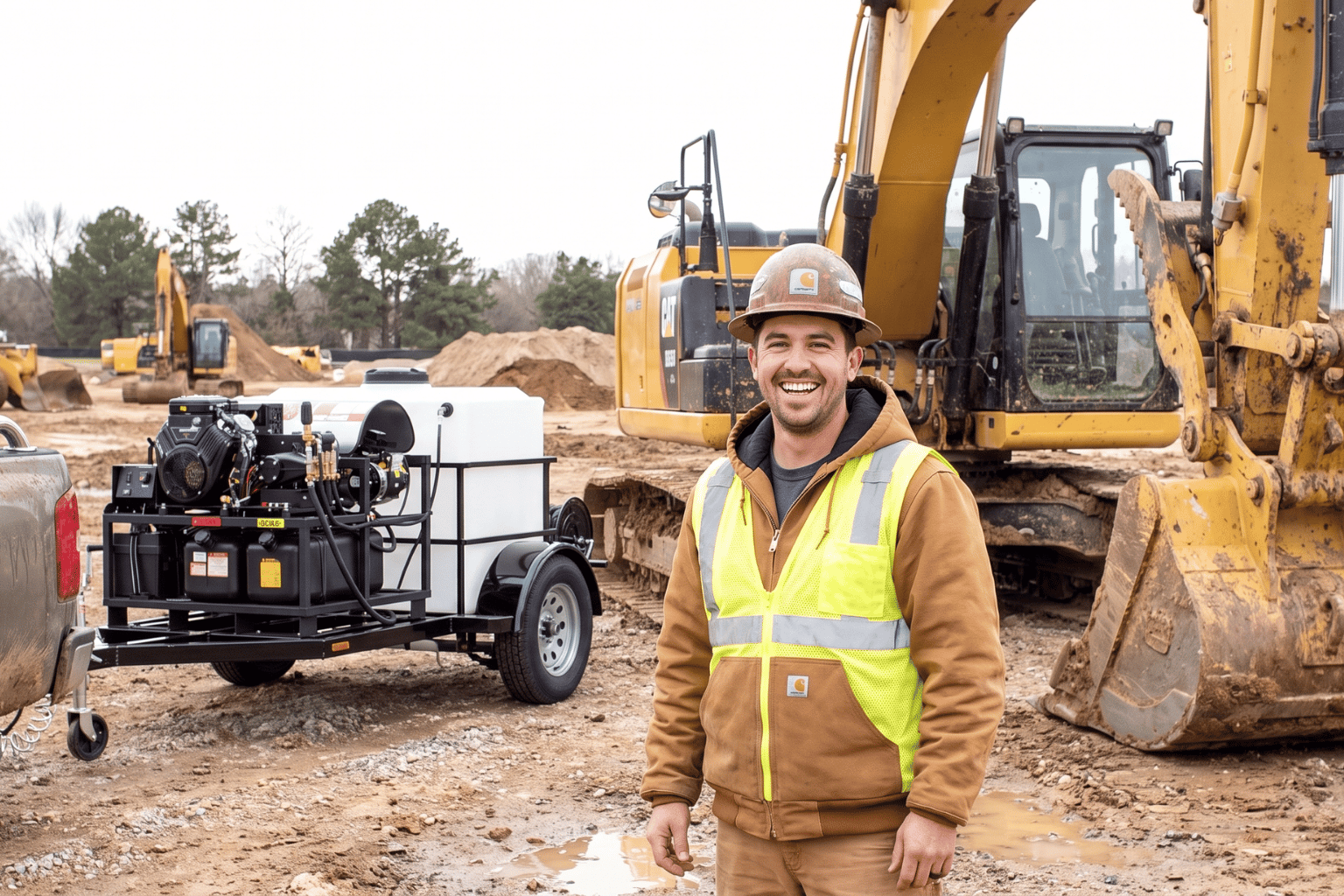
Heavy equipment cleaning takes more than a powerful spray. Excavators, bulldozers, wheel loaders, backhoes, and construction machinery collect layers of mud, hydraulic oil, grease, and debris that require a coordinated cleaning approach. Your equipment needs the right combination of water flow, controlled pressure, heat, and compatible detergents—supported by a mobile system that fits your operation.
At Universal Trailer and American Water Works, we provide commercial pressure washer trailers and mobile cleaning equipment for businesses that need to wash heavy machinery at construction sites, equipment yards, agricultural properties, and industrial facilities. Our trailer configurations bring hot water cleaning and onboard water storage together so your crew can work where the equipment is located.
Whether you manage a construction fleet, operate a rental yard, or provide mobile heavy equipment washing, we help you compare systems around practical requirements: the machines you clean, the contamination you encounter, your water supply, and your towing capacity.
Explore our commercial pressure washer trailers or request a heavy equipment cleaning system quote to discuss your application.
TABLE OF CONTENTS
What Is Heavy Equipment Cleaning?
Heavy equipment cleaning is the removal of accumulated soil, grease, oil, and other contamination from construction, agricultural, mining, and industrial machinery. Depending on the machine and cleaning objective, the process can include bulk debris removal, detergent application, hot water pressure washing, controlled rinsing, and wash-water collection.
A routine maintenance wash has a different purpose from preparing a machine for sale. A rental return may require careful inspection of attachments and access areas, while a service technician may need grease removed from a specific component before diagnosing a leak.
We encourage customers to define the desired result before choosing equipment. “Clean the excavator” can mean anything from removing loose mud to completing a detailed exterior wash before inspection.
That distinction affects water consumption, detergent selection, cleaning time, and the pressure washer trailer that makes sense for your business.
Heavy Equipment Cleaning Applications
Our mobile cleaning systems can support operations involving:
- Excavators, mini excavators, and backhoes.
- Bulldozers, crawler loaders, and compact track loaders.
- Wheel loaders, skid steers, and telehandlers.
- Motor graders, rollers, and road construction machinery.
- Dump trucks and other construction support vehicles.
- Tractors, agricultural implements, and forestry equipment.
- Rental equipment, industrial machinery, and selected attachments.
For every application, the machine manufacturer’s cleaning instructions should guide the method. A steel bucket, painted body panel, radiator, and electrical connector require different treatment.
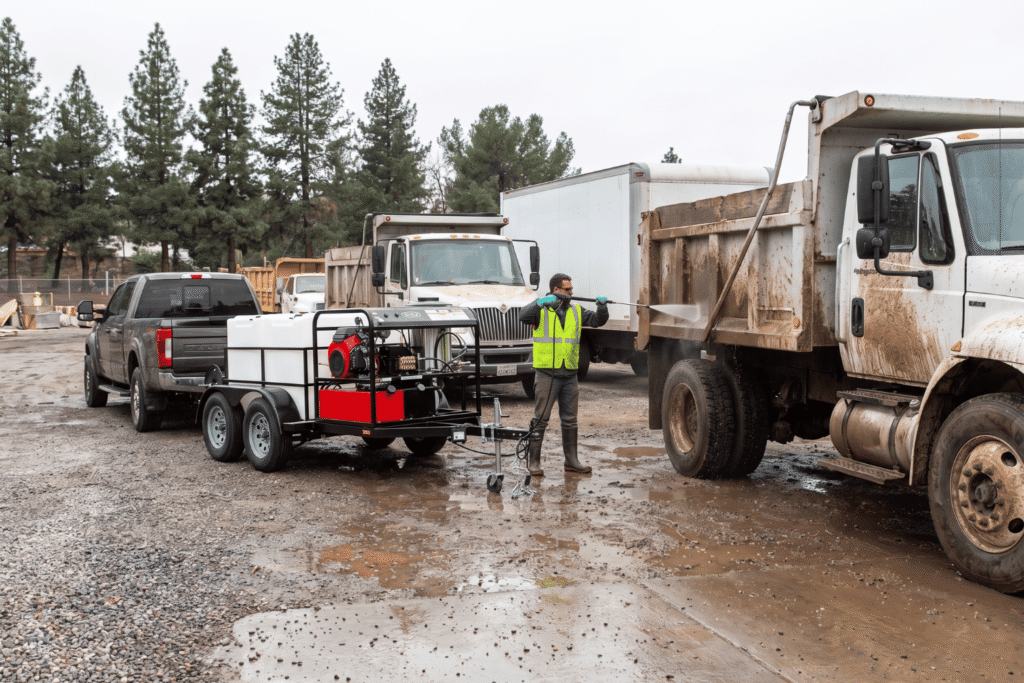
Why Heavy Equipment Cleaning Belongs in Your Maintenance Plan
A cleaning program gives your maintenance team a more useful view of the machine. Dirt can obscure fittings, damaged hoses, loose hardware, and areas that deserve closer inspection. Removing contamination helps technicians examine those components before work continues.
Cleaning also matters when equipment moves between customers, projects, and storage locations. An organized wash process makes it easier to document condition, prepare equipment for handover, and present your fleet professionally.
Make Inspections More Effective
An oily surface can make the source of a leak difficult to identify. Packed dirt may hide damage around a hose or mounting point. Cleaning the relevant area gives your technician a better starting point for diagnosis.
A useful inspection wash is targeted. It removes the material preventing an inspection while protecting the components being examined. Record existing damage before washing, then inspect again afterward.
Caterpillar discusses the relationship between cleaning, machine condition, and maintenance in its heavy equipment cleaning guidance.
Keep Access Areas Usable
Steps, handholds, platforms, and service access points deserve their own cleaning attention. A machine can look presentable from a distance while still having greasy steps or mud-covered access panels.
Include these areas in your checklist and inspect them after rinsing. Cleaning should leave the crew with usable access to the machine, rather than simply improving the appearance of its largest panels.
Support Rental Returns and Resale Preparation
Rental yards need a repeatable standard for incoming equipment. A consistent wash makes condition comparisons easier and helps staff distinguish ordinary dirt from damage requiring attention.
For resale preparation, clean the machine thoroughly enough to show its condition honestly. Remove residue from accessible exterior surfaces, attachments, and undercarriage areas without using aggressive methods to disguise wear.
Photographs taken before and after cleaning can also support internal records, customer handovers, and maintenance planning.
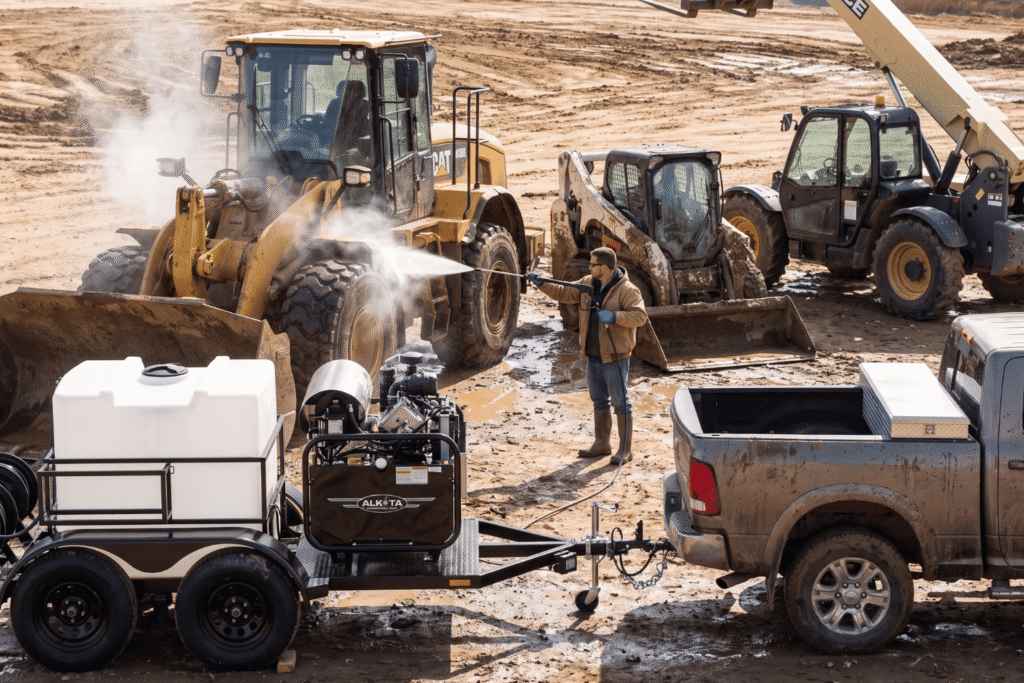
Mobile Heavy Equipment Cleaning Where Your Fleet Works
Moving a machine solely for washing can create an additional scheduling burden. A mobile pressure washer trailer lets your team bring cleaning equipment to an approved wash location near the fleet.
At Universal Trailer and American Water Works, our equipment offering includes trailer and truck-mounted cleaning solutions, hot water pressure washers, water tanks, hose reels, and configurable layouts. These components help businesses organize a practical mobile washing operation.
The benefit depends on your site. You still need safe access, sufficient room, suitable ground conditions, and a plan for the dirty water produced during cleaning.
Construction Sites and Contractor Yards
An earthmoving contractor may need to remove mud before servicing a machine or moving it to another project. A yard manager may want scheduled washes that fit around dispatch and maintenance.
For these customers, the important questions include where the wash will occur, how the trailer will reach that location, and whether a reliable refill source is available.
Our article on industrial pressure cleaner trailers provides additional background on mobile commercial cleaning equipment.
Equipment Rental Operations
Rental fleets often include machines of different sizes and surface materials. Your wash process must account for that variety.
A compact machine returning from landscaping work may need a different cleaning sequence from a loader covered in oily industrial residue. The equipment should offer useful operating flexibility, and the crew should have written instructions for sensitive components.
Agricultural, Forestry, and Industrial Operations
Agricultural and forestry machinery may accumulate plant debris, soil, and grease. Industrial equipment can introduce different contaminants and site-specific handling requirements.
Describe those conditions when discussing a system with us. The more accurately we understand your workload, the more useful the equipment comparison becomes.
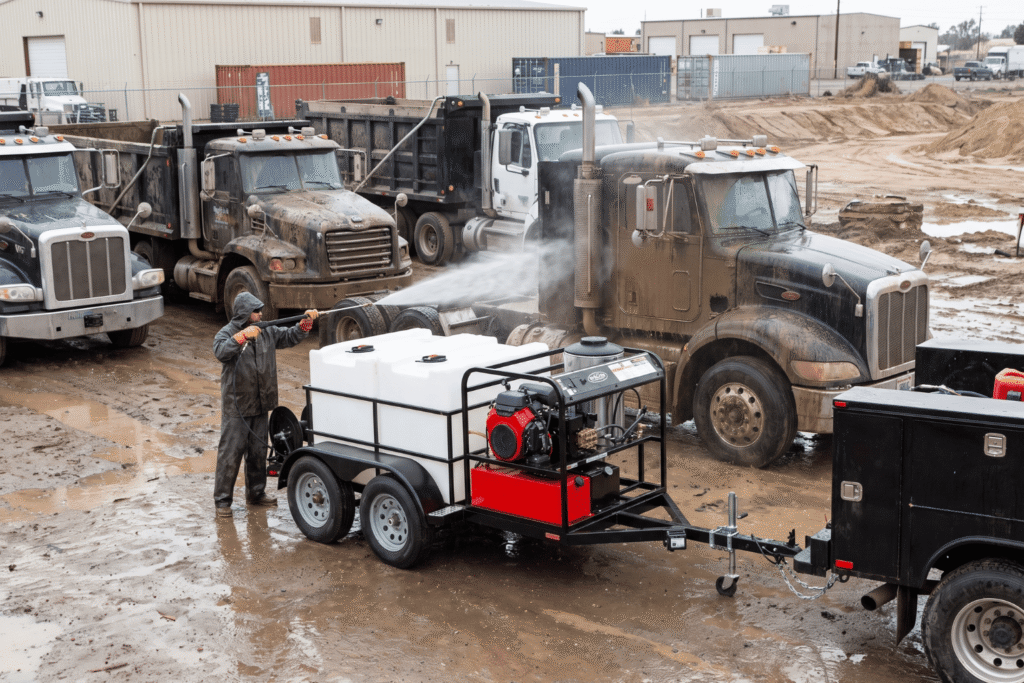
Hot Water vs. Cold Water for Heavy Equipment Cleaning
Cold water pressure washing can be useful for loose soil, mud, and routine rinsing. Hot water becomes especially valuable when oily or greasy contamination is part of the job.
Heat helps loosen greasy deposits, while compatible detergents help the cleaning process address the contamination. Water flow then carries loosened material away. Pressure contributes mechanical cleaning action, but pressure alone does not solve every problem.
Kärcher’s construction equipment cleaning resource discusses both cold water intermediate cleaning and hot water cleaning for greasy machinery.
When Cold Water May Be Sufficient
If the task is removing ordinary soil from a manufacturer-approved surface, cold water may meet the objective. Bulk debris removal and a controlled rinse can be appropriate for some routine jobs.
The important distinction is whether the contamination releases readily. Continuing to spray an oily deposit with more pressure can waste time when the cleaning method needs to change.
When Hot Water Deserves Priority
Consider hot water capability when your workload regularly includes grease, oil films, or machinery preparation before maintenance.
A heated system adds another control to the cleaning process. It does not mean every surface should receive the hottest available water. Temperature must remain compatible with the machine, detergent, and pressure washer instructions.
Match the Method to the Surface
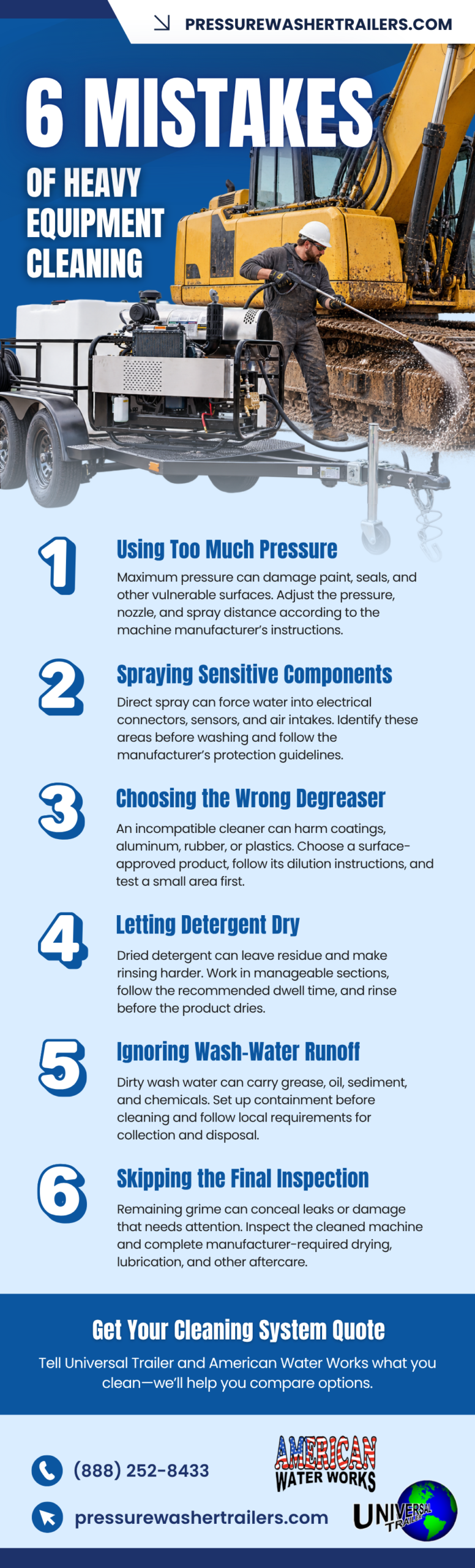
Paint, rubber, plastics, seals, wiring, and decals can respond differently to pressure, chemicals, and heat.
Start with a controlled test in an appropriate area. Use the least aggressive method that achieves the required result, and adjust the process rather than repeatedly increasing pressure.
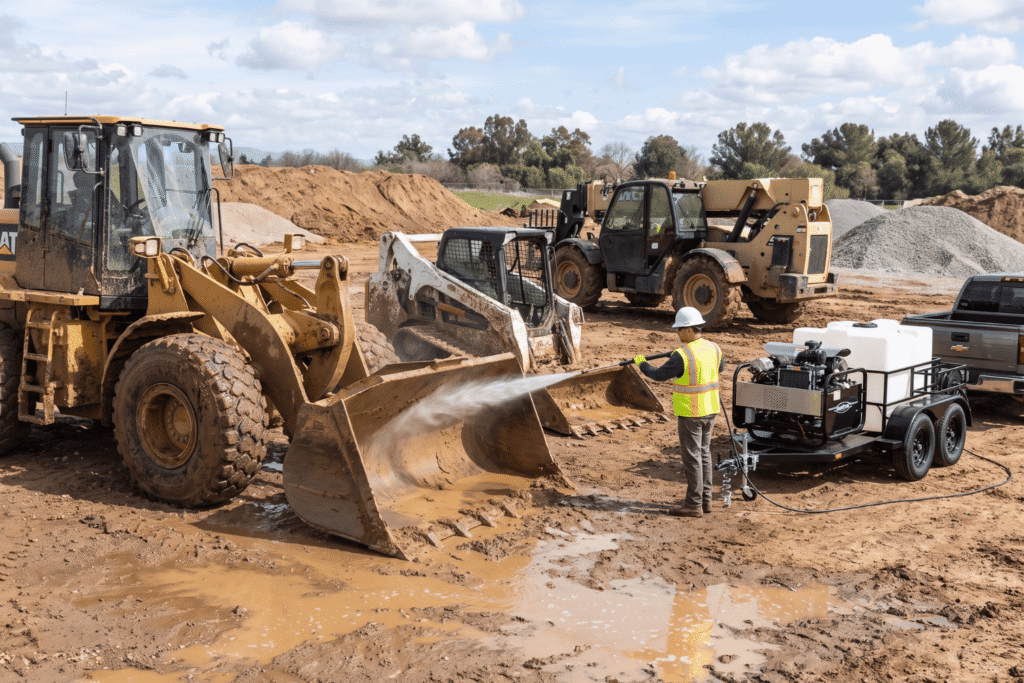
How Much PSI and GPM Do You Need?
When comparing a heavy equipment pressure washer, two specifications deserve attention: PSI, or pounds per square inch, and GPM, or gallons per minute.
PSI describes pressure. GPM describes water flow. Both affect the cleaning process, but they serve different purposes.
A pressure washer’s maximum rating is not an instruction to apply that pressure to every component. Actual cleaning conditions also depend on the nozzle, spray distance, hose configuration, and surface.
PSI: Controlled Cleaning Force
Pressure helps loosen attached contamination. Excessive pressure or an unsuitable nozzle can also damage surfaces and drive water into vulnerable areas.
Choose equipment with useful capability, then operate it according to the pressure washer and machinery instructions. Maximum pressure should never replace surface-specific judgment.
GPM: Water Available for Rinsing
Flow matters when carrying mud and loosened residue away from broad surfaces. A higher-flow machine may be worth considering for a fleet with substantial rinsing requirements.
However, an 8 GPM system does not guarantee that every job will finish twice as quickly as a 4 GPM system. Detergent dwell time, access, setup, operator technique, and contamination all influence completion time.
Heat, Chemistry, and Workflow Complete the Picture
The right specification depends on the whole job. A high-flow machine without an adequate water supply creates interruptions. A capable hot water system paired with the wrong detergent may still struggle with a particular deposit.
We recommend comparing pressure, flow, water capacity, and heating capability together. Describe your cleaning task before choosing a model solely by its largest advertised number.
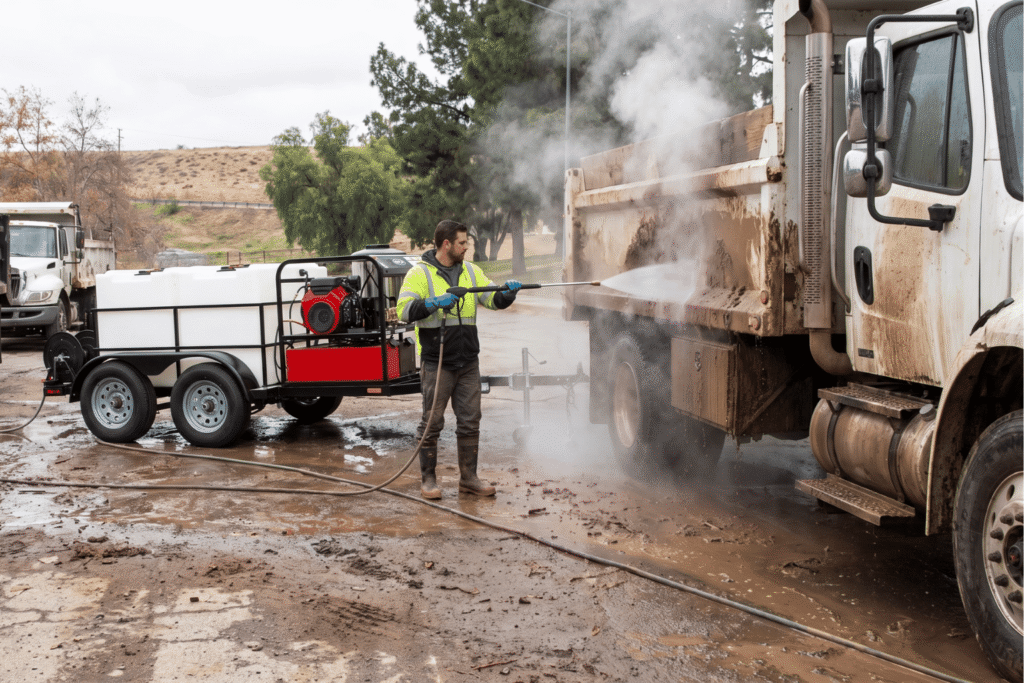
Compare Our Heavy Equipment Cleaning Trailer Options
The following systems offer different combinations of flow, water storage, and trailer configuration. The application notes are starting points for discussion, rather than guarantees of suitability for every machine or site.
System | Listed pressure and flow | Water tank | Trailer configuration | Application to discuss with us |
AWW Vanguard hot water system | 3,500 PSI, 5 GPM | 230 gallons | Single axle | Routine machinery washing with planned refill access |
Alkota 5357C Kubota diesel system | 3,500 PSI, 4.7 GPM | 230 gallons | Single axle | Customers evaluating our California-compliant diesel offering |
Alkota 5357C Kubota diesel system | 3,500 PSI, 4.7 GPM | 330 gallons | Tandem axle | Similar cleaning output with additional onboard water |
Honda GX690 hot water system | 3,500 PSI, 8 GPM | 330 gallons | Tandem axle | Higher-flow rinsing for construction and equipment-yard workloads |
Honda GX690 hot water system | 3,500 PSI, 8 GPM | 460 gallons | Tandem axle | Higher-flow cleaning with a larger water reserve |
230-Gallon AWW System: 5 GPM at 3,500 PSI
Our 230-gallon single-axle Vanguard hot water pressure washer trailer combines a 5 GPM pressure washer with onboard water storage. Listed features include an 18HP Vanguard gasoline engine, diesel-heated burner, adjustable thermostat, and hose reels.
This configuration is worth evaluating when your work involves routine equipment washing and your refill plan suits a 230-gallon tank.
Before ordering, compare the complete loaded trailer with your tow vehicle’s capabilities and discuss your expected cleaning schedule with us.
California-Compliant Kubota Diesel Options
Our 230-gallon Alkota 5357C trailer is listed as a California-compliant system with a Kubota Z602 diesel engine and 4.7 GPM output at 3,500 PSI.
For additional water storage, compare our 330-gallon tandem-axle Alkota 5357C trailer.
Tell us where you intend to operate so we can discuss the exact configuration and documentation. Equipment selection and site wash-water requirements should both be addressed before deployment.
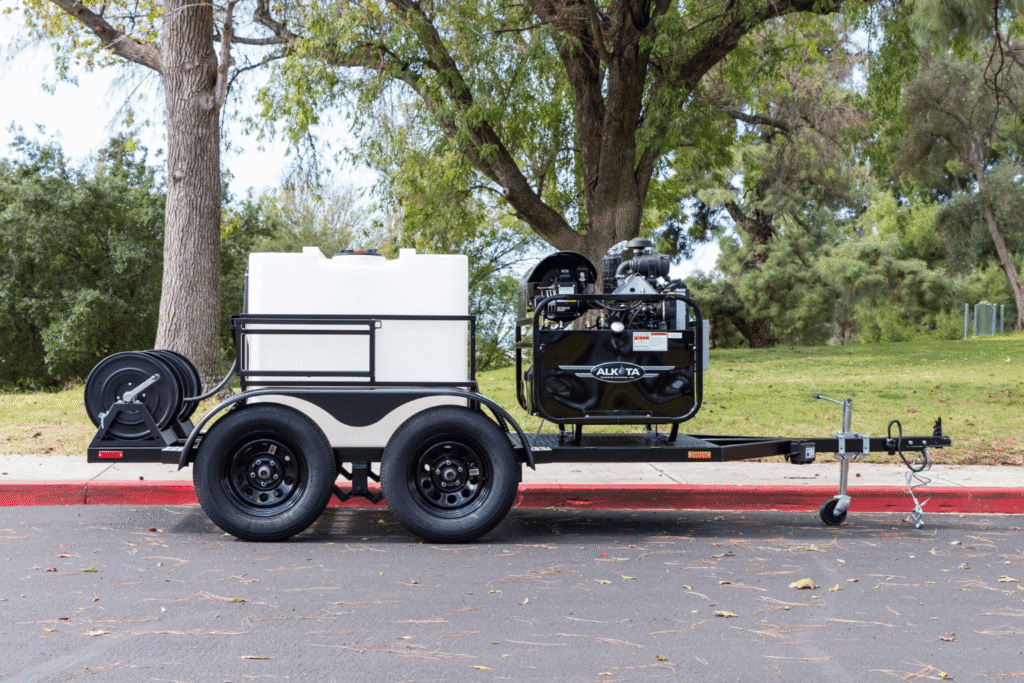
330-Gallon System: 8 GPM at 3,500 PSI
Our 330-gallon tandem-axle Honda GX690 hot water trailer offers 8 GPM flow at 3,500 PSI.
Consider this option when broad-surface rinsing is a substantial part of your workload. Higher flow also increases water demand, making tank capacity and refill access important parts of the purchase decision.
460-Gallon System: Additional Onboard Water
Our 460-gallon tandem-axle Honda GX690 hot water trailer combines the listed 8 GPM output with a larger tank.
The additional storage may be useful where refilling takes time or machines are spread across a large property. It also adds water weight, so towing and payload calculations deserve careful attention.
Water Tank Capacity: Plan Around Actual Spray Time
Tank size should reflect your cleaning workload and the distance to a reliable refill source.
A simple planning calculation is:
Nominal tank capacity ÷ operating flow = theoretical continuous spray time.
For example, 230 gallons divided by 5 GPM equals 46 minutes. A 330-gallon tank divided by 8 GPM equals approximately 41 minutes. At the same 8 GPM flow, 460 gallons equals approximately 57.5 minutes.
These figures assume the nominal tank volume is available and the stated flow remains constant. Usable water can be lower, and your system must retain the supply conditions required for safe pump operation.
Elapsed job time is different from continuous spray time. Setup, detergent application, dwell time, repositioning, and inspection can extend the period spent on a job without extending the available water volume.
Include Water Weight in Your Towing Plan
Fresh water weighs approximately 8.34 pounds per US gallon. A nominal 460 gallons therefore weighs about 3,836 pounds before adding the trailer, pressure washer, fuel, hoses, and other equipment.
Evaluate the completed configuration against trailer ratings, axle and tire ratings, hitch limits, tow vehicle payload, and the vehicle manufacturer’s towing requirements.
Our article on choosing a pressure washer with a water tank introduces the available tank-size options. For your purchase, use the specifications and loaded-weight information for the exact configuration.
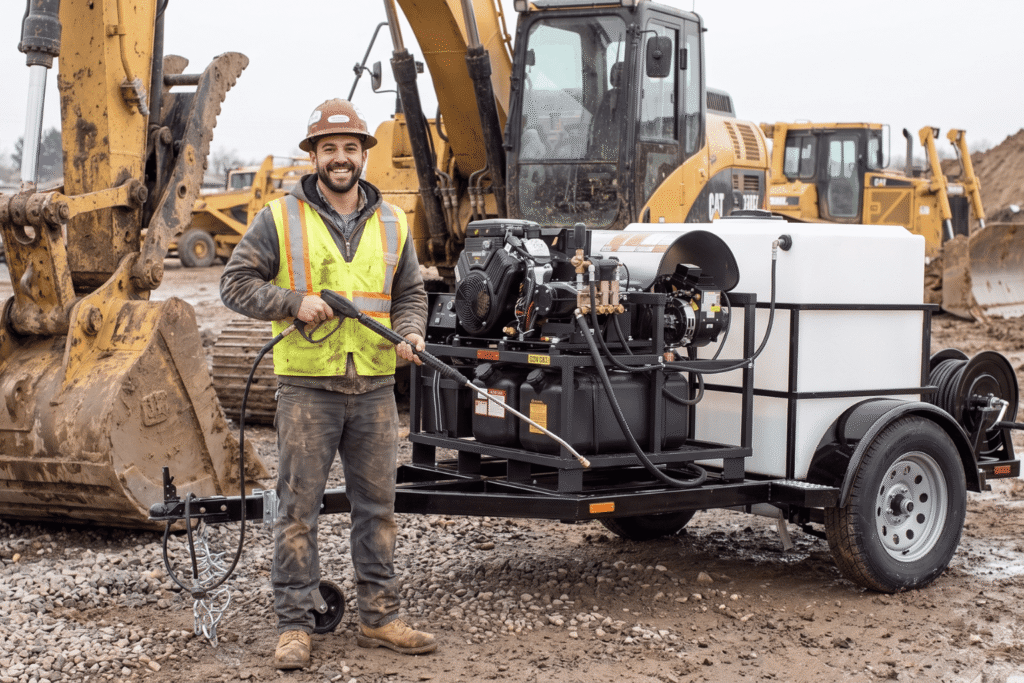
Heavy Equipment Degreasing and Detergent Selection
The best degreaser for heavy equipment depends on the contamination and the surfaces being cleaned.
A product suited to greasy steel may require different handling around aluminum, coatings, plastics, or rubber. Detergent compatibility also matters for chemical application equipment and wash-water treatment.
When evaluating a cleaner, review its label and Safety Data Sheet. Confirm dilution, permitted surfaces, application method, protective equipment, and disposal considerations.
Give Detergent Time to Work
Applying detergent and immediately rinsing it away can limit its usefulness. Follow the specified dwell time and prevent the product from drying on the surface.
Stubborn deposits may require controlled agitation with a suitable brush. Test the method before treating a larger area, especially on older paint or unfamiliar materials.
Match Chemistry to the Deposit
Mud, petroleum grease, asphalt residue, and cured concrete are different cleaning challenges. One chemical should not be assumed suitable for all of them.
For unusual deposits, identify the material and obtain a surface-compatible recommendation. Avoid improvised chemical combinations and aggressive cleaning methods that could damage the machine or complicate wastewater handling.
Bring those details to our team when discussing your heavy equipment cleaning setup. They help establish whether heat, detergent delivery, water flow, or specialized accessories deserve priority.
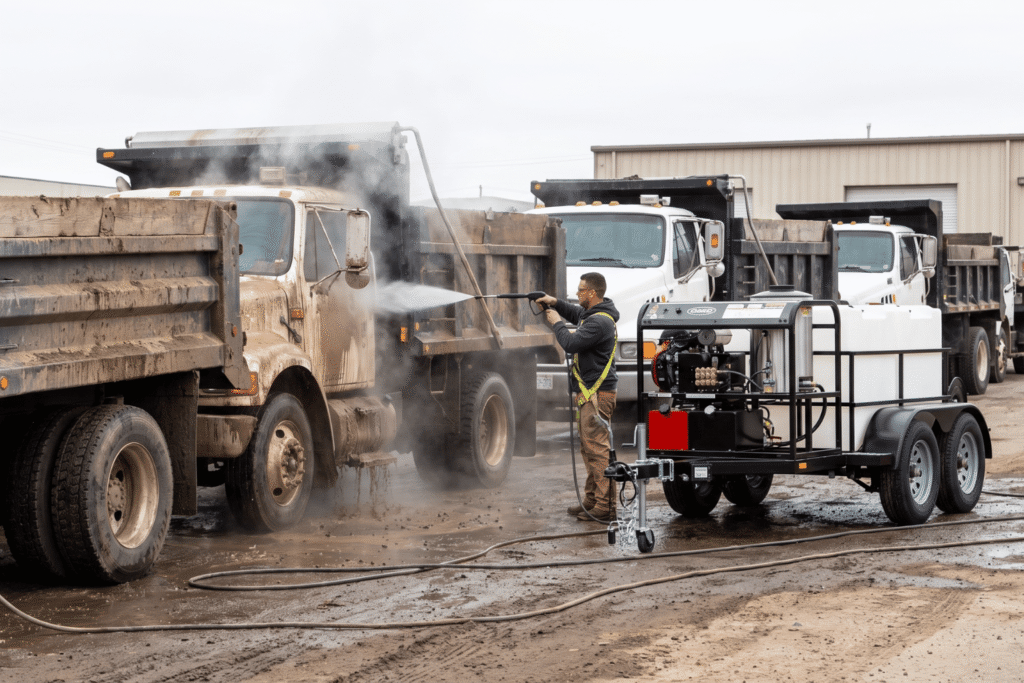
A Practical Heavy Equipment Washing Workflow
A repeatable process helps your crew produce a consistent result and estimate future jobs more accurately.
The sequence below is a planning framework. Your machinery manuals, chemical instructions, site procedures, and pressure washer operating instructions should determine the final method.
1. Define the Cleaning Objective
Decide whether the machine needs routine washing, inspection preparation, rental-return cleaning, or resale presentation.
Identify included surfaces and any exclusions. Photograph existing damage, loose decals, or leaks that may affect the work.
2. Prepare the Machine and Wash Area
Follow the manufacturer’s shutdown and securing procedures. Allow hot components to reach an appropriate condition for cleaning.
Confirm safe access around the machine, identify nearby drainage, and establish the containment arrangement before introducing water or detergent.
3. Remove Accessible Bulk Debris
Where safe and permitted, remove loose material with suitable tools before washing. Collect the debris for appropriate handling.
Do not reach into hazardous areas, work beneath unsupported equipment, or reposition attachments without the required operating procedures.
4. Protect Sensitive Components
Identify electrical connections, sensors, air intakes, seals, and other vulnerable areas. Follow the manufacturer’s instructions for shielding or avoiding them.
Keep the cleaning method appropriate to each surface rather than treating the machine as one uniform object.
5. Apply Compatible Detergent
Use the approved dilution and application method. Work in manageable sections so the cleaner remains within its specified dwell conditions.
Agitate selected areas when appropriate, then proceed to controlled washing.
6. Wash and Rinse Systematically
Use a planned sequence that limits repeated work and prevents loosened material from accumulating on cleaned areas.
Adjust pressure, temperature, nozzle, and distance according to the surface. Maintain clear communication if more than one person is working near the machine.
7. Inspect, Document, and Complete Aftercare
Check for residual contamination and report newly visible concerns to the equipment owner or maintenance team.
Complete required drying, lubrication, and other manufacturer-directed aftercare before returning the machine to service. Clean the wash area and handle collected water and debris through the approved process.
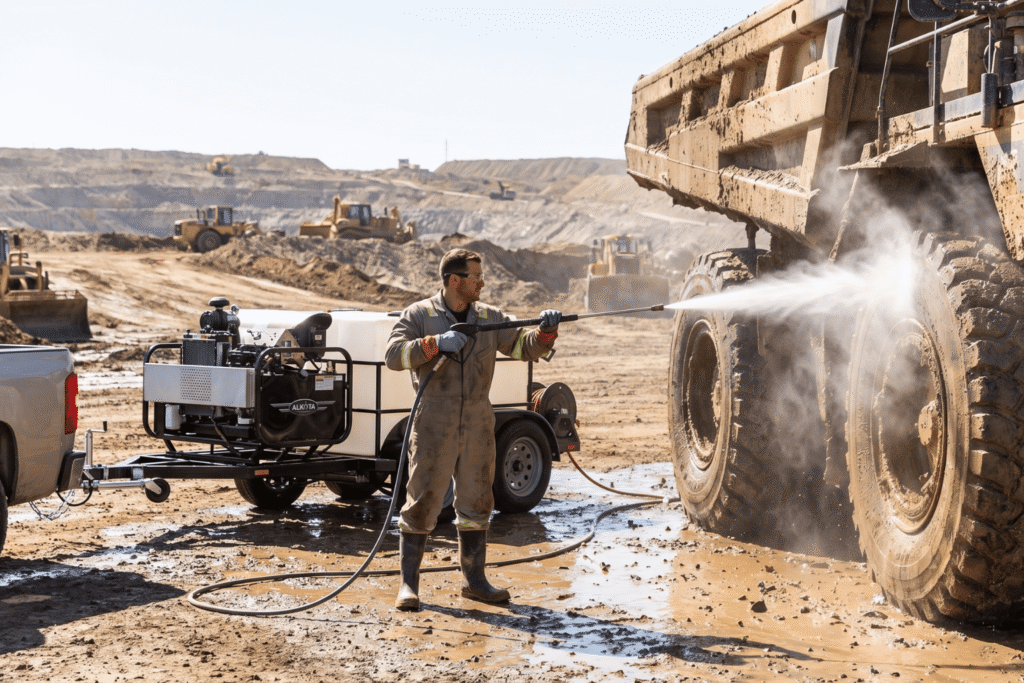
Wash-Water Containment and Responsible Disposal
Heavy equipment wash water may contain soil, oil, grease, detergent, and other contaminants. A clean-looking rinse does not establish that the water is suitable for discharge.
Plan where the water will go before beginning work. Depending on the site, that may involve a designated wash pad, temporary containment, collection equipment, storage, and an authorized disposal or treatment route.
The EPA’s municipal vehicle and equipment washing guidance describes containment and treatment practices and emphasizes local requirements.
Avoid directing wash water into storm drains. Discharge to a sanitary sewer may require permission and pretreatment from the local sewer authority. Check the applicable site and jurisdiction requirements before selecting a disposal method.
Biodegradable detergent does not make contaminated wash water automatically acceptable for discharge.
When discussing a trailer with us, describe your containment and recovery plan separately. Confirm which components are included in the quotation and what additional equipment your site requires.
Build Safe Operation Into Your Cleaning Program
Pressure washing involves high-pressure spray, flying debris, slippery surfaces, and, when heated water is used, burn hazards.
Train operators on the specific system and inspect hoses, fittings, guns, and other components before use. Establish a work boundary that keeps bystanders away from the spray and moving equipment.
Select protective equipment through your task assessment and chemical instructions. The CDC’s pressure washer safety guidance addresses spray injuries and other operating hazards, including carbon monoxide from gasoline-powered equipment.
Follow the manufacturer’s operating instructions and applicable site procedures throughout the job. A capable pressure washer needs a trained operator and a suitable working environment to deliver useful results.
How to Evaluate Heavy Equipment Cleaning Costs
If you operate a fleet, compare the complete cost of your current washing process with the proposed equipment investment.
Include labor, water access, engine fuel, burner fuel, detergents, maintenance, transportation, containment, and disposal. Also consider how cleaning fits into dispatch and service schedules.
If you provide commercial heavy equipment washing, define the customer’s scope before quoting. Machine size alone is an incomplete pricing method. A lightly soiled loader and a loader with thick oily deposits can require very different work.
Inspect representative machines and record actual time and consumption. Separate routine maintenance washing from restoration-level cleaning, and account for travel, access restrictions, and wastewater handling.
We encourage customers to choose equipment around measured work. A system that fits your water supply and daily schedule can be more useful than a larger machine purchased without a clear operating plan.
Why Choose Universal Trailer and American Water Works?
Your heavy equipment cleaning system should connect the pressure washer, water supply, trailer, and job requirements into a workable package.
We offer commercial trailer configurations that let you compare those decisions together. You can evaluate hot water capability, tank capacity, flow, trailer arrangement, and the accessories relevant to your operation.
Our product selection gives customers clear options for different workloads. Whether you are building an in-house fleet washing program or expanding a mobile cleaning business, we invite you to discuss the conditions that matter most to your crew.
For layout ideas and purchase considerations, explore our custom pressure washer trailer article.
Before requesting a quote, gather the machine types you clean, typical contamination, expected workload, refill availability, tow vehicle details, and wash-water plan. Those facts make the conversation more productive and help you compare configurations with confidence.
Bring dependable cleaning capability to your equipment operation. Contact Universal Trailer and American Water Works to discuss a heavy equipment cleaning system, or browse our pressure washer trailers to begin comparing options.
Frequently Asked Questions About Heavy Equipment Cleaning
What is the best way to clean heavy equipment?
Use a controlled process that matches the contamination and the machine manufacturer’s instructions. Remove accessible loose debris, apply a compatible detergent when needed, allow the specified dwell time, and wash with appropriate pressure and temperature. Protect sensitive components and establish wash-water handling before starting. Finish with inspection and any required lubrication or other aftercare.
Do I need hot water to clean heavy machinery?
Hot water is especially useful for oily and greasy contamination. Cold water may be sufficient for some mud removal and routine rinsing tasks. The best choice depends on what you clean regularly. If grease removal is a frequent requirement, compare hot water capability alongside water flow, detergent compatibility, and tank capacity.
What is the best degreaser for heavy equipment?
There is no universal best degreaser. Choose a product labeled for the contamination and surfaces involved, then review dilution, dwell time, application instructions, and the Safety Data Sheet. Check compatibility with paint, aluminum, plastics, seals, and your wash-water treatment process. Test an appropriate area before wider application.
Can I remove grease with a pressure washer without detergent?
Some light contamination may release with water alone, particularly when suitable heat is available. Thick or aged grease may require a compatible detergent and controlled agitation. If a deposit resists washing, reassess the method rather than repeatedly increasing pressure. Surface compatibility and the required cleaning result should guide the decision.
How much PSI is needed for heavy equipment cleaning?
There is no single safe pressure for every machine and component. Our listed systems include models rated at 3,500 PSI, but that maximum rating is not a recommended setting for every surface. Follow the machinery and pressure washer instructions, and consider nozzle selection, spray distance, temperature, and material condition.
Is 5 GPM or 8 GPM better for washing construction equipment?
A 5 GPM system may suit routine work with manageable rinsing requirements. An 8 GPM system provides more water flow and deserves consideration for larger rinsing tasks. It also consumes onboard water faster. Compare both against your fleet, refill supply, towing limits, and operating schedule instead of choosing by flow alone.
How long does a pressure washer trailer’s water tank last?
Divide available water by operating flow to estimate continuous spray time. Nominally, 230 gallons at 5 GPM equals 46 minutes, while 330 gallons at 8 GPM equals approximately 41 minutes. Actual usable capacity and operating conditions affect the result. Total job duration includes periods when the trigger is released.
Can pressure washing damage excavators and bulldozers?
Yes. Unsuitable pressure, temperature, chemicals, nozzles, or spray distance can damage vulnerable surfaces and components. Avoid direct aggressive spray at sensitive areas identified by the manufacturer. Inspect the machine first, use controlled methods, and follow the correct manual for the model being cleaned.
How do I clean an excavator undercarriage?
Follow the manufacturer’s shutdown, access, and cleaning procedures. Remove accessible bulk material safely, then use an appropriate washing method around track frames and other permitted areas. Do not work beneath unsupported equipment or improvise ways to reach hazardous spaces. Have the maintenance team inspect and complete required aftercare afterward.
Can a pressure washer remove dried concrete from equipment?
A pressure washer may remove loose residue, but cured concrete can require a specialized, surface-compatible process. Obtain guidance from the equipment manufacturer and cleaning-product supplier before treatment. Avoid aggressive blasting, scraping, or chemical application that could damage coatings, metal, or nearby components.
How often should heavy equipment be cleaned?
Set the schedule around operating conditions, manufacturer guidance, and maintenance needs. Some machines need frequent removal of accumulated material; others may need scheduled washing before inspections, rental returns, transport, or storage. Define what requires immediate attention and what belongs in a routine wash cycle.
How much does professional heavy equipment washing cost?
Pricing depends on machine condition, cleaning scope, access, travel, water supply, labor, and wastewater handling. A routine exterior wash and detailed grease removal are different services. Request a written scope and a quote based on representative machines. If you provide washing services, measure actual job costs before setting repeat rates.
Can I wash heavy equipment at a construction site?
Potentially, if the site provides safe access and an approved cleaning and wash-water arrangement. Obtain the site operator’s authorization and review applicable procedures before starting. A mobile trailer supplies cleaning capability, but the site still needs a suitable location, containment plan, and authorized water-handling route.
Does biodegradable soap make wash water safe for storm drains?
No. The water can still contain oil, grease, sediment, and other contaminants removed from the machinery. Detergent labeling does not establish discharge permission. Follow the applicable site requirements and consult the relevant authority about containment, treatment, and disposal.
Should I buy a trailer or a truck-mounted pressure washer?
A trailer may suit an operation that wants to tow its cleaning system with an appropriate vehicle. A truck-mounted system may fit a dedicated service vehicle. Compare payload, towing, storage, access, maintenance, and the way your crew travels between jobs. We can discuss the available configurations around those requirements.
What should I tell you when requesting a heavy equipment cleaning system quote?
Tell us which machines you clean, their typical condition, how often you wash them, and whether you need hot water. Include water availability, preferred tank capacity, tow vehicle details, site restrictions, and your containment plan. Photos and representative job descriptions can help us understand the application and discuss suitable options.
Disclaimer: Equipment specifications and performance capabilities may vary based on specific configurations and operating conditions. Professional consultation is recommended for custom applications and specialized requirements. Regulatory compliance requirements vary by location and application – consult local authorities for specific permit and operational requirements.