

Key Takeaways (TLDR)
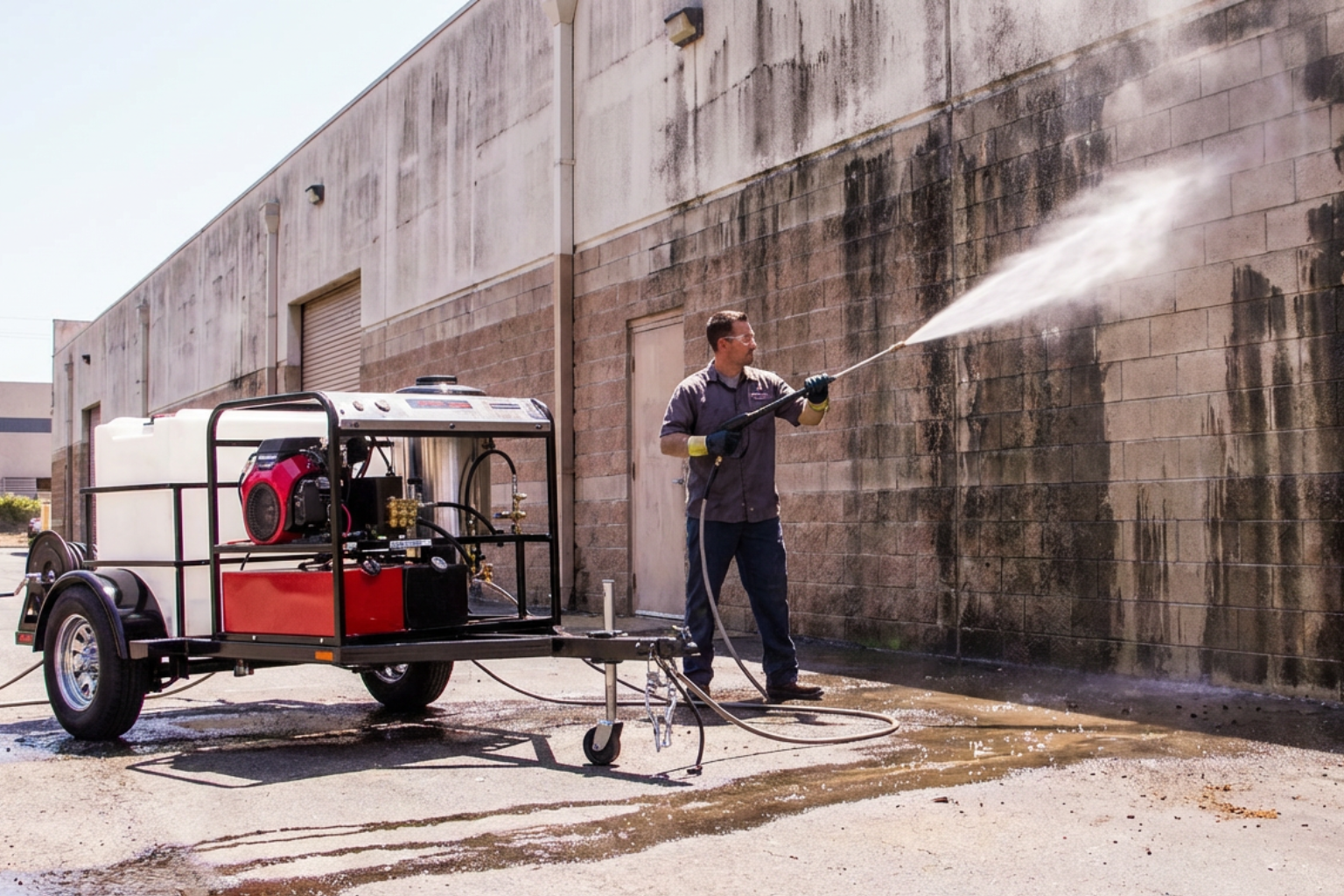
- A pressure washer with water tank eliminates your dependence on unreliable water sources at job sites
- Tank sizes range from 230 to 460 gallons, perfect for different towing capacities and job durations
- Mobile detailing is booming—the market hit $139 billion in 2025 and is projected to reach $367 billion by 2035
- Our turnkey trailer systems include everything you need and ship FREE anywhere in the US
- Professional-grade equipment pays for itself by eliminating downtime and expanding your service radius
TABLE OF CONTENTS
Picture this: You pull up to a lucrative fleet washing job, ready to make serious money. Your equipment is pristine, your chemicals are mixed, your schedule is clear. Then you walk over to connect your hose and… the spigot’s broken. Or worse—there’s no water hookup at all.
We’ve heard this nightmare story from contractors more times than we can count. It’s frustrating, expensive, and completely avoidable. That’s exactly why we built Universal Trailer and American Water Works into the industry’s go-to source for mobile cleaning solutions that truly work anywhere.
A pressure washer with water tank changes everything. Instead of hunting down water sources or begging property managers for access, you literally bring the water with you. Game changer? Absolutely.
Why Do I Need a Pressure Washer with an Onboard Water Tank?
Let’s talk real-world scenarios. The mobile car detailing industry is exploding—we’re talking 10.2% annual growth, with the market jumping from $139 billion in 2025 to a projected $367 billion by 2035. That’s not pocket change. More importantly, 79% of drivers now prefer professional cleaning services over DIY, according to the International Carwash Association.
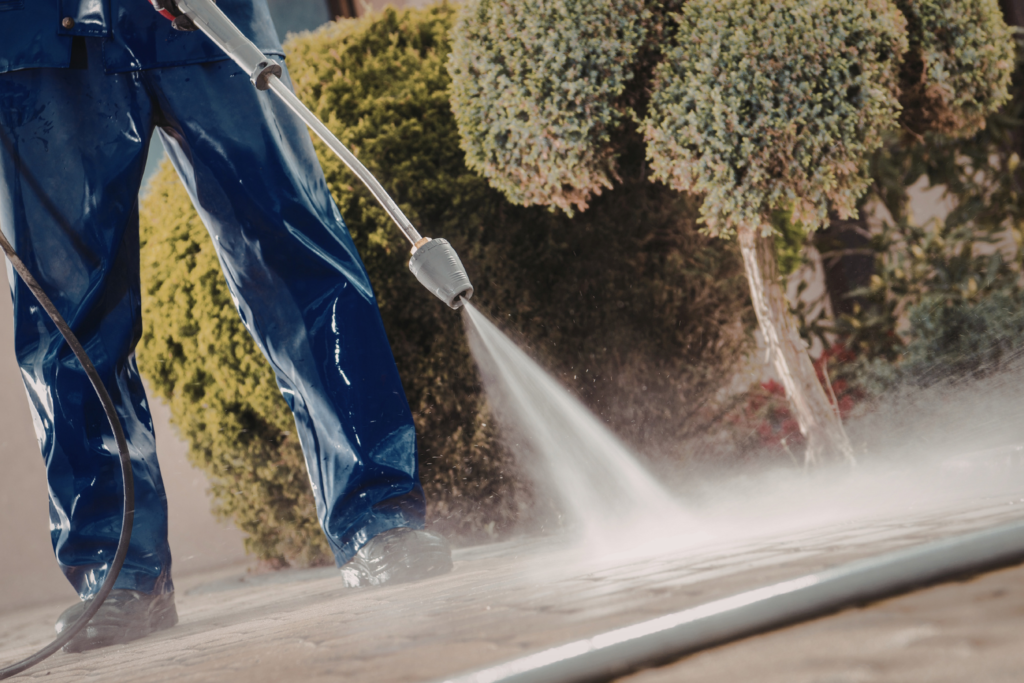
Translation? There’s money on the table. But here’s the catch—you can only grab it if you can actually show up and do the work.
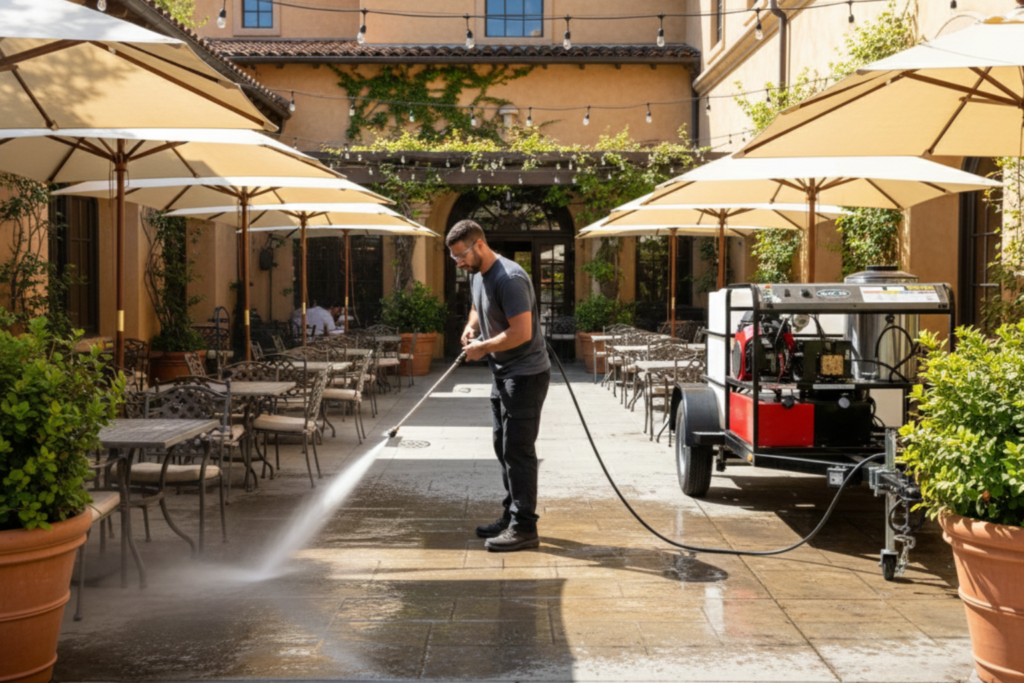
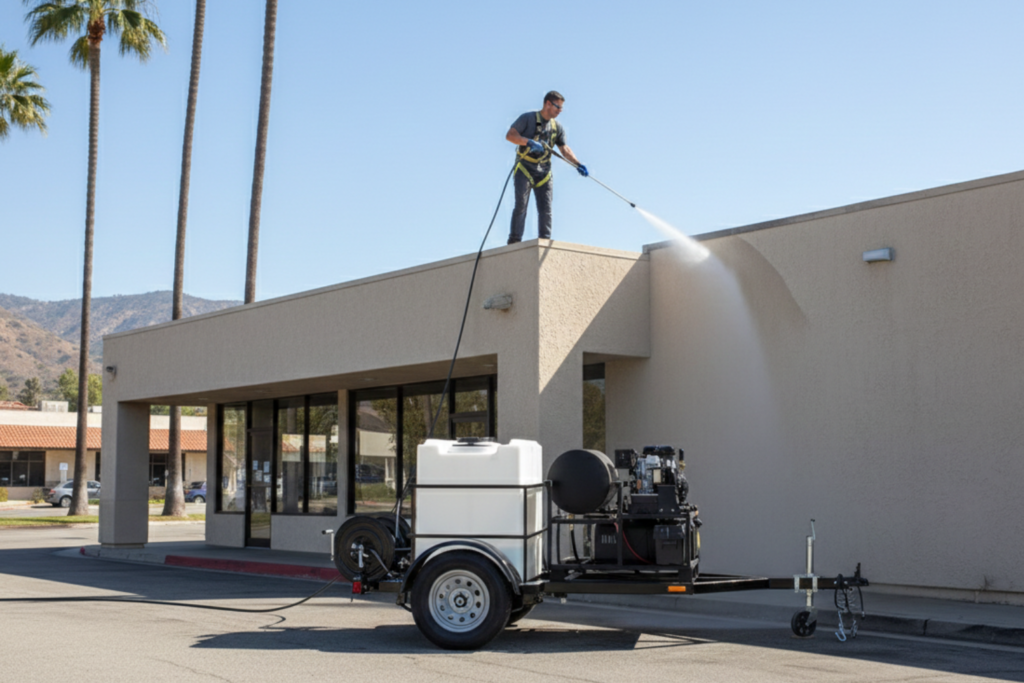
Remote construction sites, new developments, parking lots, fleet yards, agricultural operations—these are all places where traditional pressure washing setups fail spectacularly. A pressure washer with water tank solves these problems:
True mobility: You’re not limited to properties with functioning water connections. Our self-contained pressure washer units go literally anywhere your truck can tow.
Professional image: Nothing screams “amateur hour” like showing up to a commercial job and asking to borrow a garden hose. Our commercial cleaning rigs look the part.
Consistent water pressure: Ever tried running a 3000 PSI power washer off a residential spigot delivering barely 40 PSI? It’s painful. Your onboard tank with a proper pump delivers consistent performance every single time.
Water conservation: With regulations tightening (especially in the Southwest), having a measured water supply helps you track usage and stay compliant with local ordinances.
Fun Fact: A properly maintained pressure washer with water tank can reduce water waste by up to 50% compared to continuous-flow setups. Your wallet and the EPA both appreciate that.
Understanding Tank Sizes: 230 vs 330 vs 460 Gallons
Not all water buffer tanks are created equal, and choosing the wrong size is like buying shoes two sizes too small—technically functional, but you’re gonna have a bad time.
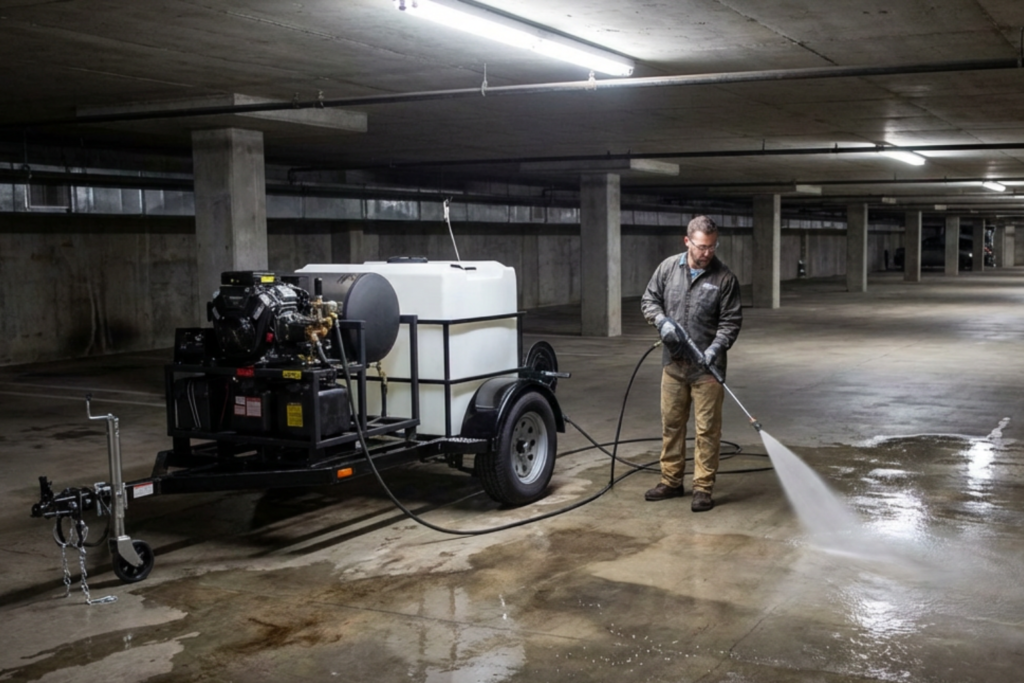
Here’s our breakdown based on years of real-world feedback from fleet washing equipment operators:
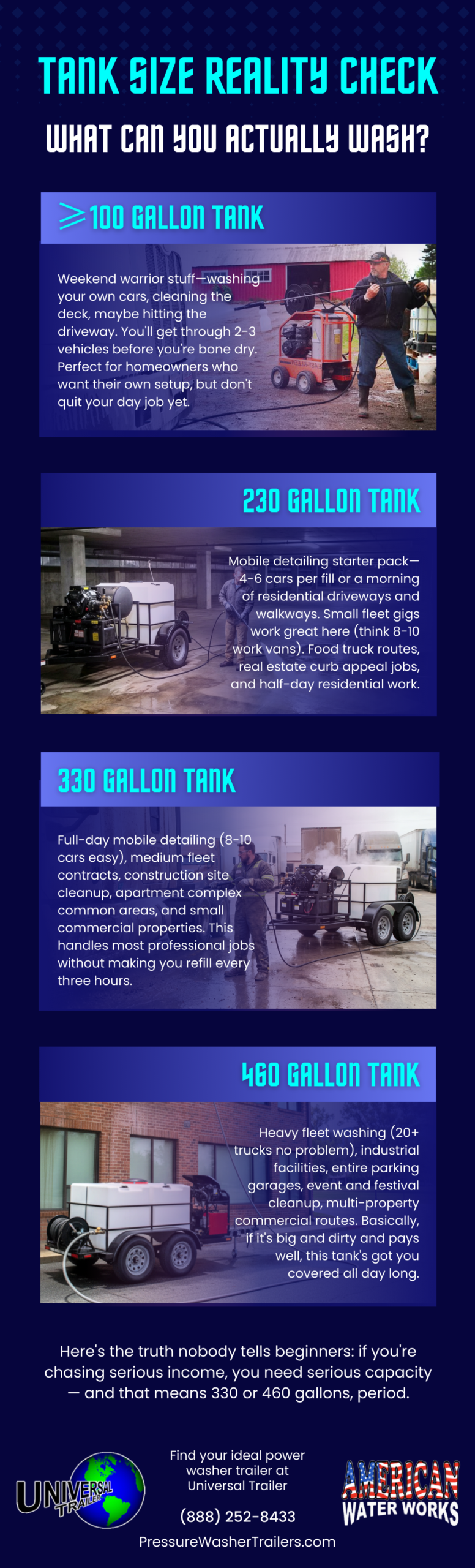
230-Gallon Pressure Washer Tank
This is your nimble workhorse. Perfect for mobile detailing trailers that need to squeeze into residential driveways or navigate tight parking structures.
Best for: SUVs and light trucks (towing capacity under 7,000 lbs), residential mobile detailing, spot cleaning jobs
Real-world capacity: At 3 GPM (gallons per minute)—standard for most Honda engine pressure washers—you get roughly 75 minutes of continuous spray time. That’s enough to detail 4-6 standard vehicles or wash a medium-sized commercial fleet before refilling.
Towing considerations: Fully loaded, you’re looking at around 2,500-3,000 lbs total trailer weight. Most half-ton trucks handle this beautifully.
330-Gallon Water Tank
The Goldilocks option. Not too big, not too small, this industrial power washer trailer setup hits the sweet spot for serious professionals.
Best for: 3/4-ton trucks, full-day detailing operations, construction site cleaning
Real-world capacity: About 110 minutes of spray time at 3 GPM. You can knock out an entire apartment complex’s walkways or handle 8-10 vehicles without thinking about water.
Towing considerations: Total loaded weight around 3,500-4,200 lbs. Requires a decent towing setup but nothing crazy.
460-Gallon Heavy-Duty Tank
This is the beast. When you absolutely, positively need to work all day without refilling, accept no substitutes.
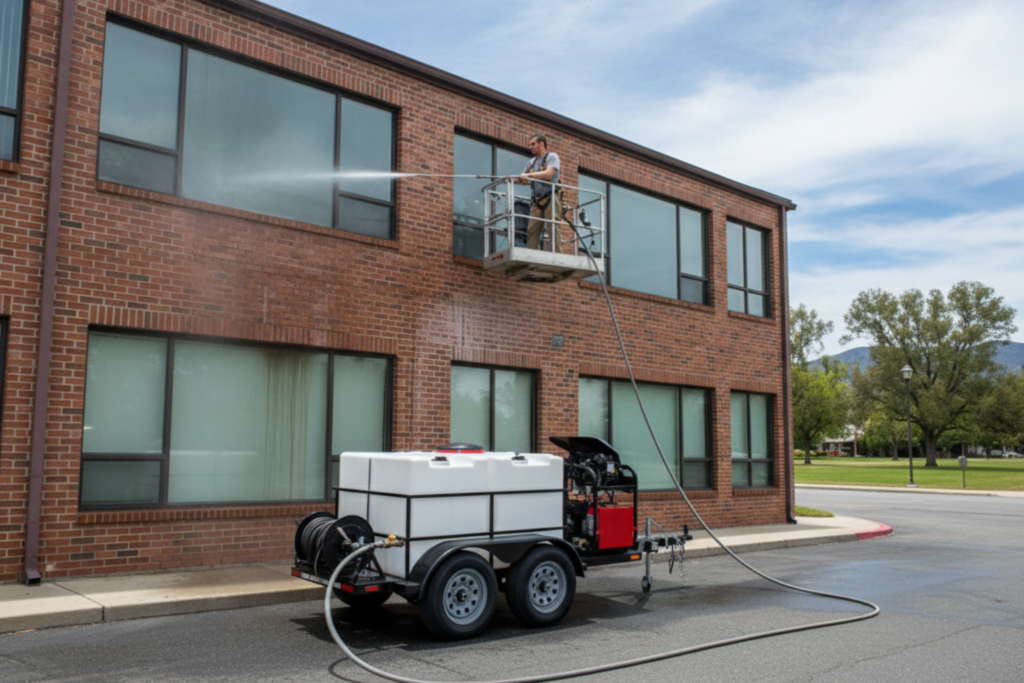
Best for: Heavy-duty trucks (F-350, Ram 3500, etc.), all-day fleet washing, industrial cleaning contracts
Real-world capacity: Over 150 minutes of continuous operation. We’ve had customers report washing 20+ vehicles or cleaning entire warehouse facilities on a single tank.
Towing considerations: Fully loaded, you’re pushing 5,000+ lbs. This requires a proper tandem axle trailer and a truck that can handle the weight. But if you’re running a serious commercial operation, you already know this.
Pro tip: Our 460-gallon units use heavy-duty polyethylene tanks with baffles to prevent water sloshing during transport. That’s not sexy, but it’s the difference between a stable towing experience and white-knuckling it down the highway.
How Long Will a 230-Gallon Pressure Washer Tank Last?
Let’s do some quick math that actually matters to your bottom line.
Most professional pressure washers run between 2.5 and 4.0 GPM. The CAT Pumps and General Pumps we spec on our units typically hit that 3.0 GPM sweet spot—powerful enough to clean effectively, efficient enough to make your water last.
Here’s the breakdown:
230 gallons ÷ 3 GPM = 76.6 minutes of continuous spray
But here’s the thing—you’re not holding the trigger down for 76 straight minutes. Real-world usage includes setup time, moving between vehicles, applying soap, letting dwell time work, and those moments when you’re making awkward small talk with the client.
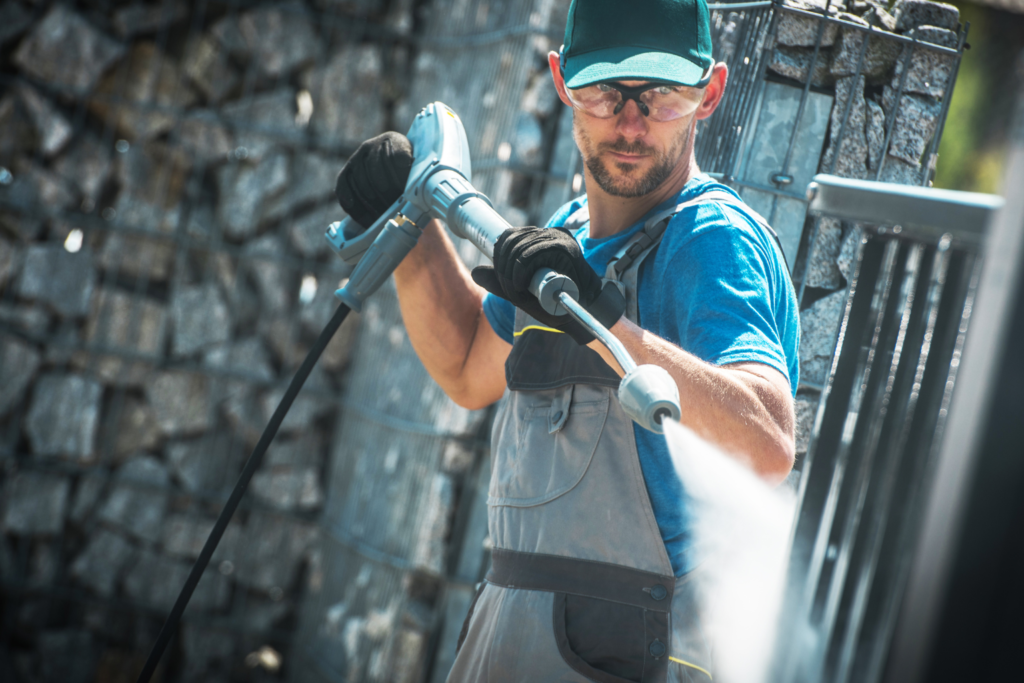
Realistically, a 230-gallon pressure washer with water tank gives you a solid 3-4 hours of working time for most mobile detailing jobs. That’s a full morning of revenue-generating work before you need to find a refill station.
For comparison, the 330-gallon unit stretches that to 5-6 hours, and the 460-gallon beast? You’re looking at a full 8-hour workday in most cases.
What Size Trailer Do I Need for a 460-Gallon Tank?
Size matters, especially when you’re hauling nearly 4,000 pounds of water plus equipment.
For our 460-gallon commercial power washer trailers, we exclusively use tandem axle trailers—that’s two sets of wheels for the uninitiated. Here’s why:
Weight distribution: Single-axle trailers get squirrely above 3,500 lbs. Tandem axles spread the load, giving you better highway stability and reducing wear on your truck.
DOT compliance: Many states have specific requirements for trailers over certain weights. Our rigs are built to be DOT compliant out of the box.
Longevity: Two axles mean half the stress on each tire and bearing. Your maintenance intervals get longer, and catastrophic failures get rarer.
The typical footprint for our 460-gallon setup is roughly 6 feet wide by 12-14 feet long. That’s small enough to fit in most storage units or garage bays, but substantial enough that people know you mean business.
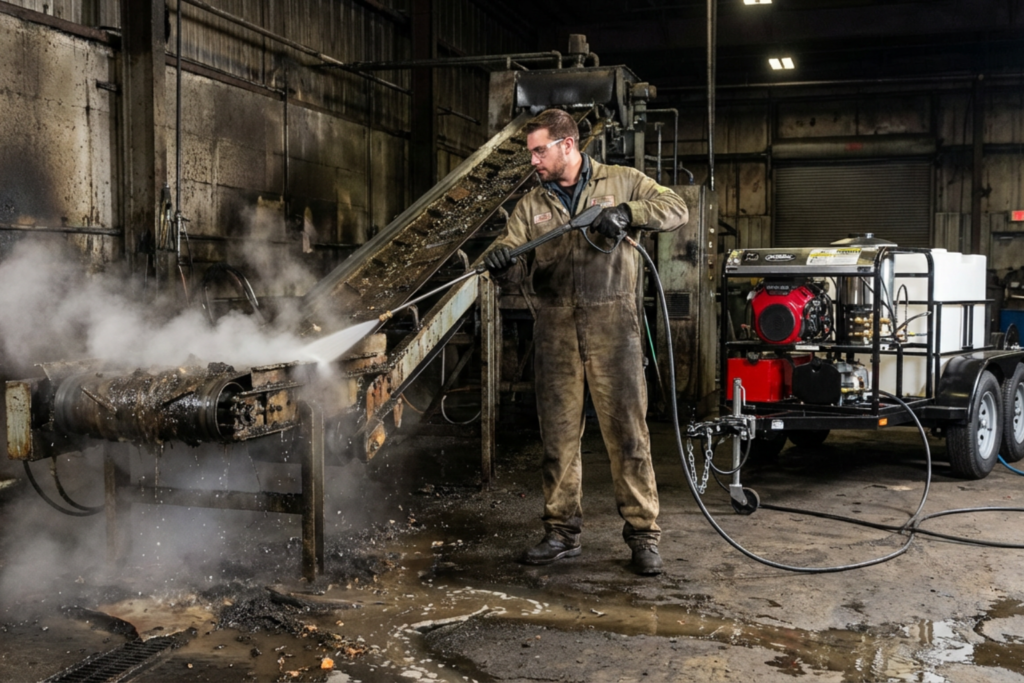
Trailer features we include as standard:
- Electric brakes on both axles (legally required in most states at this weight)
- DOT-rated lighting and safety chains
- Powder-coated steel frames that laugh at road salt and humidity
- Quick-connect couplers for fast hookup
- Built-in hose reels to keep your workspace organized
And yes, this entire setup ships FREE anywhere in the contiguous United States. More on that later.
The Technology Behind Professional Mobile Pressure Washing
Let’s geek out for a minute on what makes these systems actually work, because understanding your equipment makes you better at using it.
PSI and GPM: The Dynamic Duo
You’ll hear people obsess over PSI (pounds per square inch), and yeah, it matters. Higher PSI means more cleaning punch. But GPM (gallons per minute) is equally critical—it’s what actually rinses away the grime you’ve blasted loose.
Our units typically spec at 3000-4000 PSI with 3-4 GPM. That combination handles everything from delicate vehicle paint to industrial concrete, assuming you’re using the right nozzles.
Honda GX Series Engines
We don’t mess around with off-brand motors. Every unit we sell includes either a Honda GX Series or equivalent commercial-grade engine. Why? Because when you’re three hours into a fleet washing job and your engine decides to take a coffee break, you’re not making money.
The Honda GX390 is our workhorse—reliable, parts are everywhere, and any decent small engine shop can service it. It’s the Toyota Camry of pressure washer engines: maybe not glamorous, but it’ll still be running when the sun burns out.
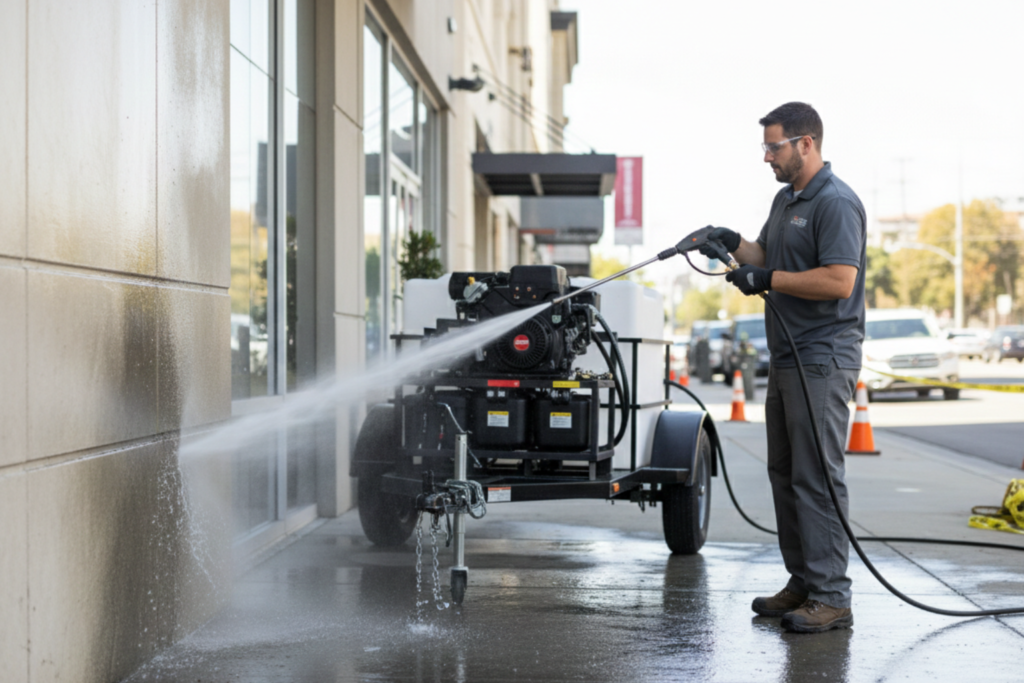
CAT Pumps and General Pumps
These are the premier pump manufacturers in the industry. We use them exclusively because they’re designed for commercial duty cycles. Consumer-grade pumps from the hardware store might last 100 hours. These? Try 2,000+ hours with proper maintenance.
The secret is in the materials—ceramic plungers, stainless steel valves, and better seals. Yes, they cost more upfront. No, you won’t regret it when you’re still using the same equipment three years later.
Polyethylene Tanks
All our water tanks are rotationally-molded polyethylene. This isn’t your garden-variety plastic—it’s UV-resistant, impact-resistant, and chemically stable. You can fill it with hot water (for heated pressure washing), mild cleaning solutions, or even slightly salty water in a pinch.
The tanks are also designed with baffles—internal walls that prevent water from sloshing around during transport. Trust us, you don’t want 460 gallons of water acting like a wave pool when you hit the brakes.
5 Industries That Must Have a Self-Contained Water Supply
Still wondering if a pressure washer with water tank is right for your business? Here are the industries where it’s basically non-negotiable:
1. Mobile Auto Detailing
This one’s obvious. The mobile detailing market is projected to grow at 10.2% annually through 2035, and every single successful operator we know uses a self-contained system. Your customers don’t hire mobile services because they have great water hookups—they hire you for convenience.
2. Construction and Site Cleanup
New construction sites often don’t have water service until late in the build process. But they accumulate dirt, concrete residue, and general grime from day one. A pressure washer with water tank lets you bid on cleanup contracts that your competition can’t even consider.
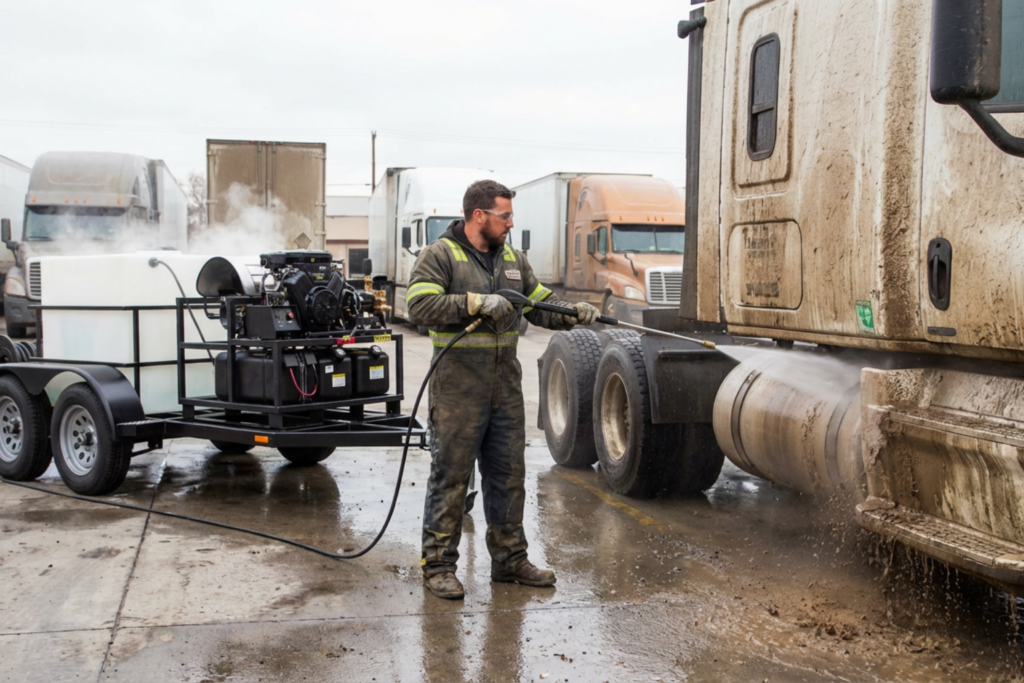
3. Fleet Washing Services
Whether it’s delivery trucks, rental cars, or municipal vehicles, fleet accounts are the bread and butter of professional washing services. Many fleet yards have limited water access or require you to work after hours. Self-contained systems let you work on your schedule, not theirs.
4. Agricultural Operations
Farms and ranches need regular equipment washing—tractors, livestock trailers, barn equipment. But running water to every work location isn’t practical. Our customers in the ag sector love the mobility our industrial power washer trailers provide.
5. Event and Festival Cleanup
Temporary events mean temporary infrastructure. Music festivals, fairs, and outdoor markets generate enormous cleanup needs but rarely have adequate water access. Smart cleaning contractors show up with self-contained rigs and charge premium rates.
Time is Money: The ROI of Mobile Cleaning Equipment
Let’s talk dollars and sense (see what we did there?). A complete pressure washer with water tank setup from us runs $8,000-$15,000, depending on size and features. That’s not chump change.
But consider this: The average mobile detailing operation charges $150-$300 per vehicle for full-service work. Fleet washing contracts? $50-$100 per truck, and you can knock out 20+ vehicles in a day with the right setup.
Do the math: Even at the conservative end, that’s $1,000+ revenue per day for fleet work. Work 20 days a month and you’ve paid off your equipment in three months. Everything after that is profit (minus your operating costs, obviously, but still).
More importantly, you can bid on jobs your competitors literally cannot do. When someone needs remote site cleaning, you’re not scrambling to figure out water logistics—you’re sending them a quote.
The hidden savings are equally real:
- No more turning down jobs because “there’s no water there”
- Reduced downtime from equipment failures (our commercial-grade stuff just works)
- Faster job completion with consistent water pressure
- Professional image that lets you charge premium rates
One of our customers in Arizona told us his income jumped 40% in the first year after switching from a consumer-grade setup to our 330-gallon commercial rig. Not because he worked more hours—because he could take jobs he previously couldn’t handle and finish existing jobs faster.
Maintenance Tips: Keeping Your Investment Running
Professional equipment deserves professional care. Here’s how to keep your pressure washer with water tank running like new:
Daily Maintenance
After each work session, run clean water through the system for 2-3 minutes. This flushes out soap residue and prevents pump seals from drying out. Also check your oil level—low oil is the number one killer of pressure washer engines.
Weekly Tasks
Inspect your high-pressure hoses for wear, especially near the couplings. Replace them at the first sign of cracking—a burst hose at 3000 PSI is not fun. Clean your intake filter and check for debris in your spray nozzles.
Monthly Duties
Change your engine oil (we recommend full synthetic for extended intervals). Lubricate your hose reel. Check trailer tire pressure and wheel bearings. Inspect the water tank for cracks or damage.
Winterization (Critical for Cold Climates)
If you’re in a freeze zone, this is non-negotiable. Here’s the process:
- Completely drain your water tank using the bottom drain valve
- Run antifreeze pump saver through your pressure washer pump
- Store the trailer in a covered area if possible
- Disconnect the battery and keep it on a trickle charger
Frozen water expands with about 10,000 PSI of force. Your polyethylene tank might survive; your pump absolutely will not. Don’t ask us how we know this.
Tank Cleaning
Every few months, drain your water tank and rinse it with a mild bleach solution (1 cup bleach per 50 gallons of water). This prevents algae growth and keeps your water fresh. Let it sit for 30 minutes, then flush thoroughly.
Why Universal Trailer and American Water Works?
Look, we could tell you we’re the best, but you’ve probably heard that from every company you’ve ever considered buying from. So here are the facts:
Turnkey solutions: Our industrial pressure cleaner trailers arrive ready to work. No assembly required, no hunting for missing parts, no “some assembly required” surprises. Hook it up, fill the tank, and start making money.
Professional-grade components: We don’t cut corners with consumer equipment. Honda engines, CAT Pumps, heavy-duty polyethylene tanks, powder-coated frames—every component is spec’d for commercial use.
Free US Shipping: Let’s be honest—shipping a 4,000-pound trailer isn’t cheap. We eat that cost because we want to make it easy for you to get started. Free shipping to all 48 contiguous states. Alaska and Hawaii, let’s talk.
Customization options: Need a different pump configuration? Want hot water capability? Prefer a specific trailer length? We build these to order, so tell us what you need.
Real support: When you call us, you talk to people who actually understand pressure washing equipment. We’re not just order-takers—we’re here to help you succeed.
Common Mistakes When Choosing a Mobile Pressure Washer
We’ve seen people make these errors enough times that we feel obligated to warn you:
Mistake #1: Buying based on PSI alone. A 4000 PSI unit with 2 GPM cleans worse than a 3000 PSI unit with 4 GPM in most real-world scenarios. Balance both metrics.
Mistake #2: Undersizing the tank. “I’ll just refill more often” sounds reasonable until you’re driving across town three times a day to fill up. Buy bigger than you think you need.
Mistake #3: Skimping on the trailer. A quality trailer costs more upfront but saves you thousands in repairs and downtime. Single-axle trailers over 3,500 lbs are asking for trouble.
Mistake #4: Ignoring your towing capacity. Check your truck’s actual towing capacity (not the marketing number). Account for the full weight of water, equipment, and trailer. Overloading is illegal and dangerous.
Mistake #5: Forgetting about storage. Where are you keeping this thing? Make sure you have adequate space before you order a 14-foot trailer.
Ready to Bring the Water With You?
The mobile cleaning industry is booming, with growth projections that would make any investor jealous. But growth means nothing if you can’t actually service your customers. A pressure washer with water tank isn’t just equipment—it’s your ticket to jobs you couldn’t touch before and efficiency gains that directly impact your bottom line.
We’ve built our reputation on providing turnkey mobile cleaning solutions that work right out of the box. Whether you need a nimble 230-gallon pressure washing rig for residential mobile detailing or a beast-mode 460-gallon custom pressure washer trailer, we’ve got you covered.
And did we mention? Free US Shipping on every unit. No hidden fees, no surprise freight charges. What you see is what you pay.
Browse our complete selection of pressure washer trailers at https://www.pressurewashertrailers.com/shop/ or give us a call. We’re here to help you build a business, not just sell you equipment.
Because at the end of the day, the best pressure washer with water tank is the one that’s actually making you money. Let’s make that happen.
Frequently Asked Questions
Do these trailers come with hose reels?
Yes, all our units include commercial-grade hose reels with 50+ feet of high-pressure hose.
Is the shipping really free to any state?
Free shipping to all 48 contiguous United States. Alaska and Hawaii require special arrangements.
Can I mix chemicals directly in the water tank?
No. Use the built-in soap injector system instead. Mixing chemicals in the tank can damage seals.
What kind of maintenance is required?
Daily flush, weekly inspections, monthly oil changes. About the same as any commercial engine.
Do I need a special driver's license?
No. A standard driver’s license is fine as long as you stay under your vehicle’s towing capacity.
How do I refill the water tank on location?
Use any standard garden hose connection. Most gas stations allow this for a small fee.
What's the warranty coverage?
Honda engines carry a 3-year commercial warranty. Pumps are typically 1-2 years. Trailers are 1 year.
Can I upgrade to hot water later?
Yes, though it’s easier and cheaper to spec it initially. Contact us for retrofit options.
Disclaimer: Equipment specifications and performance capabilities may vary based on specific configurations and operating conditions. Professional consultation is recommended for custom applications and specialized requirements. Regulatory compliance requirements vary by location and application – consult local authorities for specific permit and operational requirements.