
Here’s the truth nobody tells you when you’re staring down a procurement spreadsheet: most pressure washers on the market were never built to survive a city. They were built to survive a driveway.
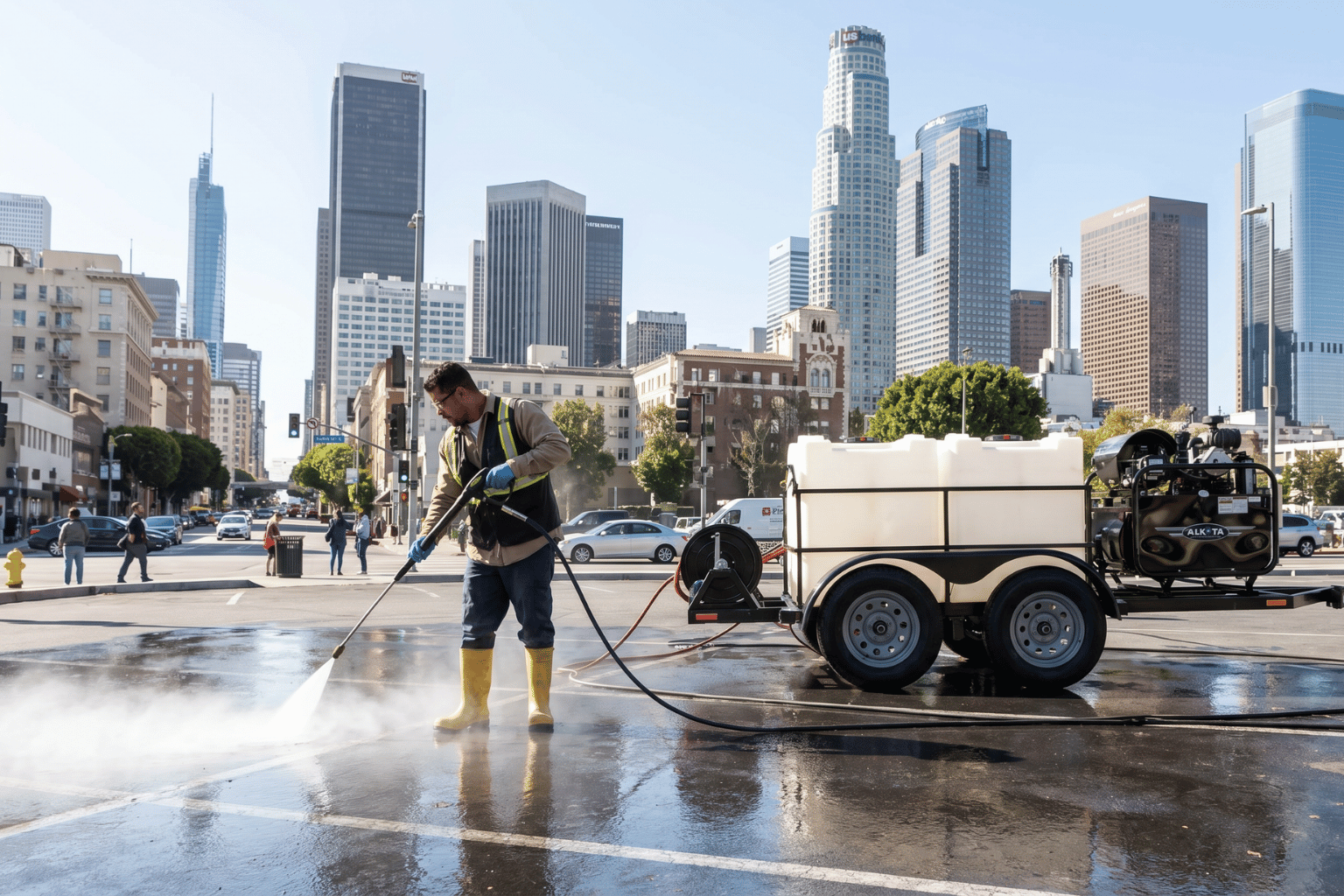
Municipal work is a different animal. You’ve got graffiti crews rolling out at 5 AM, transit depots that need a full bus fleet degreased before rush hour, and public works teams chasing decade-old gum stains off a plaza that never stops seeing foot traffic. None of that happens with a big-box store rental. It happens with municipal pressure washing equipment engineered for continuous, multi-shift, multi-department abuse — and built to survive it.
We build those machines. At Universal Trailer and American Water Works, we’ve spent years engineering turnkey and custom mobile wash systems specifically for public works departments, fleet managers, and facilities superintendents who can’t afford downtime and can’t afford a compliance violation either. This guide walks through exactly what separates real municipal-grade equipment from everything else, and how to buy the right rig the first time.
TABLE OF CONTENTS
What Is Municipal Pressure Washing Equipment?
Municipal pressure washing equipment isn’t a category defined by horsepower alone. It’s defined by duty cycle. A consumer-grade washer is built to run for an hour on a Saturday. A true municipal asset is built to run eight, ten, twelve hours a day, five or six days a week, for years, without the frame cracking or the pump seizing.
That threshold shows up in the engineering details. We’re talking heavy-gauge steel framing that can absorb the vibration of a diesel engine running continuously without fatiguing at the welds. We’re talking chemical-resistant subcomponents that won’t corrode after months of exposure to degreasers, graffiti removers, and roadway salts. We’re talking industrial triplex pumps — not the axial pumps you’d find in a homeowner unit — because triplex pumps are designed for continuous-duty cycles and won’t overheat after twenty minutes of trigger time.
Then there’s the water side. Continuous-duty hot water burners that can run all shift without cycling down, paired with high-capacity tanks so crews aren’t hunting for a hydrant every twenty minutes. When we spec municipal pressure washing equipment, we’re not asking “can this clean a sidewalk.” We’re asking “can this clean sidewalks, buses, and lift stations for the next decade without a mid-life rebuild.”
What Can Municipal Pressure Washers Clean?
This is where municipal-grade equipment earns its keep — versatility across departments that have almost nothing in common except a need for clean.
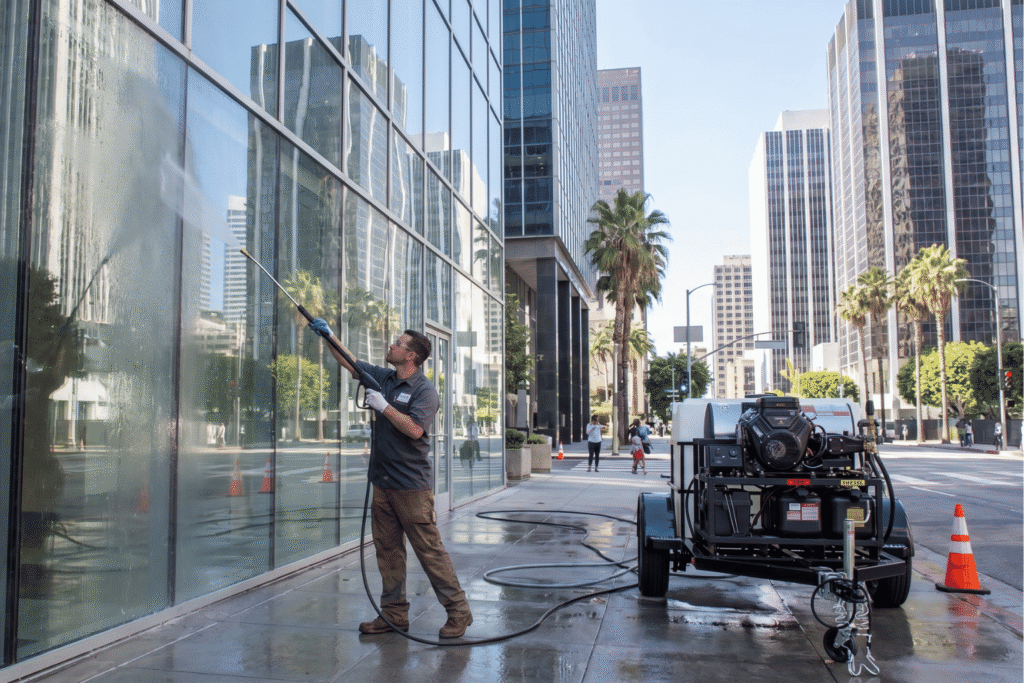
Graffiti Abatement. Aerosol paint and oil-based tags don’t come off historic brick, concrete walls, or traffic signs with brute force. It takes precise thermal control to vaporize the paint layer without damaging what’s underneath — especially on protected or historic surfaces where one wrong pass means a restoration bill nobody budgeted for.
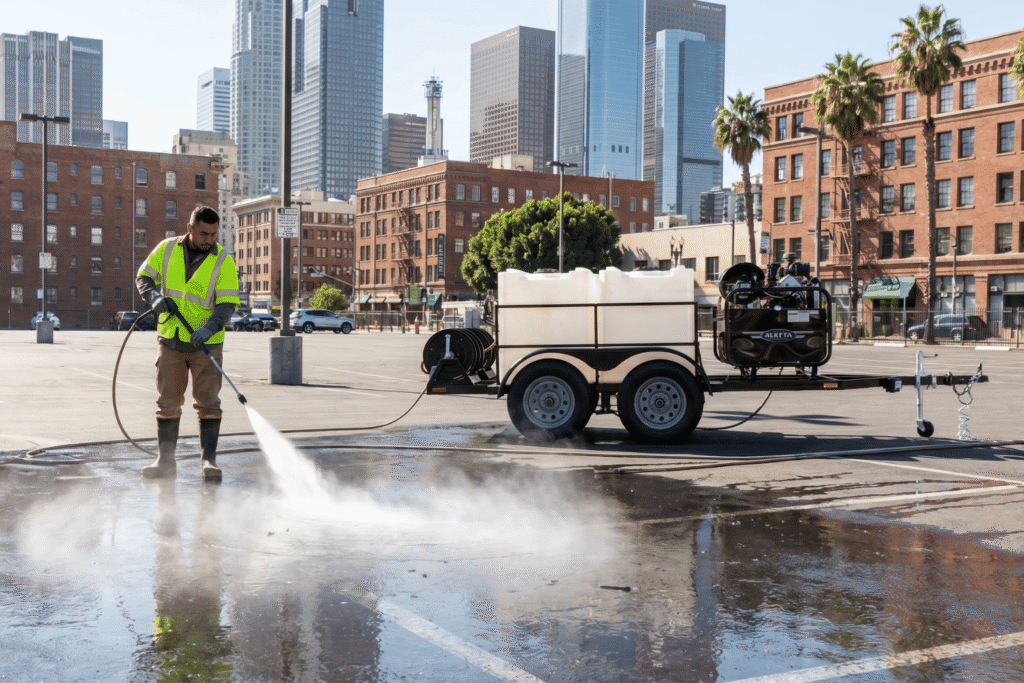
Sidewalk & Public Square Sanitation. High foot traffic means embedded gum, grease trails from food carts, and biological waste that’s had time to bond with the concrete. This is a GPM problem more than a PSI problem, and we’ll get into why in a minute.
Transit & Fleet Decontamination. Buses, waste management trucks, police cruisers, yellow iron — all of it collects road grime, brake dust, and diesel soot that needs to come off fast if a fleet is going to stay on schedule.
Monuments & Historic Restorations. Statues, marble, and historic brickwork call for the opposite of brute force. Low-pressure, high-temperature micro-stripping techniques lift grime without eroding stone that’s been standing for a century.
Wastewater Facility & Lift Station Cleaning. Dried sludge, grease buildup, and industrial scale on municipal infrastructure assets need serious thermal output paired with flow volume most consumer machines simply don’t have.
One well-specced trailer can realistically move between all five of these jobs across a single week, which is exactly why departments increasingly share equipment budgets instead of buying isolated units for each division.
Choosing the Right Pressure Washer for Your Municipality
Not every department needs the same rig, and matching the machine to the environment matters more than most procurement officers realize going in. The right choice comes down to fuel type, engine configuration, noise tolerance, and how the equipment will actually move through a shift. Here’s how we break it down department by department.
Gasoline-Powered Systems
Gasoline-powered units offer rapid mobility and the lowest upfront cost of entry. They’re lighter, they start easily even in cold weather, and they’re a strong fit for parks departments or smaller facilities crews that need to move fast between short jobs without worrying about diesel exhaust regulations or extended warm-up times. Gas engines also tend to be easier to service locally, since parts and mechanics are more widely available than for diesel or specialty platforms. The tradeoff is fuel economy over long runtimes — a gas engine working a full eight-hour shift will burn through more fuel per gallon of water moved than a comparable diesel unit, which matters when a department is running equipment daily rather than occasionally.
Liquid-Cooled Diesel Systems
Liquid-cooled diesel systems are the better call for departments running longer shifts or working in dense urban centers, especially at night. Diesel engines run quieter and with more low-end torque, which matters when your graffiti crew is working a downtown corridor at 4 AM and the last thing anyone wants is a noise complaint from residents. Diesel also delivers meaningfully better fuel economy over long runtimes, which adds up fast across a fiscal year when equipment is logging hundreds of operational hours. These systems tend to carry a higher upfront cost, but for public works and transit divisions running near-daily shifts, the total cost of ownership usually favors diesel within the first couple of years.
Dual-Fuel and Hybrid Configurations
Some municipal applications call for flexibility that a single fuel source can’t offer. Dual-fuel systems — often pairing a diesel burner for hot water generation with a separate power source for the pump — give departments the ability to run hot water cleaning cycles without tying the whole system to one fuel type. This configuration shows up most often in water and sanitation facility work, where high thermal output needs to run continuously alongside high flow rates, and equipment downtime for refueling simply isn’t an option during a lift station descaling job.
Cold Water vs. Hot Water Platforms
Fuel type isn’t the only decision — thermal capability matters just as much. Cold water systems are lighter, cheaper, and sufficient for basic rinsing tasks like general facility washdowns or light dust removal. But most municipal applications involve grease, oil, diesel soot, or petroleum-based graffiti that cold water simply can’t break down efficiently. Hot water platforms with continuous-duty burners cost more upfront but cut cleaning time dramatically on anything involving embedded grime, and they pay for themselves quickly in reduced labor hours once a department is running regular fleet or public works cleaning.
Noise Considerations for Urban and Nighttime Work
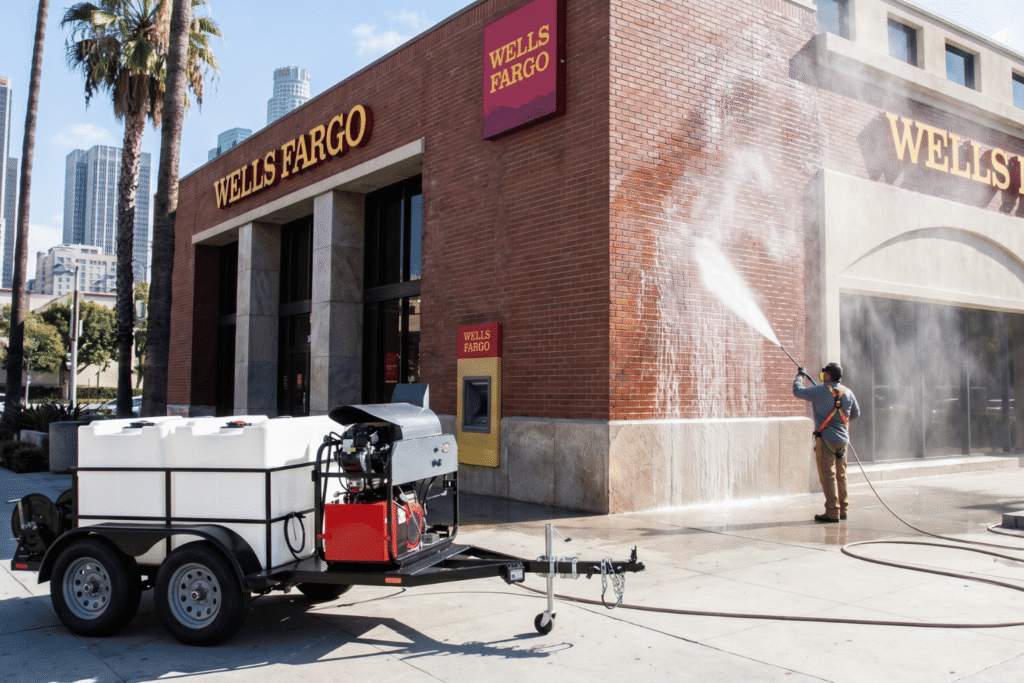
Noise ordinances are an underrated procurement factor. Downtown corridors, residential-adjacent public works zones, and overnight graffiti abatement schedules all put a premium on low-decibel operation. Liquid-cooled diesel engines are the quietest heavy-duty option available, running at lower RPMs than comparable gas units while still delivering the torque needed for continuous-duty cycles. Departments that skip this consideration often end up with noise complaints that restrict their operating hours, effectively shrinking the usable window for equipment they already paid for.
Matching Fuel Type to Department Workload
The honest answer is that most well-run municipalities end up with a mixed fleet rather than standardizing on one fuel type across every department:
- Parks & Recreation — gasoline units for quick-turnaround, lower-intensity jobs like playground and facility washdowns.
- Public Works / Streets — diesel units for extended shifts, nighttime graffiti work, and heavy concrete restoration.
- Fleet & Transit Maintenance — high-GPM gas or diesel units depending on shift length, prioritized for flow volume over fuel efficiency.
- Water & Sanitation Facilities — dual-fuel or hot water diesel platforms built for continuous thermal output during descaling and industrial cleaning cycles.
It’s not about picking a single winner across the whole fleet. It’s about matching the fuel and thermal profile to how each machine will actually be used, and then budgeting departments accordingly instead of forcing a one-size-fits-all purchase across divisions with very different operational demands.
How Much PSI and GPM Does a City Actually Need?
This is the single most misunderstood spec in municipal procurement, and it costs cities real money when they get it wrong.
PSI (pounds per square inch) breaks the initial bond between a contaminant and a surface. That’s it. GPM (gallons per minute) is what actually flushes the contaminant away and dictates how fast a job gets done. A machine with sky-high PSI and weak GPM will hit a stain hard, break it loose, and then take forever to rinse it clear — burning labor hours the whole time.
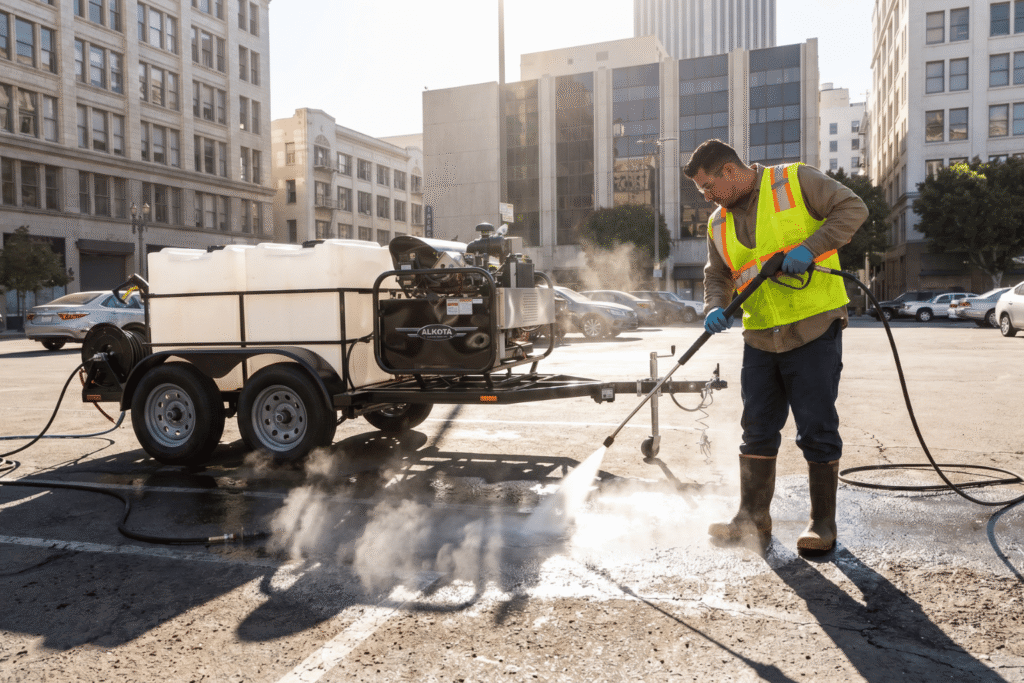
For most municipal applications, the sweet spot is around 3,500 PSI paired with 5 to 8 GPM Pressure washer. That combination delivers enough force to break surface bonds on grease, grime, and graffiti residue, while the higher flow rate clears the job fast. Push PSI too far past that range and you start doing damage instead of cleaning — spalling city concrete, stripping the reflective coating off highway signage, or etching stone on historic structures that can never be undone.
If there’s one number worth memorizing before a procurement meeting, it’s this: GPM is what saves labor hours. PSI is what breaks the bond. Cities that overbuy PSI and underbuy GPM end up with equipment that looks powerful on a spec sheet and performs poorly in the field.
Water Recovery Requirements for Municipal Cleaning
Here’s the part of procurement that isn’t optional, no matter what budget line it falls under.
Municipal cleaning operations fall under real legal scrutiny when it comes to where wastewater ends up. Wash runoff carries oil, grease, heavy metals, and chemical residue — and letting that runoff flow into a storm drain isn’t a gray area. It’s a violation.
Integrated vacuum recovery systems solve this at the source. These systems capture wash wastewater directly at the surface level as it’s generated, routing it through multi-stage filtration loops before it ever has a chance to reach a storm drain. This isn’t an accessory upgrade — for most departments, it’s the difference between a compliant operation and a state environmental fine that dwarfs the cost of the equipment itself.
Any municipal pressure washing equipment purchase that skips water recovery provisions is a purchase that’s setting a department up for a compliance problem down the road, not a purchase that’s saving money.
Bestselling Configurations: Real-World Equipment Spotlights
These are three configurations we build regularly for municipal clients, each solving a slightly different operational need.
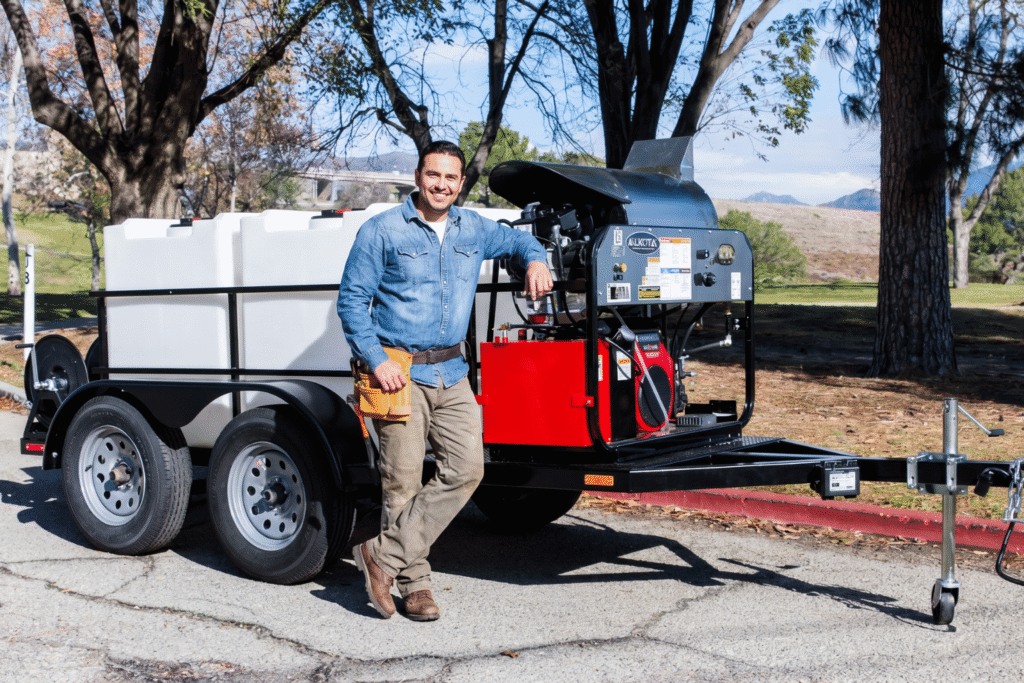
California-Compliant Hot Water Pressure Washer Trailer with 460 Gallon Tank – Tandem Axle, 4.7 GPM, 3500 PSI, Kubota Z602 Diesel Engine. Our California-Compliant Hot Water Trailer pairs a 460-gallon water tank with a Kubota Z602 diesel engine, giving departments a low-emission, heavy-duty platform built for urban operations where noise and emissions regulations are strict. This is the rig we recommend for overnight graffiti abatement work and downtown corridor maintenance where quiet, clean-running equipment isn’t optional.
Hot Water Pressure Washer Trailer with 460 Gallon Tank – Tandem Axle, 8 GPM 3500 PSI, 18HP Honda GX690 Engine. For transit and fleet maintenance divisions moving through buses, waste trucks, and heavy equipment on a tight schedule, our Hot Water Trailer with a 460-gallon tank and an 18HP Honda GX690 engine delivers the flow volume needed for rapid sidewalk rinsing and heavy grease cutting without slowing the shift down.
Hot Water Pressure Washer Trailer with 330 Gallon Tank – Tandem Axle, 5 GPM 3500 PSI, 18HP Vanguard Gas Engine. Our Hot Water Trailer with a 330-gallon tank and an 18HP Vanguard gas engine is the workhorse configuration for general public works deployment — versatile enough to handle the bulk of everyday municipal cleaning without the premium cost of a full diesel platform.
You can review full specs on all three configurations directly at https://www.pressurewashertrailers.com/shop/ .
Best Municipal Pressure Washing Equipment for Different Departments
Different departments, different budgets, different operational demands. Here’s how we typically align rig configurations across a municipal fleet:
City Department | Primary Application | Recommended Rig Setup | Core Operational Benefit |
Parks & Recreation | Playground sanitation, facility cleaning, sidewalk washdowns | 330-Gallon Tank / 5 GPM Vanguard Gas Setup | Compact footprint, easily towed by half-ton utility trucks |
Public Works / Streets | Massive concrete restoration, graffiti removal, gum abatement | 460-Gallon Tank / 4.7 GPM Kubota Diesel Setup | CARB-compliant, ultra-quiet for night shifts, max water runtime |
Fleet & Transit Maintenance | Bus depots, waste truck degreasing, yellow iron cleaning | 460-Gallon Tank / 8 GPM Honda GX690 Setup | Extreme GPM water volume for ultra-fast rinse cycles on massive vehicles |
Water & Sanitation Facilities | Lift station descaling, processing plant sanitation | 330-Gallon Tank / 8 GPM Kärcher Dual-Fuel Setup | High thermal output combined with high flow to cut through industrial grease |
This kind of department-by-department matrix is exactly what we walk procurement officers through before a purchase — because the “best” configuration is never universal. It’s whatever matches the workload.
Municipal Pressure Washer Accessories Worth Buying
The base rig gets you most of the way there. The right accessories close the gap on efficiency and safety.
Heavy-Duty Flat Surface Cleaners. Stainless steel whirl-a-ways deliver uniform, streak-free sidewalk cleaning up to four times faster than a standard wand — a serious labor-hour savings on large plaza or sidewalk jobs.
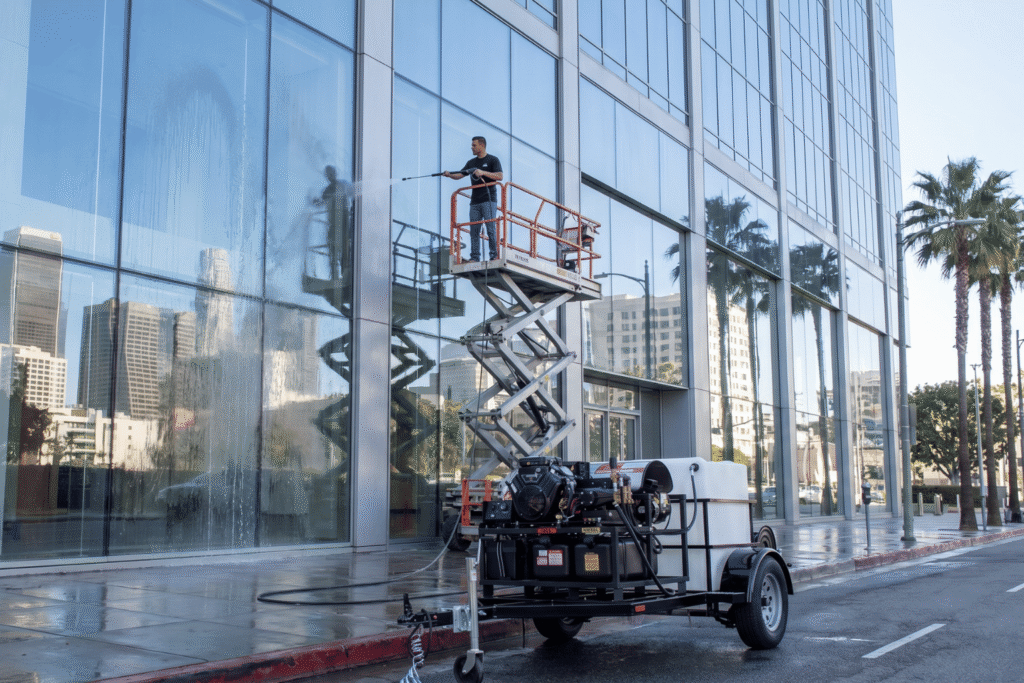
Telescoping Extension Wands. Fiber-reinforced or carbon fiber poles let crews reach bridges, signage, and building facades from ground level, eliminating the need to deploy a ladder or bucket truck for jobs that don’t warrant one.
Duct and Pipe Cleaning Jettors. Specialized self-propelling nozzles handle clogged municipal culverts, drains, and small-diameter sewer linkages — turning a single trailer into a multi-purpose infrastructure maintenance tool.
Downstream Chemical Injectors. Adjustable injector systems let crews meter degreasers, graffiti removers, or sanitizing agents directly into the water stream at the correct dilution ratio, cutting chemical waste and making sure every job gets consistent coverage instead of guesswork.
Surface Cleaner Casters and Skid Guards. Reinforced caster wheels and protective skid plates on flat surface cleaners prevent scarring on decorative pavers, stamped concrete, and painted curb lines — a small add-on that saves a city from an expensive resurfacing bill.
Hose Reels with Auto-Retract. Powered or spring-assisted reels for both high-pressure hose and chemical lines keep crews from dragging, kinking, or tripping over loose hose across job sites, and they cut setup and breakdown time between stops.
Undercarriage and Wheel Well Wands. Angled, low-profile wands built specifically for blasting brake dust, road salt, and packed grime out of undercarriages and wheel wells — essential for fleet and transit divisions running daily bus and truck washdowns.
Insulated Hose Guards. Heat-rated sleeves and guards for hot water lines protect crew members from accidental burns during high-temperature graffiti or grease-cutting work, an easy win for department safety compliance.
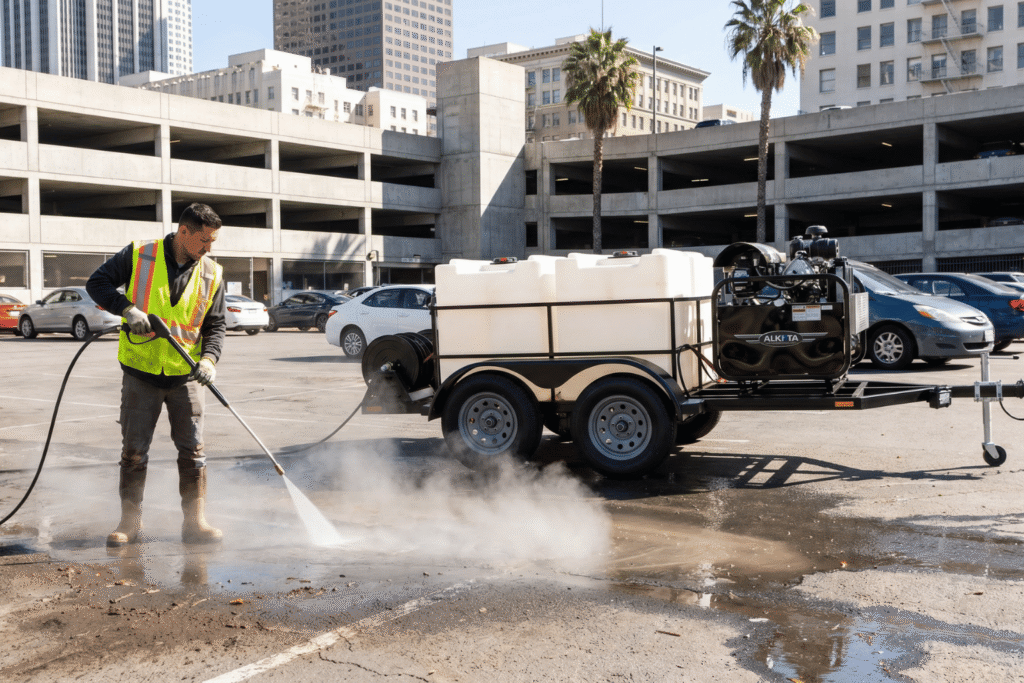
Trailer-Mounted LED Work Light Kits. Weatherproof LED light bars mounted to the trailer frame extend safe working hours into early morning or overnight shifts — a must for public works crews handling graffiti abatement before sunrise to avoid disrupting daytime foot traffic.
None of these accessories are flashy. They’re the difference between a crew finishing a job in two hours instead of five.
Common Mistakes Cities Make When Buying Pressure Washing Equipment
We see the same procurement mistakes repeat across municipalities, year after year. Here’s what to avoid.
Buying too much PSI. Extreme 5,000+ PSI units feel powerful on paper but pit, score, and permanently degrade public asphalt, concrete, and historic masonry over time.
Ignoring GPM. Under-specifying flow rate results in painfully slow rinse cycles that quietly burn through city labor hours on jobs that should be quick.
No water recovery provision. Skipping surface vacuum recovery leaves a city exposed to serious environmental fines the moment wastewater reaches a public waterway.
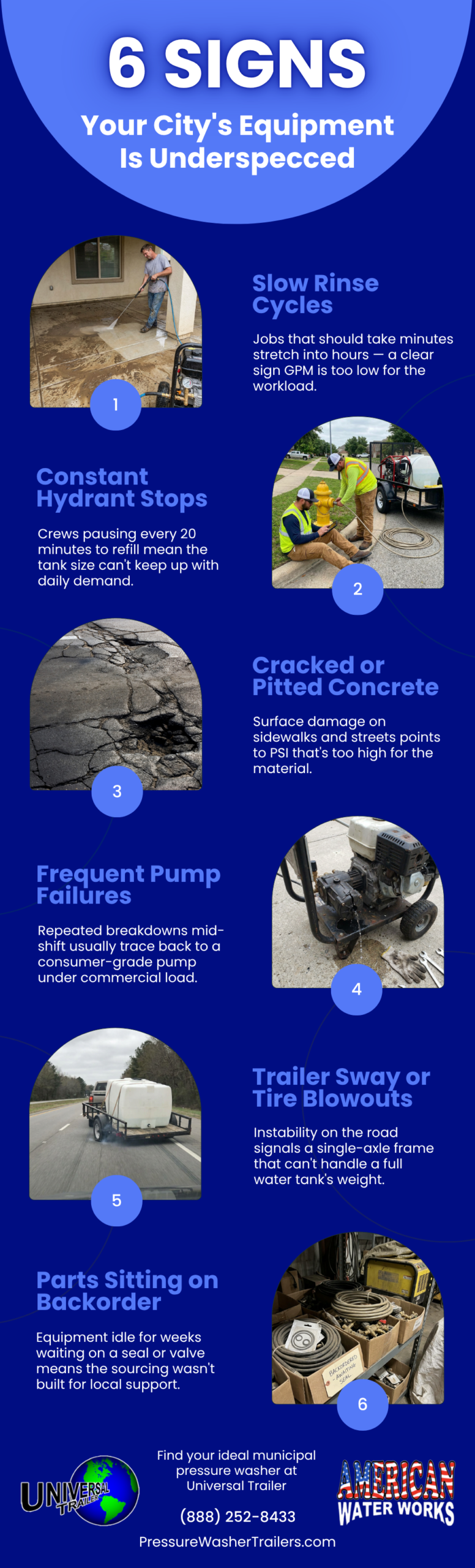
Poor trailer design. Cheap, single-axle utility frames bend, sway, and blow tires prematurely under the shifting weight of a full water tank.
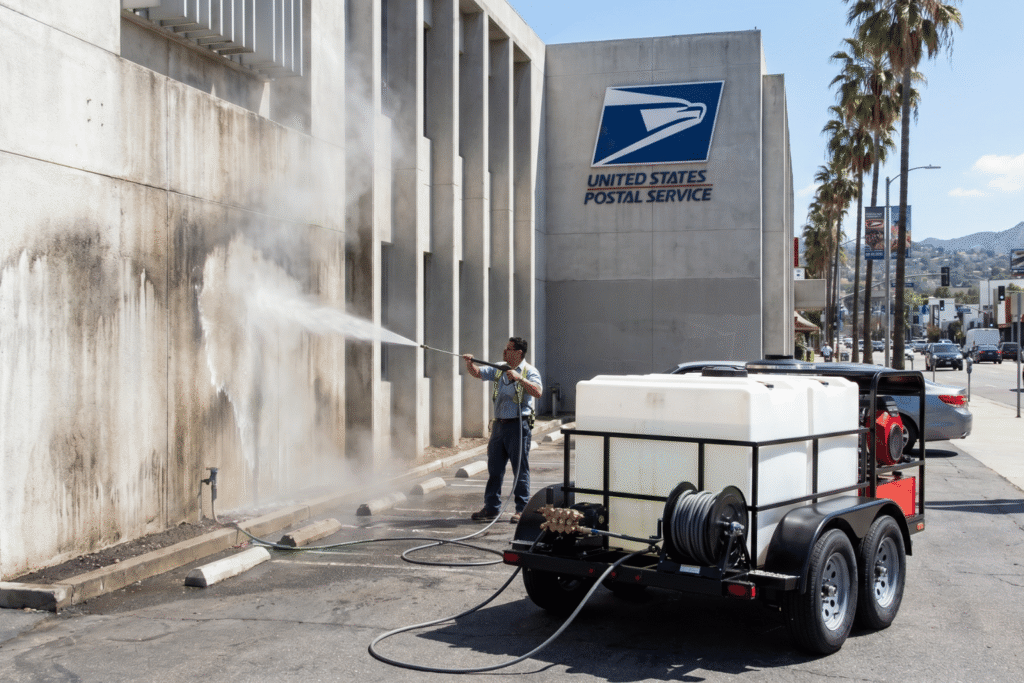
Undersized water tanks. Small 100–200 gallon tanks force crews to stop and hunt for a fire hydrant every twenty minutes, killing productivity.
Cheap, consumer-grade pumps. Lower-tier axial pumps fail fast under prolonged, multi-shift municipal workloads that a triplex pump would handle without issue.
Ignoring local parts availability. Obscure import equipment sits sidelined in maintenance yards for months waiting on a basic replacement seal or valve — a downtime cost most departments never factor into the purchase price.
Every one of these mistakes is avoidable with the right upfront spec work, which is exactly the conversation we have with every municipal client before a build.
Why Buy Municipal Pressure Washing Equipment at Universal Trailer and American Water Works
Municipal procurement doesn’t get a redo. When a public works department commits budget to a piece of equipment, that machine needs to run for years across multiple crews, multiple applications, and every kind of weather a fiscal year can throw at it. That’s the standard we build to, and it’s the reason municipalities keep coming back to us instead of shopping big-box rental fleets or overseas import platforms.
We engineer for duty cycle, not just spec sheets. A lot of manufacturers will sell you a machine based on peak PSI numbers because that’s what looks impressive on paper. We build around what actually holds up under continuous, multi-shift municipal use — heavy-gauge steel framing, industrial triplex pumps, and tandem-axle trailers rated to carry a full water tank without premature tire wear or frame fatigue. If a rig can’t survive a decade of real public works duty, we don’t build it that way in the first place.
We understand compliance because we build for it. Water recovery isn’t an afterthought we bolt on when a customer asks. Our systems are engineered with EPA stormwater compliance and Clean Water Act requirements in mind from the start, because we know a municipality can’t afford a state fine over an equipment purchase that skipped the right filtration setup. When you buy from us, compliance is part of the engineering conversation, not a line item you have to chase down separately.
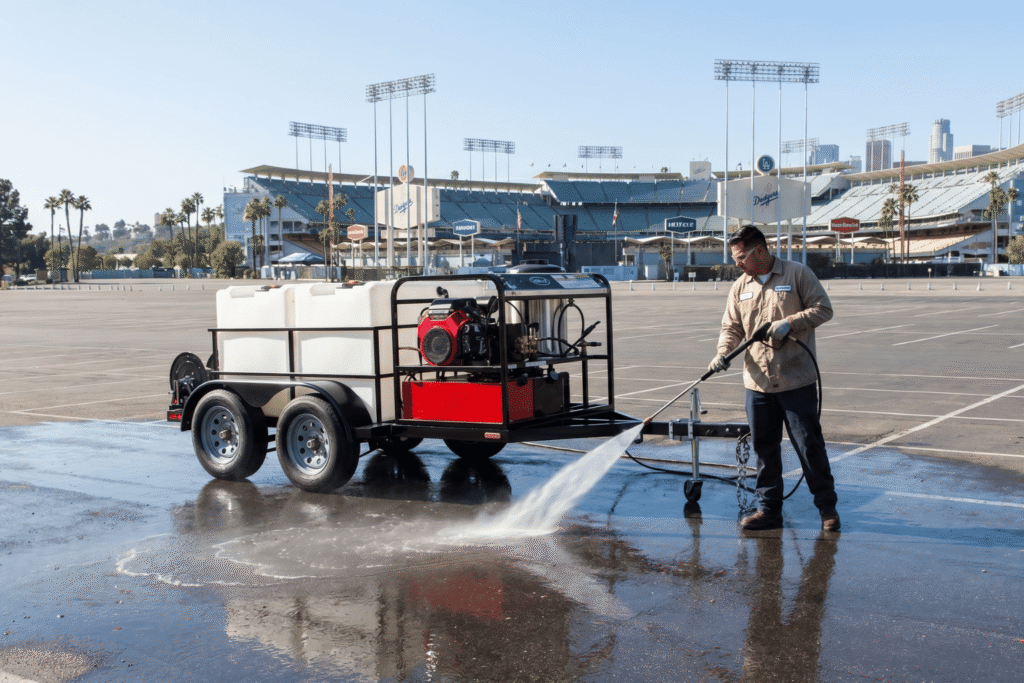
We build department-specific configurations, not one-size-fits-all units. Every rig on our shop floor can be configured around the actual workload it’s going to face— California-compliant pressure washer trailers for overnight graffiti crews, high-GPM Honda-powered rigs for fleet and transit divisions, dual-fuel setups for water and sanitation facilities. We’d rather walk a procurement officer through a real matrix of options than sell a generic unit that’s wrong for half the departments trying to use it.
We keep parts and support domestic and accessible. One of the most common mistakes we see cities make is buying obscure imported equipment that sits idle in a maintenance yard for months waiting on a replacement seal. Our platforms are built around commercial-grade components — Kubota, Honda, Vanguard, Kärcher — with parts availability that keeps downtime measured in days, not months.
We’re a single point of accountability. From the initial spec conversation through delivery and ongoing support, you’re working with the people who actually engineered the rig — not a reseller relaying questions to a manufacturer three time zones away. If something needs adjusting six months into service, we’re the ones you call.
Municipal budgets are public money, and every purchase gets scrutinized. We’d rather help a city land on the right rig the first time than sell an oversized, underspecced, or noncompliant unit that turns into next year’s procurement headache. If your department is ready to evaluate municipal pressure washing equipment, reach out to us at pressurewashertrailers.com — we’ll walk through your department’s workload and get you into a configuration built to actually last.
We’ve built these systems for public works departments that don’t get a second chance when equipment fails mid-shift. If your city is evaluating municipal pressure washing equipment, we’re happy to walk through department-specific configurations and help you land on a rig that actually fits your workload — not just your budget line. Reach out through pressurewashertrailers.com.
Frequently Asked Questions
What PSI is best for municipalities?
For general municipal infrastructure maintenance, a range of 3,000 to 3,500 PSI is ideal because it provides sufficient impact pressure to break surface bonds without risking structural degradation or spalling to city concrete and public stonework.
Is hot water worth it for municipal pressure washing?
Yes, hot water burner systems are essential for municipal applications because thermal energy is required to effectively melt and emulsify oil stains, engine grease, diesel exhaust soot, and petroleum-based graffiti, which cold water systems cannot efficiently dissolve.
How much water does a municipal pressure washer use?
A commercial-grade municipal pressure washer typically consumes between 4 to 8 Gallons Per Minute (GPM), translating to roughly 240 to 480 gallons of water per hour of continuous trigger engagement.
Do municipalities legally need water recovery systems?
Yes, under Section 402 of the Clean Water Act and local National Pollutant Discharge Elimination System (NPDES) mandates, municipalities must use water recovery systems to capture wash runoff and prevent polluted, untreated water from draining into public stormwater networks.
Can one pressure washer trailer serve multiple city departments?
Absolutely. A self-contained, tandem-axle hot water trailer outfitted with a balanced 3,500 PSI and 5 to 8 GPM pump configuration possesses the modular versatility to handle parks sanitation, public works graffiti removal, and transit fleet washing within a single asset lifecycle.
What pump design is most reliable for heavy municipal workloads?
The industrial triplex plunger pump featuring solid ceramic plungers, forged brass manifolds, and integrated thermal protection valves is the most reliable configuration for prolonged, multi-shift municipal operations.
What engine lasts the longest on a municipal wash rig?
Liquid-cooled, multi-cylinder clean diesel engines, such as Kubota, deliver the longest operational lifespan due to their rugged structural design, lower operating RPMs, high fuel economy, and exceptional thermal efficiency compared to traditional air-cooled gasoline engines.
How often should municipal pressure washing equipment be serviced?
Municipal pressure washers should undergo pump and engine oil changes every 100 operational hours, alongside daily pre-shift checks of water inlet filters, inline structural screens, high-pressure hose structural integrity, and unloader valve operations.
Can municipal pressure washers remove chewing gum from sidewalks?
Yes, chewing gum is easily dissolved using a high-pressure hot water setup operating at 200°F to 212°F with low impact pressure, which quickly softens the gum’s synthetic polymers, allowing it to lift cleanly off concrete without damaging the pavement surface.
What is the best trailer configuration size for a city fleet?
The optimal municipal platform is a heavy-duty tandem-axle trailer, minimum 7,000 to 10,000 lbs GVWR, equipped with electric brakes and supporting either a centralized 330-gallon or 460-gallon baffled water tank to ensure balanced weight distribution and safe highway transport.
Disclaimer: Equipment specifications and performance capabilities may vary based on specific configurations and operating conditions. Professional consultation is recommended for custom applications and specialized requirements. Regulatory compliance requirements vary by location and application – consult local authorities for specific permit and operational requirements.