
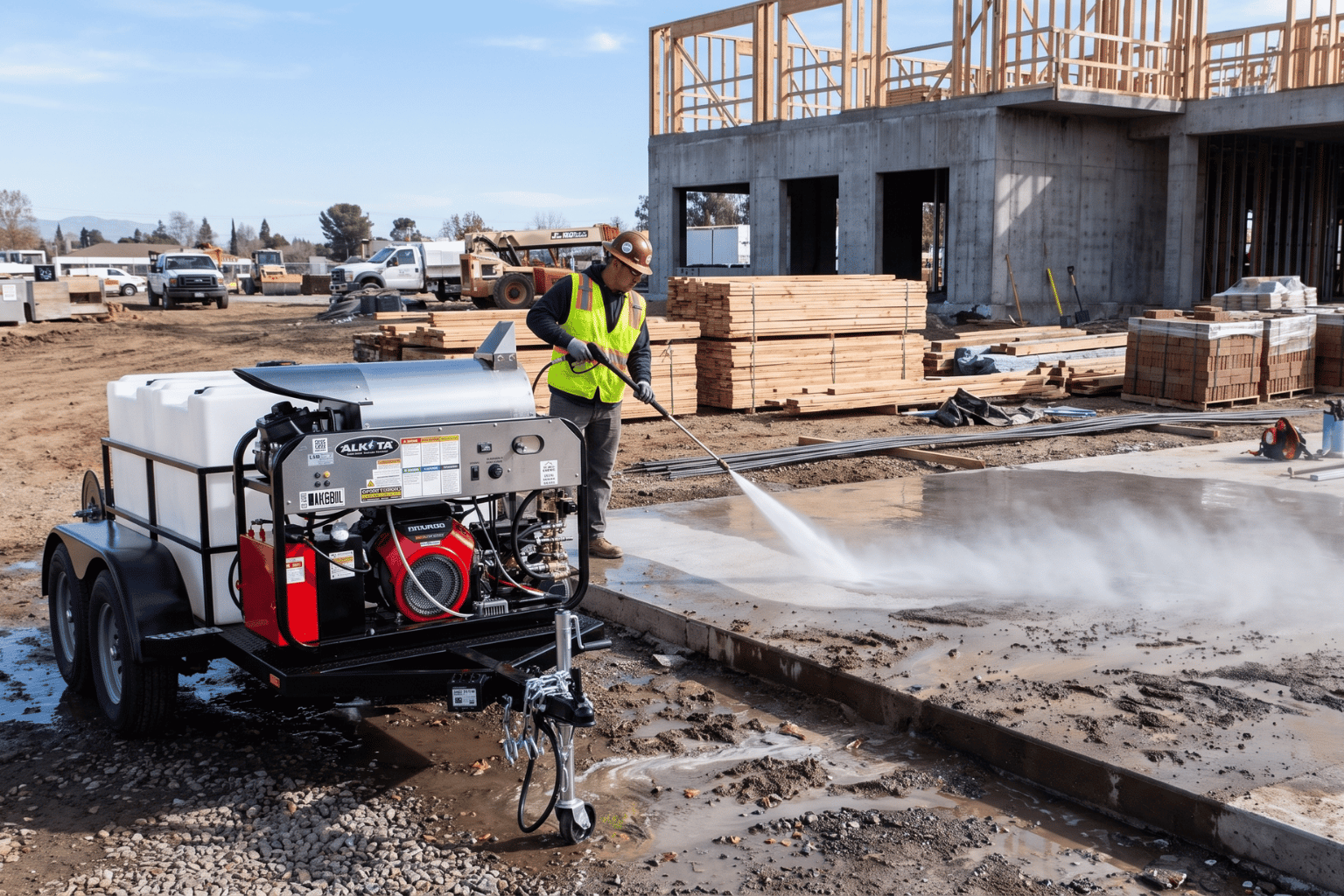
A dependable construction site pressure washer helps your crew remove mud, concrete residue, grease, oil, dust, and jobsite grime before they slow down your operation. From cleaning excavators and loaders to preparing concrete surfaces and washing fleet vehicles, the right commercial pressure washer can reduce manual labor, protect valuable equipment, and help maintain a safer, more professional work environment.
Universal Trailer and American Water Works provide heavy-duty pressure washing equipment for contractors, construction companies, equipment operators, property developers, municipalities, and industrial cleaning professionals. Our mobile pressure washer trailers can be configured with powerful hot-water machines, large water tanks, hose reels, toolboxes, and practical jobsite accessories.
Instead of transporting equipment, hoses, and tanks separately, you can arrive with a complete mobile cleaning system ready for work. Our experienced team can help you choose a pressure washer and trailer configuration that matches your typical surfaces, equipment, water access, towing capacity, and cleaning schedule.
Shop construction site pressure washers or contact Universal Trailer and American Water Works to discuss a custom pressure washer trailer.
Free nationwide shipping is available.
TABLE OF CONTENTS
A Mobile Cleaning Solution for Construction Sites
Construction work produces some of the most difficult cleaning conditions. Heavy equipment moves through wet soil. Concrete splashes onto tools and machinery. Hydraulic fluid, grease, fuel, asphalt, and road film collect on working surfaces. Dust settles on vehicles, buildings, and finished materials.
A household power washer is not designed for this environment. Construction crews need commercial equipment capable of working reliably under demanding conditions.
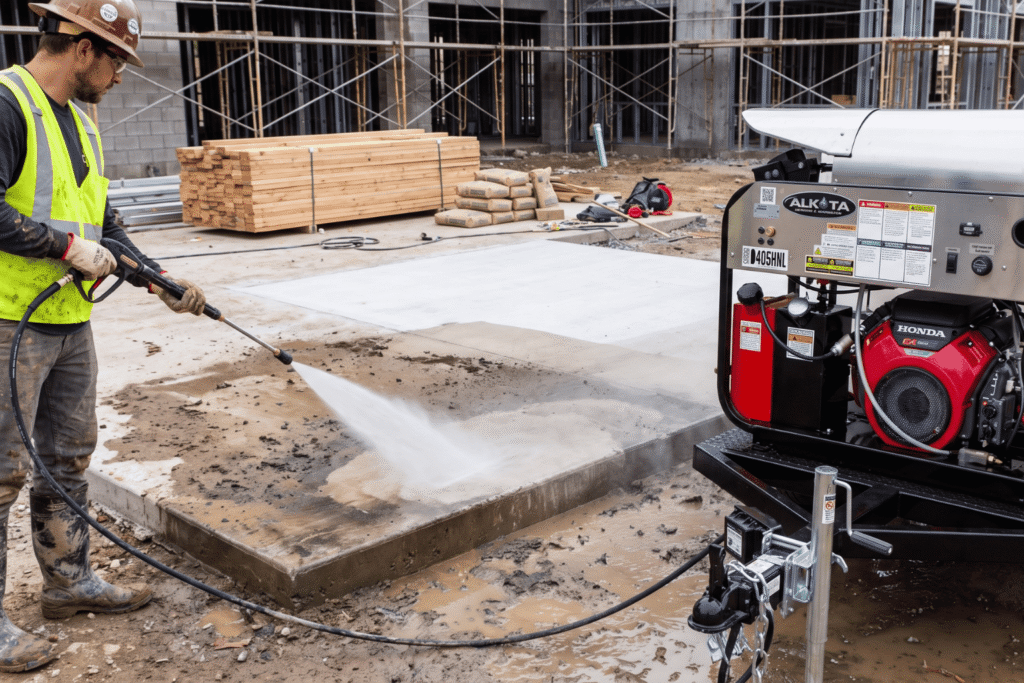
A professional construction site pressure washer can be used to clean:
- Excavators, backhoes, and bulldozers
- Skid steers and compact track loaders
- Wheel loaders and graders
- Dump trucks and concrete trucks
- Cranes and lifting equipment
- Pavers and asphalt equipment
- Concrete forms and reusable panels
- Scaffolding and jobsite barriers
- Construction trailers and storage containers
- Work trucks, vans, and fleet vehicles
- Tools and equipment attachments
- Shop floors and maintenance areas
- Parking structures and loading areas
- Sidewalks, curbs, and exterior surfaces
- Machinery before inspection or maintenance
- Finished areas before project turnover
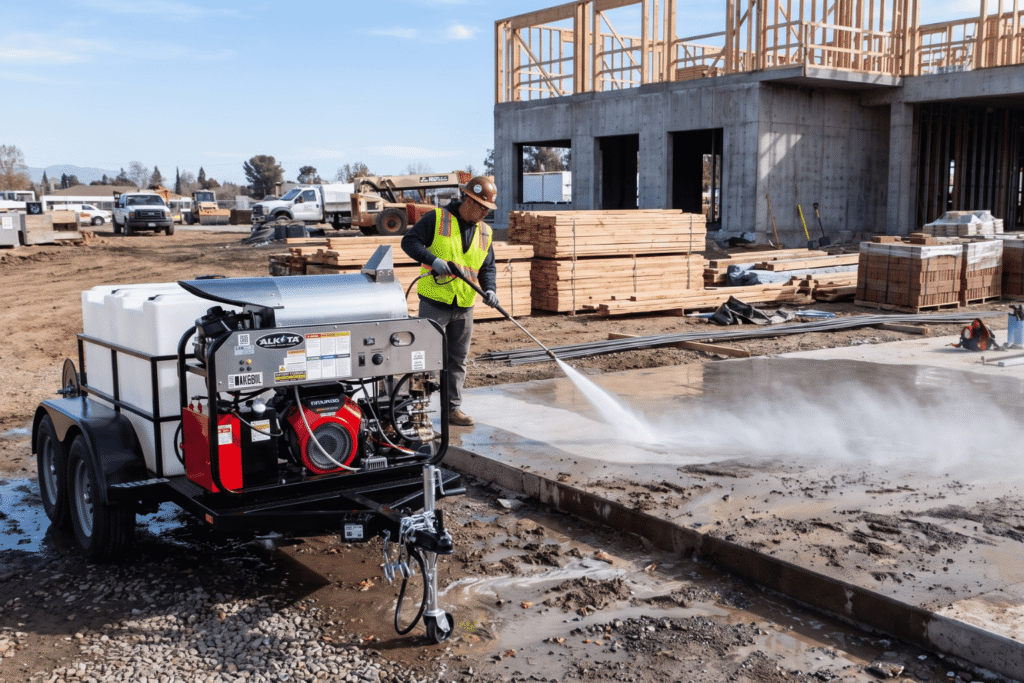
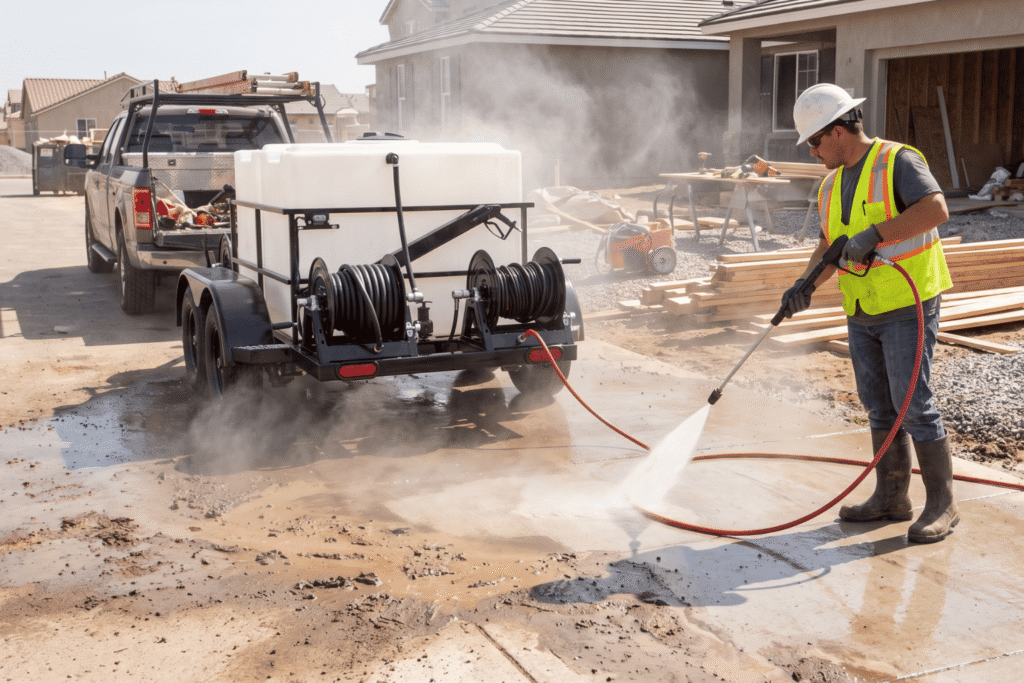
A trailer-mounted system gives crews the ability to move the cleaning equipment from one project to another. When the unit includes an onboard water tank, cleaning can also take place in locations where a convenient pressurized water connection is unavailable.
Why Construction Companies Need Commercial Pressure Washing Equipment
Mud and dirt are more than cosmetic problems. Heavy buildup can hide leaks, loose connections, damaged hoses, cracked components, and other maintenance concerns. It can also make daily inspections more difficult.
Regular pressure washing helps expose equipment surfaces so mechanics and operators can inspect them more effectively. Cleaning before service work also gives technicians a clearer, more manageable area in which to work.
A commercial construction site pressure washer can help your company:
Reduce Time Spent on Manual Cleaning
Scraping and scrubbing construction equipment by hand can consume hours of labor. High-pressure water removes loose dirt and buildup more quickly. Hot water can further accelerate the removal of grease, oil, and stubborn residue.
Maintain Valuable Equipment
Dirt, mud, salts, and chemicals can accumulate around frames, undercarriages, wheels, tracks, and working components. A consistent washing process helps remove contaminants before they remain on equipment for extended periods.
Pressure washing does not replace manufacturer-recommended maintenance, but it can make routine inspections and service easier.
Improve Your Professional Image
Clean equipment communicates organization and attention to detail. This matters when your machinery is visible to customers, inspectors, developers, general contractors, and members of the public.
A clean fleet also helps branded trucks and equipment present your company more professionally as they travel between projects.
Prepare Equipment for Maintenance
Mechanics should not have to dig through layers of mud and grease before reaching the component that needs service. Washing equipment before maintenance can improve visibility and make the service area easier to access.
Support Safer Jobsite Practices
Excessive mud, oil, and residue can contribute to slippery working surfaces. Cleaning high-traffic areas and equipment access points may help reduce avoidable buildup.
Every site still requires an appropriate safety plan. Crews must use suitable personal protective equipment, follow equipment instructions, control overspray, and comply with local wastewater requirements.
Keep Cleaning Equipment Ready to Move
A trailer-mounted system stores the washer, tank, hoses, and accessories together. Your crew does not need to assemble a temporary cleaning setup every time the company starts a new project.
Why Choose a Pressure Washer Trailer?
Portability is one of the greatest advantages of a pressure washer trailer. Construction projects change locations, water access varies, and equipment may need cleaning in a yard one day and at a remote site the next.
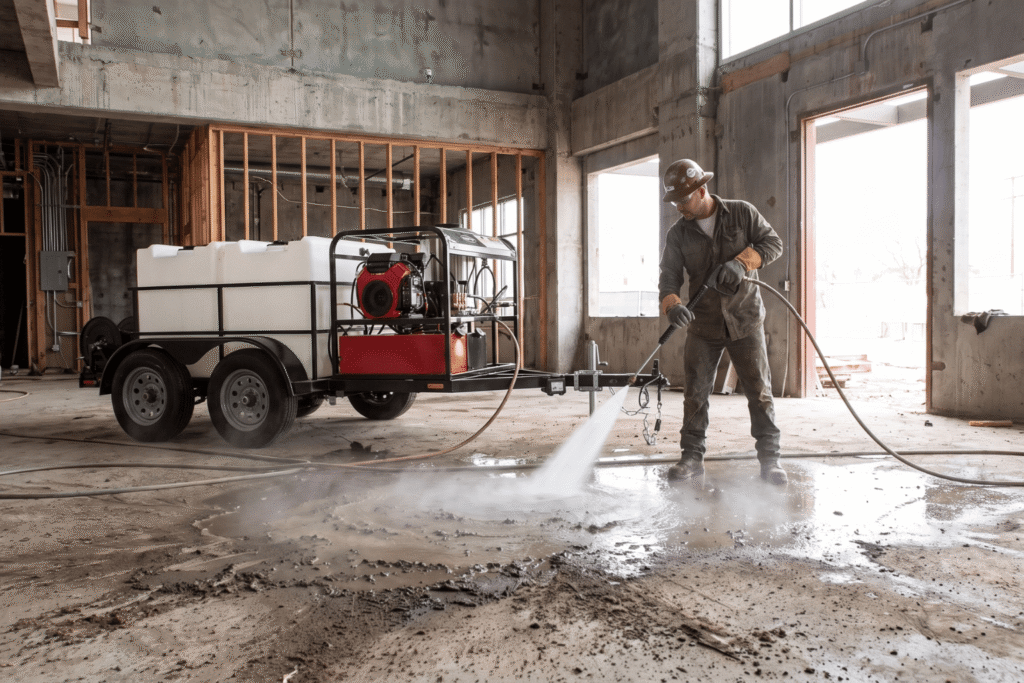
A properly configured trailer turns multiple components into a unified mobile cleaning station.
Depending on the selected configuration, a pressure washer trailer may include:
- A commercial hot-water or cold-water pressure washer
- A single-axle or double-axle trailer
- An onboard water tank
- High-pressure and water-supply hose reels
- High-pressure hose
- Inlet water hose
- Water filtration
- A gun and wand holder
- Electric brakes on applicable trailer models
- A heavy-duty jack
- Storage or toolboxes
- Surface-cleaning accessories
- Detergent or chemical application equipment
- Custom colors and other available options
Universal Trailer builds mobile systems for the practical needs of commercial users. The goal is not simply to place a machine on a trailer. The goal is to create a working layout that makes filling, towing, operating, draining, storing, and maintaining the system more convenient.
Explore our available pressure washers and trailer configurations.
Hot-Water Pressure Washers for Heavy Equipment and Grease
Water pressure is important, but pressure alone does not determine cleaning effectiveness. Temperature and water flow also matter.
A hot-water construction site pressure washer is especially useful when crews need to remove:
- Grease
- Oil
- Hydraulic fluid residue
- Diesel film
- Road grime
- Clay and compacted mud
- Equipment exhaust deposits
- Organic material
- Certain adhesives and construction residue
- Oily buildup on shop floors
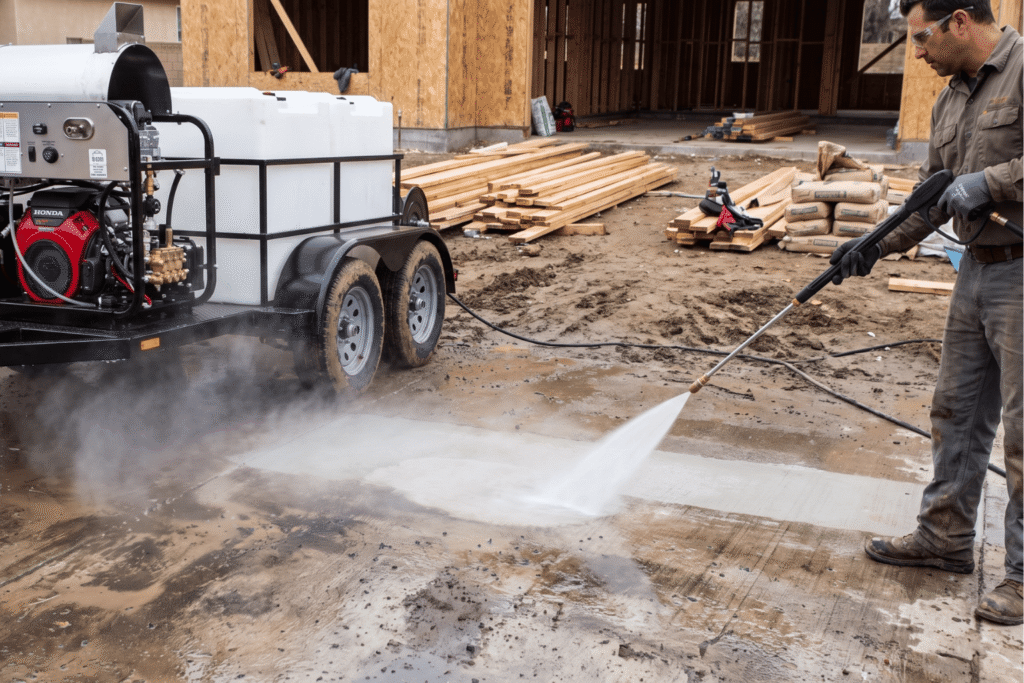
Hot water can help loosen oily contaminants and reduce the amount of time required to clean heavily soiled equipment. It is often the preferred choice for equipment yards, fleet maintenance operations, paving companies, concrete contractors, and industrial service providers.
Available systems include models with adjustable temperature controls, commercial pumps, steel frames, electric-start engines, fuel tanks, burner systems, and other heavy-duty components. Specifications vary by model, so buyers should select equipment according to the actual work they intend to perform.
Understanding PSI and GPM For Construction Jobs
Two specifications appear frequently when comparing commercial pressure washers: PSI and GPM.
PSI, or pounds per square inch, describes water pressure. Higher pressure can increase the system’s ability to break material away from a surface.
GPM, or gallons per minute, describes water flow. Greater flow helps move loosened dirt and rinse large surfaces efficiently.
Construction buyers sometimes focus only on PSI. That can lead to choosing a machine with substantial pressure but insufficient rinsing capacity for large equipment. For many commercial applications, strong water flow is just as important as pressure.
The best PSI and GPM combination depends on:
- The material being cleaned
- The size of the equipment
- How often cleaning will occur
- Whether hot water is needed
- The available water supply
- The number of operators
- Required hose length
- Surface sensitivity
- Daily operating time
Some commercial systems listed by Universal Trailer provide configurations such as 5 GPM at 3,500 PSI or 8 GPM pressure washer at 3,500 PSI. Other available model-dependent configurations can reach higher flow or pressure ratings. Always confirm the current specifications of the exact machine before purchasing.
Our team can help you compare the cleaning impact of different combinations rather than choosing a construction site pressure washer from one number alone.
Water Tank Capacity for Remote Construction Sites
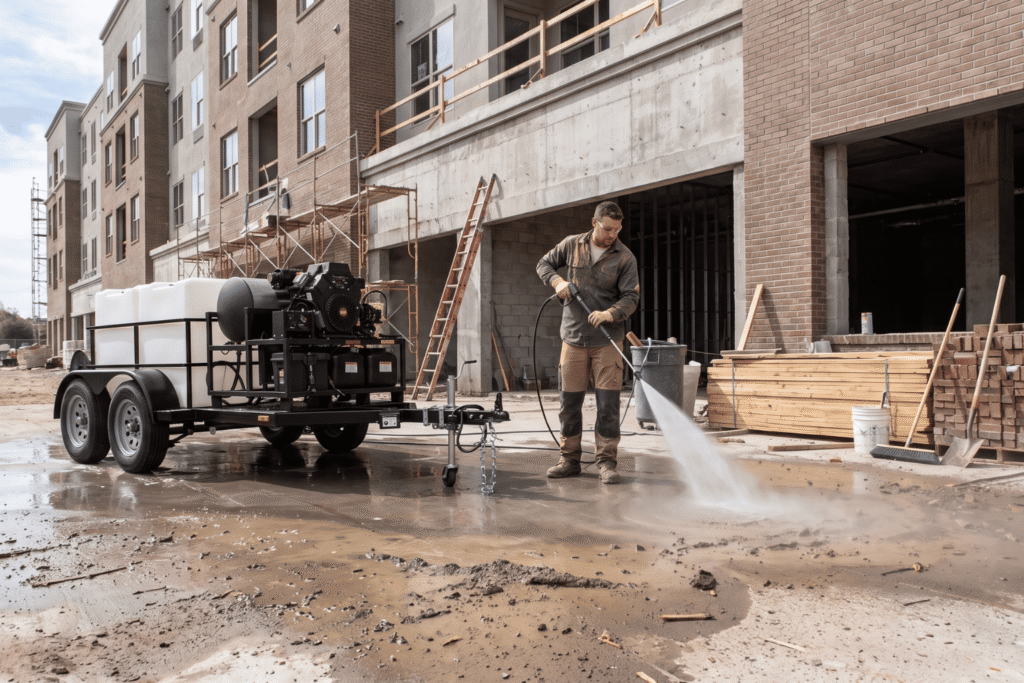
A water tank provides flexibility when cleaning away from a reliable water connection. However, tank size must be considered together with the pressure washer’s flow rate.
A machine rated at 5 GPM could theoretically consume approximately 300 gallons during one hour of continuous trigger time. Actual usage varies because operators release the trigger, reposition equipment, apply detergent, and complete other tasks during the cleaning process.
To estimate the approximate continuous operating time available from a tank, divide usable tank capacity by the machine’s GPM rating.
For example:
- A 230-gallon tank paired with a 5 GPM machine provides approximately 46 minutes of theoretical continuous trigger time.
- A 330-gallon tank paired with a 5 GPM machine provides approximately 66 minutes.
- A 460-gallon tank paired with a 5 GPM machine provides approximately 92 minutes.
These are planning estimates, not guarantees. Usable capacity, operating conditions, plumbing, refill strategy, and actual trigger time affect real-world performance.
Remember that water is heavy. One U.S. gallon weighs approximately 8.34 pounds before adding the weight of the tank, trailer, pressure washer, fuel, hoses, tools, and accessories. The tow vehicle, hitch, axles, tires, braking system, and overall trailer configuration must be appropriate for the fully loaded system.
Universal Trailer and American Water Works can help you evaluate tank capacity as part of the complete mobile cleaning package.
Construction Site Pressure Washer Applications
Heavy Equipment Washing
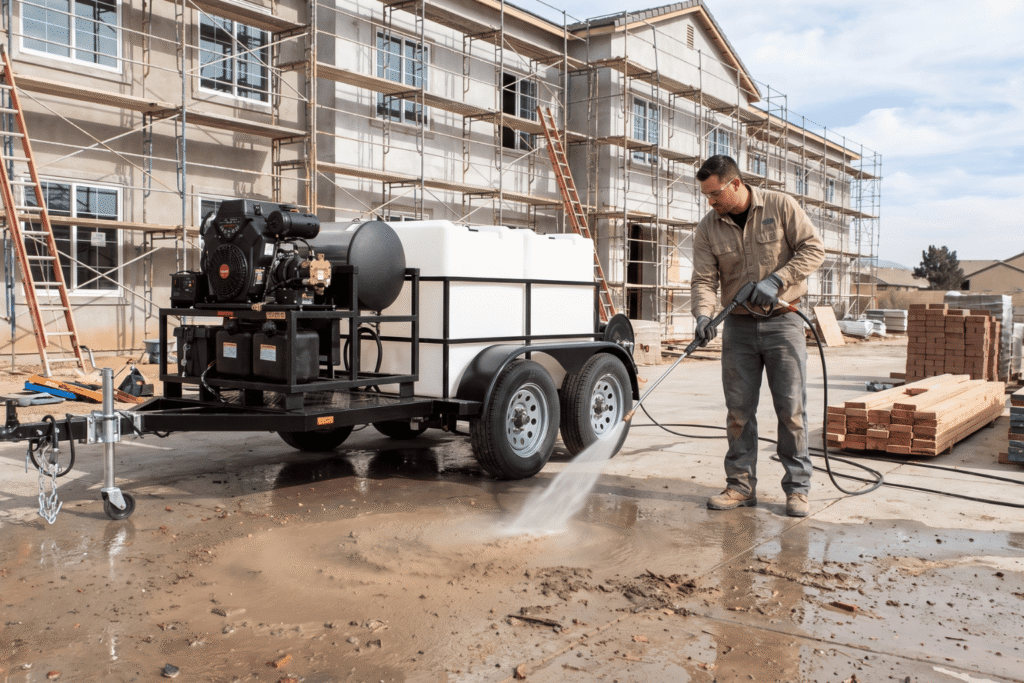
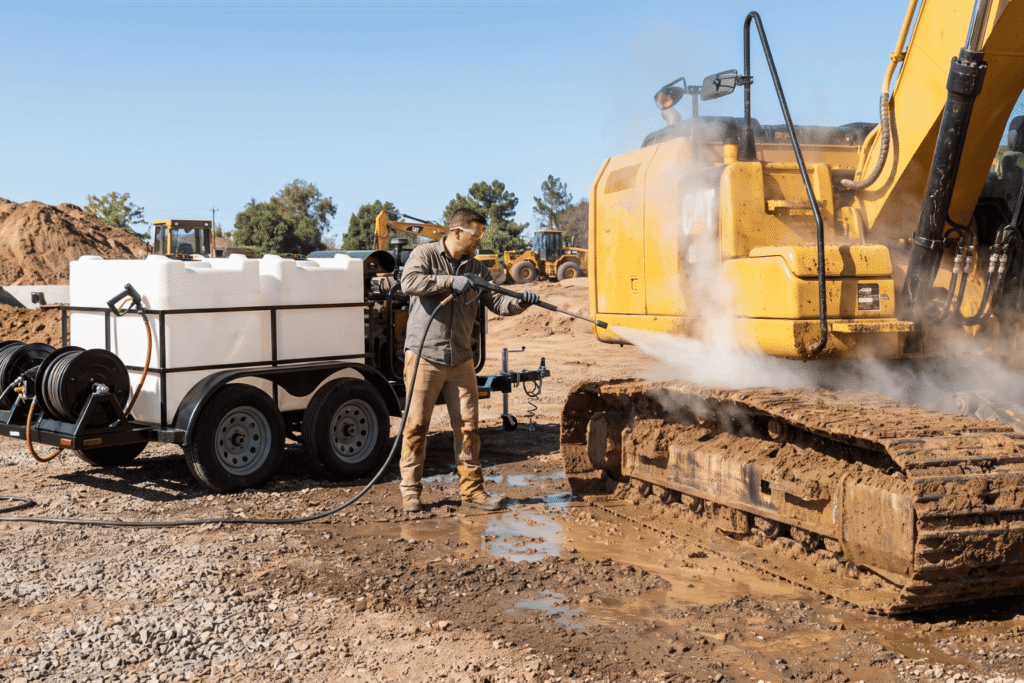
Mud can pack tightly around tracks, wheels, frames, steps, and undercarriages. A commercial pressure washer gives operators the pressure and flow needed to remove heavy deposits more efficiently than an ordinary garden hose.
Hot water is useful when the equipment also carries grease, hydraulic residue, and oily film.
Concrete Equipment Cleanup
Concrete contractors understand how quickly cementitious material can harden on tools and machinery. Prompt washing can help remove fresh material from suitable surfaces before it cures.
Pressure washing must be completed carefully. Operators should avoid directing high-pressure spray at electrical components, bearings, seals, control panels, sensitive finishes, and other vulnerable areas. Hardened concrete may require specialized methods beyond pressure washing.
Fleet and Truck Cleaning
Dump trucks, pickups, service trucks, trailers, and other fleet vehicles collect mud and road grime while moving between construction sites. A mobile system can support scheduled fleet washing at the yard or on the jobsite.
Using appropriate pressure, distance, nozzles, and detergents helps protect decals, paint, lights, seals, and other vehicle components.
Surface Preparation
Pressure washing can remove loose dirt and contaminants before certain coating, sealing, painting, or repair processes. The required preparation standard depends on the surface and the coating manufacturer’s instructions.
The surface must be allowed to dry appropriately, and pressure washing should not be treated as a substitute for specialized preparation when grinding, blasting, etching, or another process is required.
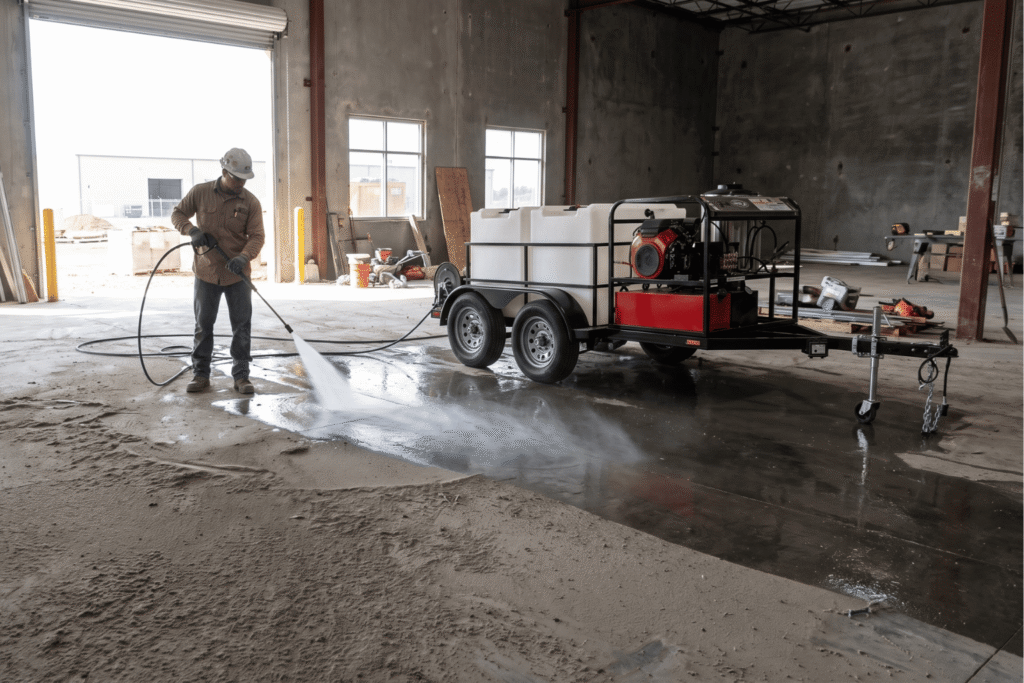
Final Project Cleanup
Exterior concrete, parking areas, curbs, walls, equipment pads, and loading zones may require cleaning before a project is delivered to the owner. A commercial pressure washer can help crews address broad areas efficiently.
Operators should first identify delicate surfaces and test the cleaning method in a less visible location.
Equipment Rental Operations
Rental equipment must often be cleaned, inspected, and prepared for the next customer. A dependable pressure washer can help rental yards maintain a repeatable turnaround process for loaders, lifts, compactors, excavators, generators, and attachments.
Municipal and Public Works Projects
Public works crews may use mobile pressure washing systems for equipment, vehicles, maintenance yards, sidewalks, and infrastructure projects. Trailer portability makes it possible to move the cleaning station according to the day’s assignment.
Industrial and Specialty Contracting
Oilfield service companies, mining operations, railroad contractors, agricultural contractors, paving companies, and industrial maintenance providers face many of the same cleaning challenges as construction companies. Mobile hot-water equipment can be configured for these demanding environments.
Important Features to Compare
Choosing the right construction site pressure washer involves more than selecting the highest advertised pressure.
Engine and Fuel Type
Commercial systems may use gas or diesel engines, while burner systems may use diesel, kerosene, or another approved fuel. Consider fuel availability, company maintenance practices, expected operating time, and applicable emissions requirements.
Pump Design
A commercial pump is central to the system’s reliability. Belt-drive triplex plunger pumps are common in heavy-duty equipment because they are designed for demanding use and serviceability.
Review the maintenance schedule and warranty for the exact pump included with your selected model.
Hot-Water Capability
Hot-water cleaning is valuable for oils and grease. Compare burner output, maximum temperature, temperature rise, fuel consumption, coil design, and available temperature controls.
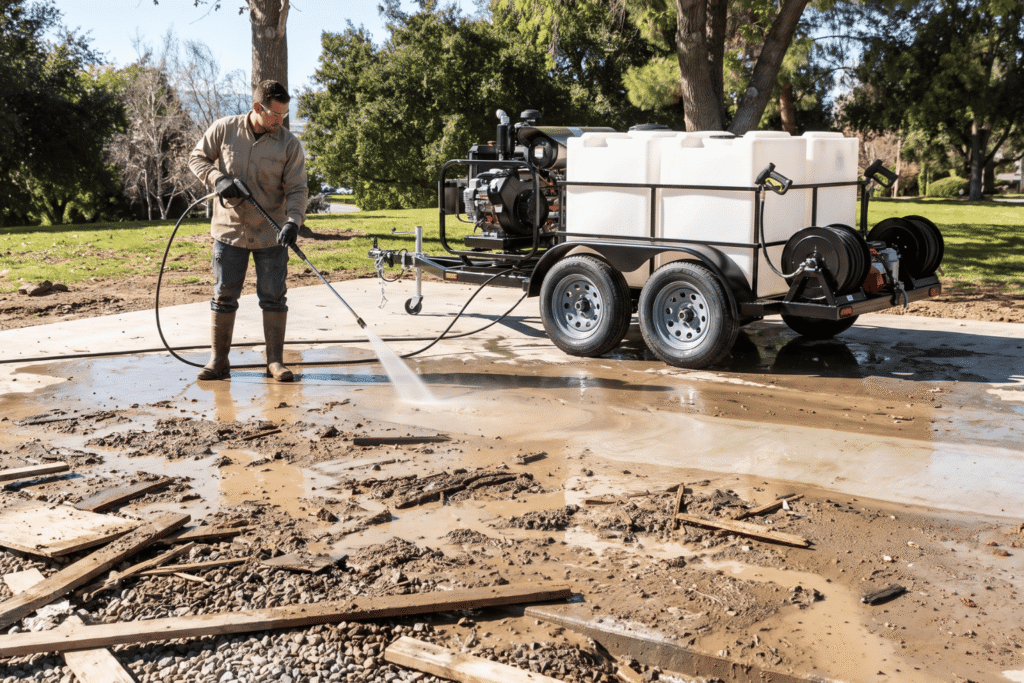
Trailer Construction
Look at the trailer frame, welding, axle rating, brakes, jack, hitch requirements, finish, weight distribution, and access to components. A construction pressure washer trailer should be designed as an integrated system rather than a loose collection of parts.
Universal Trailer configurations can include tubular-steel construction, welded frames, powder-coated finishes, aluminum diamond-plate steps, easy-swing jacks, and electric brakes on applicable models.
Hose and Reel Setup
Hose reels keep the work area more organized and reduce the time spent handling loose hose. Consider the required reach, hose pressure rating, reel position, and whether the crew needs separate high-pressure and inlet-water reels.
Longer hose is convenient, but pressure loss, hose management, and site layout should be evaluated.
Water Filtration
An inline water filter can help keep debris from entering the system. Operators should inspect and maintain filters as recommended, especially when filling tanks from variable water sources.
Storage
Toolboxes and designated holders keep wands, nozzles, fittings, personal protective equipment, and approved cleaning products organized. Good storage also reduces the chance that small components will be left behind when the trailer changes locations.
Drainage and Winterization
If the system will operate in freezing conditions, ask about the proper winterization process. Water left in pumps, hoses, coils, filters, or plumbing can freeze and cause damage.
A practical drain layout makes routine service and storage easier.
Single-Axle or Double-Axle Trailer?
The appropriate trailer depends on the complete loaded system, not simply on buyer preference.
A single-axle trailer may be suitable for a more compact pressure washer and water-tank configuration. It can offer a smaller footprint and may be easier to maneuver in certain yards or construction areas.
A dual-axle pressure washer trailer may be appropriate for larger tanks, heavier equipment, additional accessories, and configurations that require greater load capacity. Tandem axles may also influence towing stability and handling.
Before selecting a trailer, evaluate:
- Fully loaded trailer weight
- Water-tank capacity
- Pressure washer weight
- Fuel weight
- Accessories and stored tools
- Tow-vehicle rating
- Hitch rating
- Tongue weight
- Braking requirements
- State and local towing regulations
- Jobsite access and turning space
Never choose a trailer based only on its empty weight. Water and accessories can significantly change the operating load.
Cold-Water vs. Hot-Water Construction Pressure Washers
A cold-water pressure washer may be sufficient for dirt, dust, loose mud, and general rinsing. It is typically simpler than a hot-water system and may be suitable when greasy contaminants are uncommon.
A hot-water pressure washer adds heat to help break down oils and stubborn grime. It is often the more versatile option for heavy equipment, fleet vehicles, repair shops, paving machinery, and industrial cleaning.
Choose cold water when:
- Most cleaning involves loose dirt and mud
- Grease is minimal
- Lower equipment complexity is important
- The machine will be used mainly for rinsing
Choose hot water when:
- Equipment carries grease or hydraulic residue
- Faster oily-soil removal is important
- Fleet washing is a regular task
- Machinery requires frequent degreasing
- The system will support varied commercial jobs
Universal Trailer and American Water Works can help you compare the initial investment with the potential labor and cleaning-time benefits.
Detergents, Surface Cleaners, and Accessories
Pressure and heat perform much of the work, but the right accessories can make a commercial system more productive.
Available equipment and accessories may include:
- Surface cleaners
- Foamers
- Commercial detergents
- High-pressure hoses
- Water-supply hoses
- Hose reels
- Spray guns and wands
- Quick-connect nozzles
- Water filters
- Toolboxes
- Dual-operator options on selected systems
- Remote-control options on selected equipment
Use only cleaning products approved for the machine and the target surface. Contractors must also consider runoff, wastewater recovery, storm-drain protection, and local environmental regulations.
Never assume that a detergent is appropriate because it is labeled industrial strength. Verify compatibility with paint, metal, concrete, rubber, seals, landscaping, and wastewater-handling procedures.
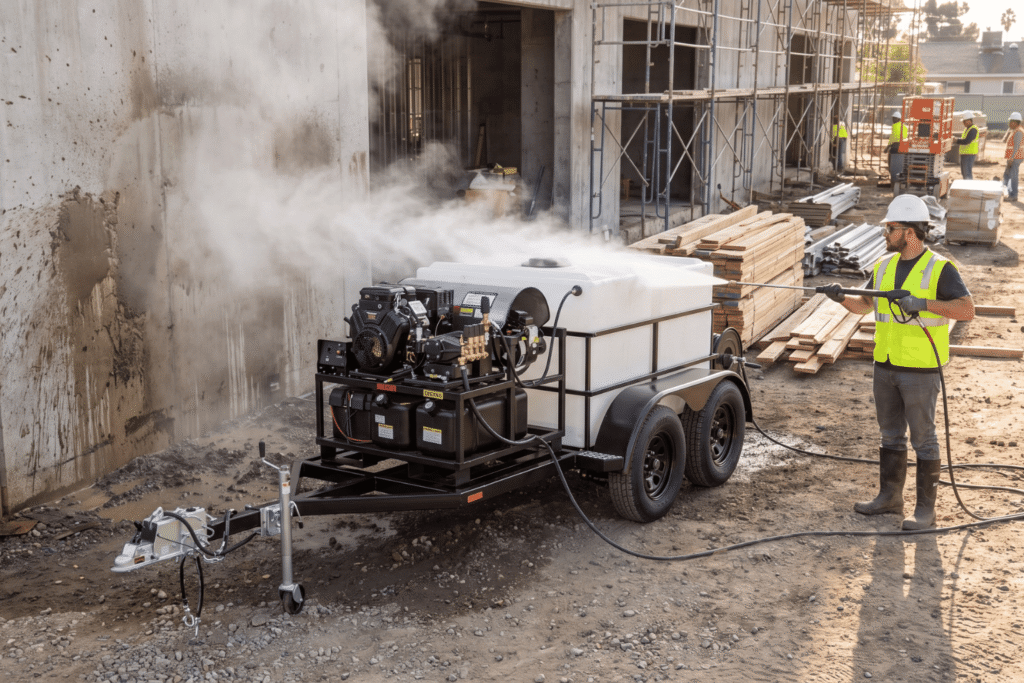
Pressure Washer Safety on Construction Sites
Commercial power washers produce a concentrated stream that can cause serious injury or property damage. Every operator should receive training before using the equipment.
Basic precautions include:
- Read the machine and trailer manuals.
- Wear appropriate eye, face, hearing, hand, foot, and body protection.
- Never point the spray gun at a person or animal.
- Never use high-pressure spray to clean clothing or skin.
- Maintain stable footing and account for spray reaction force.
- Keep workers away from the active cleaning area.
- Inspect hoses, fittings, guns, and safety devices before use.
- Do not operate damaged high-pressure hose.
- Depressurize the system before service.
- Avoid spraying electrical panels, power lines, outlets, and energized equipment.
- Allow hot components to cool before maintenance.
- Use only approved burner and engine fuels.
- Secure the trailer before operation.
- Follow towing, loading, and braking requirements.
- Prevent freezing damage through proper winterization.
- Control wastewater and comply with applicable regulations.
A strong safety process protects employees, equipment, customers, and the surrounding property.
Wastewater and Environmental Compliance
Pressure washing can move oil, fuel, sediment, paint particles, chemicals, and other contaminants. Allowing polluted wash water to enter a storm drain may violate local, state, or federal requirements.
Before cleaning, determine:
- What contaminants are present
- Where the wastewater will flow
- Whether drains must be covered or isolated
- Whether water must be collected
- Whether filtration or treatment is required
- Where recovered water may be discharged
- Whether permits or documentation are necessary
Requirements vary by location and application. Contractors should consult the applicable environmental authority and jobsite plan.
American Water Works is also a resource for water-reclaim systems, which may be useful when a project requires wastewater collection and management. Equipment selection should be based on the contaminants, required recovery rate, site layout, and governing rules.
How to Choose the Best Construction Site Pressure Washer
Start with your real cleaning conditions rather than a generic equipment list.
Ask the following questions:
- What equipment and surfaces will we clean?
- Are we removing mainly mud, or also grease and oil?
- How many machines or vehicles must be washed per day?
- Is hot water necessary?
- Is pressurized water reliably available?
- What tank capacity is practical?
- What can our tow vehicle safely pull?
- How much hose reach do we need?
- Will one or two operators clean simultaneously?
- Do we need wastewater recovery?
- Will the equipment operate in freezing weather?
- Are specific emissions requirements applicable?
- Where will tools, detergents, and safety equipment be stored?
- Does the trailer need to fit through restricted access points?
- Who will maintain the engine, pump, burner, and trailer?
These answers help determine the correct combination of pressure, water flow, heat, tank size, trailer capacity, and accessories.
Custom Pressure Washer Trailers from Universal Trailer
No two construction companies work exactly the same way. A residential concrete contractor has different needs from a highway construction company. An equipment rental yard operates differently from a mobile fleet-washing business.
Universal Trailer can customize pressure washer trailers around the intended work. Available configurations may include single or double axles, water tanks, hose reels, toolboxes, hot-water pressure washers, and additional options.
Our trailer systems are designed to bring cleaning power to locations such as:
- Construction sites
- Remote worksites
- Equipment yards
- Mines
- Municipal facilities
- Shipyards
- Farms and ranches
- Fleet maintenance locations
- Industrial properties
- Commercial service routes
Universal Trailer and American Water Works bring more than 40 years of experience in commercial pressure washing equipment and custom mobile systems. Buyers can work with a knowledgeable team rather than trying to combine an unrelated trailer, tank, washer, and plumbing layout on their own.
Why Buy from Universal Trailer and American Water Works?
When you invest in a construction site pressure washer, you are investing in equipment that may be used week after week in difficult environments. The system needs to fit your work, your crew, and your towing setup.
Customers choose Universal Trailer and American Water Works for:
- More than 40 years of industry experience
- Commercial-grade pressure washing equipment
- Custom mobile trailer configurations
- Hot-water and cold-water options
- Multiple performance levels
- Water tanks and hose-management solutions
- Equipment for remote cleaning
- Parts, accessories, and detergents
- Water-reclaim equipment
- Guidance from pressure-washing specialists
- Free nationwide shipping
Our objective is to help you purchase a practical cleaning system—not simply the largest machine available. A correctly matched system can improve productivity while avoiding unnecessary size, weight, fuel use, or complexity.
Order a Construction Site Pressure Washer with Free Nationwide Shipping
A mobile pressure washer can give your crew a repeatable way to clean machinery, fleet vehicles, tools, and working surfaces wherever the next project takes you.
Whether you need a compact commercial machine, a hot-water skid, or a complete pressure washer trailer with an onboard water tank and hose reels, Universal Trailer and American Water Works can help you evaluate the available options.
Browse our pressure washers and trailer systems.
For a configuration tailored to your construction company, request a quote from Universal Trailer.
We ship for free nationwide.
Frequently Asked Questions About Construction Site Pressure Washers
What is the best pressure washer for a construction site?
The best construction site pressure washer is one that matches the materials being removed, the size of the equipment, daily cleaning volume, available water supply, and desired portability. Construction companies cleaning grease and heavy machinery often benefit from a commercial hot-water system. Crews mainly removing dirt and loose mud may find that a cold-water machine is sufficient.
PSI should not be considered alone. GPM, water temperature, pump design, hose reach, tank capacity, trailer weight, and serviceability all affect real-world performance.
How much PSI is needed to clean construction equipment?
Many commercial equipment-washing applications use machines in the general range of 3,000 to 3,500 PSI, but there is no universal setting for every surface. Some available commercial machines provide higher model-dependent pressure ratings.
More pressure is not always better. Excessive pressure or an aggressive nozzle can damage paint, decals, seals, wiring, hoses, radiators, bearings, and sensitive components. Follow the equipment manufacturer’s cleaning guidance and test cautiously.
Is GPM or PSI more important for heavy-equipment washing?
Both matter. PSI helps loosen material, while GPM carries loosened dirt away and rinses large areas. For big machines covered in mud, strong water flow can have a major effect on cleaning speed.
The most useful comparison is the complete combination of PSI, GPM, heat, nozzle selection, and cleaning technique.
Is hot water better for cleaning construction equipment?
Hot water is generally more effective for grease, oil, hydraulic residue, and stubborn road film. Heat can help break down oily material and shorten cleaning time.
Cold water may be adequate for dust, loose dirt, and fresh mud. The best choice depends on the contaminants your crew encounters.
Can a pressure washer remove concrete from equipment?
A pressure washer may help remove fresh, uncured concrete residue from suitable surfaces when cleanup begins promptly. Fully hardened concrete is much more difficult and may require specialized removal methods.
High-pressure water can damage paint, seals, wiring, and other components. Operators should follow manufacturer instructions and never direct an aggressive stream at sensitive areas.
What size water tank do I need?
Tank size depends on the pressure washer’s GPM, desired operating time, refill access, trailer capacity, and tow-vehicle rating.
Divide usable gallons by GPM to estimate theoretical continuous trigger time. For example, 230 gallons divided by 5 GPM equals approximately 46 minutes. Actual operating time varies.
Remember that 230 gallons of water alone weighs approximately 1,918 pounds. The complete loaded weight must remain within the ratings of the trailer, axles, tires, hitch, and tow vehicle.
Can I use a pressure washer trailer without a water connection?
Yes, when the trailer has a properly configured onboard water tank containing enough water for the planned work. The tank must be filled from an approved source, and the system’s plumbing must provide the washer with the required water supply.
Never run a pressure washer without adequate water flow because pump damage may result.
What is included with a pressure washer trailer?
The exact package depends on the selected model and customization. A system may include the trailer, commercial pressure washer, water tank, high-pressure hose, inlet hose, hose reels, filter, gun, wand, nozzle set, jack, brakes on applicable models, holders, and storage options.
Confirm the written specifications of your selected package before ordering.
Are single-axle or tandem-axle pressure washer trailers better?
Neither design is automatically better. Single-axle systems can be compact and maneuverable. Tandem-axle trailers can support certain larger or heavier configurations.
The correct choice depends on fully loaded weight, tank capacity, equipment weight, towing requirements, road use, and available jobsite space.
Can a construction pressure washer clean trucks and fleet vehicles?
Yes. Commercial pressure washers are commonly used for dump trucks, pickups, service vehicles, trailers, and other fleet assets.
Operators must use suitable pressure, nozzles, distance, and detergents to avoid damaging paint, decals, lights, sensors, seals, and electrical components.
Can two people use the pressure washer at the same time?
Some commercial systems offer dual-gun or dual-operator configurations. The machine must provide sufficient flow and be designed for simultaneous operation.
Ask Universal Trailer and American Water Works about current dual-operator options if two-person cleaning is important to your workflow.
How often should construction equipment be pressure washed?
The appropriate schedule depends on operating conditions, manufacturer guidance, maintenance needs, environmental exposure, and company policy.
Some equipment may require cleaning after especially muddy or contaminated work. Other machinery may follow a weekly, monthly, or maintenance-based schedule. Avoid unnecessary spraying of sensitive areas.
Do pressure washer trailers require maintenance?
Yes. Maintenance may include checking engine oil, pump oil, filters, belts, hoses, fittings, nozzles, batteries, burner components, fuel systems, tires, wheel bearings, brakes, lights, trailer connections, and safety devices.
Follow the maintenance instructions for the exact pressure washer, engine, pump, burner, and trailer. Service intervals can vary by model and operating conditions.
How should a pressure washer trailer be stored during winter?
Water should be removed or treated according to the manufacturer’s winterization procedure. Pumps, coils, hoses, filters, float tanks, and plumbing can be damaged if trapped water freezes.
Store approved fuels safely, protect the battery, inspect antifreeze procedures, and follow all machine-specific instructions. Do not improvise winterization for a hot-water coil.
Can pressure-washing wastewater go into a storm drain?
Contaminated wash water generally should not be allowed to enter storm drains. It may contain sediment, oil, grease, fuel, chemicals, paint particles, or other pollutants.
Requirements vary by location. Review the jobsite plan, isolate drains when required, use appropriate collection or reclaim equipment, and consult the relevant environmental authority.
Does Universal Trailer offer custom configurations?
Yes. Universal Trailer builds custom commercial pressure washer trailers with options that may include different trailer sizes, single or double axles, water tanks, hose reels, toolboxes, hot-water machines, and other equipment.
The final design should be selected according to intended use, loaded weight, towing capacity, site access, and cleaning requirements.
Where can I shop for a construction site pressure washer?
You can view available pressure washers and mobile trailer systems from Universal Trailer and American Water Works. Specifications and availability can change, so confirm current model details when requesting a quote or placing an order.
Do you ship pressure washers nationwide?
Yes. Universal Trailer and American Water Works provide free nationwide shipping. Contact the company with your destination and desired configuration to confirm the details for your order.
How do I request a quote?
Visit PressureWasherTrailers.com and submit a quote request. Include the equipment you clean, typical contaminants, desired PSI and GPM if known, hot- or cold-water preference, required tank capacity, towing vehicle, location, and any accessories you need. This information will help the team recommend an appropriate construction site pressure washer configuration.
Disclaimer: Equipment specifications and performance capabilities may vary based on specific configurations and operating conditions. Professional consultation is recommended for custom applications and specialized requirements. Regulatory compliance requirements vary by location and application – consult local authorities for specific permit and operational requirements.